The data profile of a healthcare worker's spine
If you work a 12-hour nursing shift — or rotate between days and nights as a certified nursing assistant, home health aide, or orderly — the federal injury data describes your workday with uncomfortable precision. According to BLS Musculoskeletal Disorders by Occupation tracking, the back is the single most commonly injured body part across all U.S. occupations that result in days away from work. That statistic is not driven by construction workers or warehouse laborers alone. Healthcare support occupations — the aides, orderlies, and patient transport workers who move human bodies for a living — consistently appear near the top of industry-specific MSD injury rate tables. The loads involved are not boxes of freight; they are 150-to-300-pound patients who cannot always cooperate with transfers, repositioning, or lateral moves.
The downstream cost of that injury pattern is measurable in federal data. AHRQ HCUP data identifies back pain as one of the most expensive conditions in U.S. healthcare by combined inpatient and outpatient cost. AHRQ MEPS data shows that adults with chronic back conditions carry substantially higher annual personal healthcare expenditure than adults without such conditions — a gap that compounds over a nursing career. And SSA Disability Insurance reports consistently identify musculoskeletal disorders as the single largest category of new disability claims filed each year in the United States. For a healthcare worker in her 40s who has been lifting patients for 15 years, that last statistic is not abstract.
Why shift rotation amplifies the damage
The biomechanics of the problem are fairly well understood. Patient handling — repositioning a patient in bed, transferring from bed to chair, assisting with ambulation — generates repeated spinal loading events across a 12-hour shift. NIOSH's Lifting Equation documents that manual material-handling tasks in healthcare routinely exceed recommended safe spinal compression limits, even when workers are using correct technique. The spine, specifically the lumbar intervertebral discs, does not respond well to repeated compressive load followed by inadequate recovery time.
That recovery time is where healthcare shift workers face a second, underappreciated problem. The human body repairs connective tissue, reduces intervertebral disc pressure, and restores the paraspinal musculature primarily during sleep — specifically during slow-wave and REM sleep stages. Shift rotation disrupts circadian rhythm, which degrades both sleep architecture and sleep duration. CDC sleep data shows that approximately 35% of U.S. adults already report sleeping fewer than 7 hours per night — the threshold the CDC associates with elevated chronic disease risk. Among rotating-shift healthcare workers, that percentage is substantially higher due to misalignment between work schedules and endogenous circadian timing.
The compounding mechanism looks like this: high-load shifts produce spinal microtrauma → circadian disruption limits sleep quality → inadequate sleep limits tissue repair → the worker begins the next shift with accumulated damage rather than a recovered spine → the injury risk and chronic pain risk both escalate. CDC NCHS Data Brief 390 documents that approximately 20% of U.S. adults experience chronic pain, with lower back as the most common pain location. For healthcare workers, that baseline statistic describes an occupational hazard, not a random population outcome.
Arthritis layers on top of this for mid-career and senior healthcare workers. CDC arthritis data shows roughly 25% of U.S. adults carry a doctor-diagnosed arthritis diagnosis, with prevalence concentrated in exactly the sustained-physical-demand occupations that nursing and patient care represent. Facet joint arthritis and sacroiliac joint degeneration are among the most common structural findings in healthcare workers with chronic low back pain, and both conditions are sensitive to sleep-surface firmness and spinal alignment during rest.
The medication cost of all this is visible in federal drug spending data. CMS Drug Spending Dashboard data identifies opioid and non-opioid pain medications among the most expensive Medicare drug categories — a reflection of how chronic musculoskeletal pain ultimately gets managed when upstream interventions fail. Workers' compensation data adds another dimension: BLS Employer Costs for Employee Compensation data shows that industries with high MSD incidence carry workers' compensation insurance rates 3–5 times higher than low-MSD industries. The financial cost of inadequate spinal recovery is not borne by the worker alone.
Try these first — the cheapest intervention is the one that does not require buying anything
Before any discussion of sleep surfaces, it is worth being direct: most of what determines whether your back recovers during off-duty hours does not cost money. Behavioral and biomechanical interventions backed by federal evidence are the correct starting point, and several of them are more powerful than any mattress on the market.
Sleep position is the largest free variable most people have not optimized. NIH's National Institute of Arthritis and Musculoskeletal and Skin Diseases recommends side-sleeping with a pillow between the knees, or back-sleeping with a pillow under the knees, as the positions that best maintain lumbar spine neutrality during sleep. Stomach-sleeping torques the lumbar spine into extension and cervical rotation simultaneously — it is the worst sleeping position for anyone with chronic low-back or facet joint pain, and it can be corrected for free tonight. Daily walking is the intervention most people discount and the one with the strongest evidence base. NIH NCCIH's comprehensive review of low-back pain interventions found that 30 minutes of walking on most days reduces chronic low-back pain as effectively as most non-drug clinical treatments. That finding often surprises people who assume passive recovery is the goal after a hard shift — but the lumbar spine depends on movement for disc nutrition and inflammatory clearance. Finally, lifting mechanics at work are rehearsable. OSHA's ergonomics guidance is explicit: hinge at the hips not the lumbar spine, keep loads close to the body center, avoid twisting under load. Most acute back episodes in healthcare are mechanical events that correct technique can reduce in frequency and severity.
For readers who have already optimized sleep position, are walking daily, and are using proper lift mechanics — and who are still waking up stiff and unrested — the mattress question becomes legitimate. There is also a specific, evidence-based trigger for mattress replacement: visible sag in the sleep surface, consistently waking stiffer than you went to bed, or a mattress that is older than 7 to 10 years. CDC sleep hygiene guidance treats the sleep environment as one component of sleep quality, not the whole picture. If the free interventions are in place and the mattress meets replacement criteria, then equipment selection matters.
When to see a clinician before you buy anything
There is a category of back pain that no sleep surface addresses, and spending money on a mattress while ignoring these signals is a real clinical risk. NIH's National Institute of Neurological Disorders and Stroke provides clear red-flag criteria: back pain that radiates below the knee (radiculopathy suggesting nerve root compression or disc herniation), pain that follows a fall or trauma, back pain accompanied by leg weakness, any bowel or bladder dysfunction, and back pain with unexplained fever or weight loss are all indications to seek evaluation before — not after — trying a new sleep surface. These presentations require imaging and clinical assessment, and they are more common in a healthcare worker population that has been absorbing spinal load for years.
Healthcare workers, in particular, are at elevated risk for a phenomenon occupational medicine calls "presenter bias" — continuing to work and self-manage symptoms that warrant evaluation, partly because they understand enough anatomy to rationalize the pain and partly because healthcare schedules make it hard to be a patient. The federal disability data is worth revisiting here: SSA Disability Insurance reports show that MSDs are the largest single category of new disability claims each year, and the trajectory from manageable chronic pain to career-ending disability is almost always a story of undertreated escalation rather than sudden onset. Early evaluation is protective.
Where sleep-surface selection actually helps
For healthcare workers who have cleared the clinical red-flag checklist and confirmed that their pain is mechanical and chronic rather than acute or neurological, sleep-surface selection is a legitimate recovery tool. The evidence base for specific mattress constructions is thinner than most manufacturers will tell you — there is no randomized controlled trial comparing 47 mattress brands. What the evidence does support is the principle of spinal neutrality during sleep: a surface that is firm enough to prevent the hips and shoulders from sinking into pronounced lateral curves (creating a hammock shape), but cushioned enough to reduce pressure at bony prominences (hips, shoulders, sacrum) that would otherwise cause reflexive micro-arousals during the night.
For healthcare workers specifically, three construction factors are most relevant to the occupational injury pattern:
1. Pressure relief at the hip and shoulder matters most for side-sleepers — the NIH-recommended sleep position for back pain. After a shift that has compressed lumbar discs repeatedly, a sleep surface that creates additional pressure points at the trochanter or acromion will produce micro-arousals that fragment sleep architecture. Fragmented sleep limits slow-wave recovery and the tissue repair that happens during it.
2. Lumbar support and edge support matter for back-sleepers and for getting in and out of bed without re-loading the lumbar spine under torque. A mattress that compresses uniformly will allow the lumbar curve to flatten against the surface — acceptable for some people, problematic for those with lumbar stenosis, disc pathology, or facet arthritis.
3. Heat dissipation is an underrated factor for rotating-shift workers. Sleeping during daylight hours in a warm room on a heat-retaining foam surface compounds the circadian difficulty of daytime sleep. Temperature-regulating constructions — gel-infused memory foam, open-cell foam, or hybrid designs with coil layers that allow airflow — reduce that barrier.
With those three criteria established, here are the constructions that address the healthcare worker's specific off-duty recovery needs.
The Saatva Loom & Leaf Memory Foam Mattress is Saatva's premium memory foam offering and the first pick for healthcare workers dealing with serious chronic back pain. Loom & Leaf uses a multi-layer foam system — a gel-infused quilted Euro top over a convoluted "spinal zone" foam layer that provides enhanced lumbar support in the center third of the mattress — positioned precisely where the lumbar spine rests during back sleeping. Memory foam's conforming properties are particularly well-suited to the pressure-relief need at the hip and shoulder for side-sleepers, and the gel infusion in the top layer addresses the heat-retention problem common to all-foam constructions. It comes in Relaxed Firm and Firm, and for healthcare workers with documented lower-back pain, the Relaxed Firm tends to deliver both the hip cushioning that side-sleeping requires and the lumbar support that prevents the hammock effect. At $1,695–$3,295 depending on size, it is not inexpensive — but relative to the AHRQ MEPS-documented cost premium that chronic back conditions impose on personal healthcare spending, the calculus shifts.
For larger-frame healthcare workers — or those who are on their feet 12 hours a day and carry more mass through the lumbar spine with every patient transfer — the Saatva HD Mattress addresses a specific engineering gap. Standard mattresses are designed for a body-weight range that caps somewhere around 250 pounds; beyond that, traditional foam and coil constructions compress in ways that eliminate lumbar support and create the hammock problem described above. The Saatva HD uses a reinforced coil system and a higher-density foam comfort layer calibrated for sleepers up to 500 pounds. For a nursing aide who is 6'2" and 280 pounds and absorbing spinal loading all shift, sleeping on a standard mattress that bottoms out provides zero recovery benefit — the spine is in distorted alignment for 7–8 hours. The Saatva HD closes that gap. Priced at $2,395–$3,995, it sits at the higher end of the category, but it is the only construction in this list purpose-built for that load profile.
The Purple Hybrid Premier Mattress takes a mechanically different approach to the pressure-relief problem. Purple's GelFlex Grid is a polymer grid structure — not foam — that collapses under bony prominences (hip, shoulder, sacrum) while remaining supportive under broader surface areas. For healthcare workers who are confirmed side-sleepers and whose primary complaint is pressure-point pain at the hip and shoulder rather than diffuse lumbar aching, the Grid construction can outperform memory foam on pressure relief. The hybrid version adds a pocketed-coil base for edge support and airflow. At $2,499–$4,799 depending on size, it is the most expensive option on this list, and its primary advantage — grid-based pressure relief — is most pronounced for lighter-to-average-weight sleepers who side-sleep. For heavier-framed workers or those with pronounced lumbar pain as the primary complaint, the Saatva picks are likely better fits.
Sleep Surfaces Built for Healthcare-Worker Spinal Recovery
These three mattresses were selected for healthcare workers dealing with shift-work-driven back pain: they address pressure relief for side-sleepers, lumbar support for back-sleepers, and — in one case — structural reinforcement for larger-framed workers who exceed standard mattress load ratings.

Saatva Loom & Leaf Memory Foam Mattress
$1,695-$3,295
See Price at Saatva →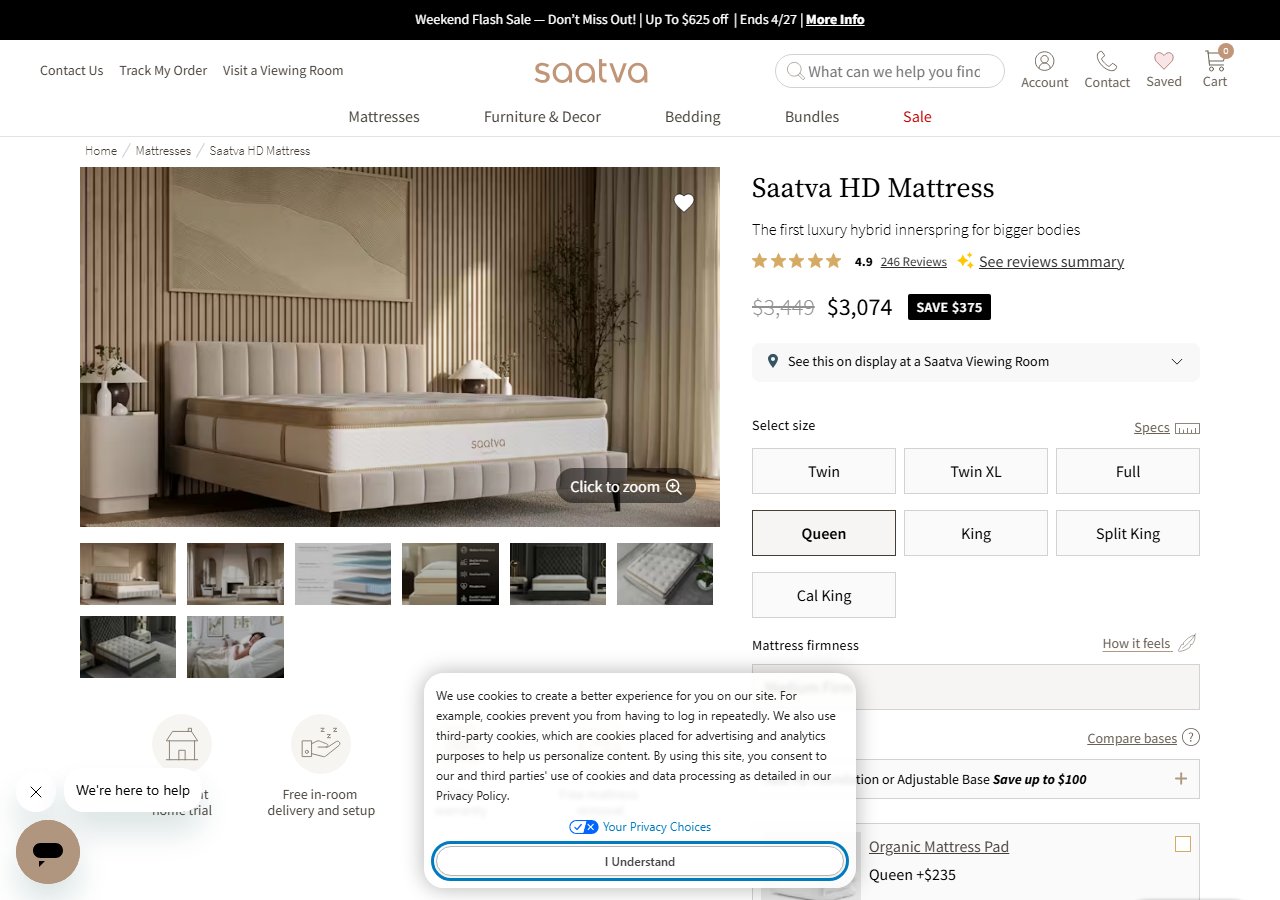
Saatva HD Mattress (Heavy-Duty)
$2,395-$3,995
See Price at Saatva →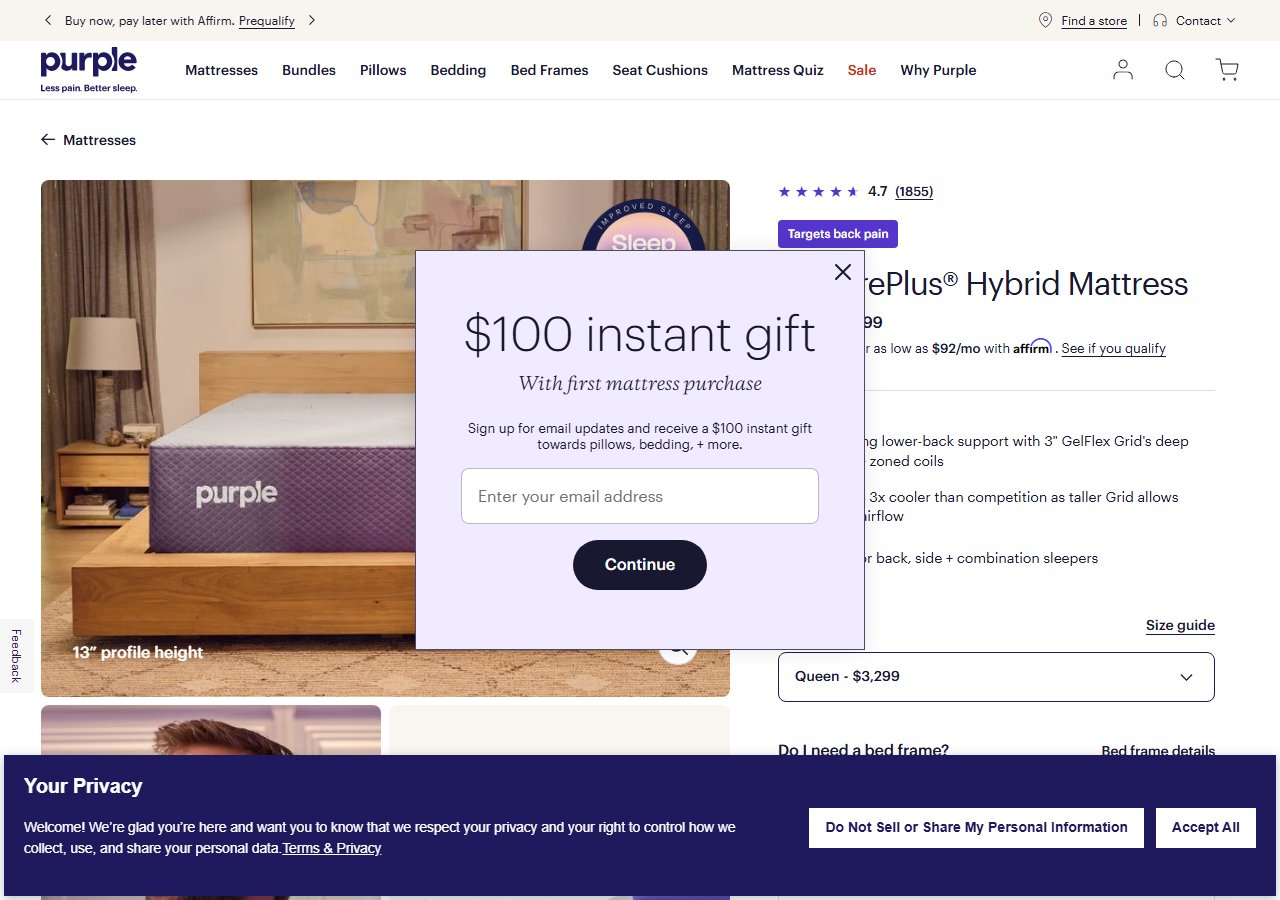
Purple Hybrid Premier Mattress
$2,499-$4,799
See Price at Purple →The hierarchy that actually matters
The federal data on healthcare worker musculoskeletal injury, chronic back pain prevalence, and shift-work sleep disruption all point in the same direction: the problem is real, it is occupationally driven, and it compounds over a career in ways that the SSA disability statistics make concrete. The solution hierarchy that the evidence supports is also clear.
Free behavioral interventions come first — sleep position, daily walking, and correct lift mechanics are each backed by NIH and NIOSH evidence and cost nothing. Clinical evaluation comes next if any red flags are present; proceeding to mattress shopping while ignoring radiculopathy or neurological symptoms is a real clinical mistake that the federal red-flag criteria exist to prevent. Sleep-surface selection comes third, with a specific trigger set: visible sag, waking stiffer than you went to bed, or a mattress older than 7–10 years.
When those triggers are met, the construction criteria most relevant to healthcare workers are pressure relief at bony prominences for side-sleeping, lumbar support for back-sleeping, and heat dissipation for daytime sleepers on rotating shifts. The Saatva Loom & Leaf addresses the first two; the Saatva HD addresses those plus the load-capacity gap for larger-framed workers; and the Purple Hybrid Premier addresses pressure relief through a mechanically distinct grid construction for confirmed side-sleepers.
None of these products undoes the occupational exposure. A nursing aide who works three 12-hour shifts per week, follows every item on this list, and still develops lumbar disc disease at 52 is not a product failure — she is a worker whose occupational risk, documented in federal data for decades, has been incompletely mitigated at the system level. What these interventions and products can do is reduce the recovery deficit between shifts, lower the rate of injury escalation, and improve the sleep quality that the CDC data shows the majority of working adults are already not getting enough of. That is not nothing. It is, in fact, the difference between a career that ends on your terms and one that ends with an SSA disability claim.