The shift ends. The back pain doesn't.
According to the BLS Musculoskeletal Disorders by Occupation data, the back is the single most injured body part across all U.S. occupations that result in days away from work. That statistic is not a surprise to any nurse, surgical tech, patient-care aide, or respiratory therapist who has ever driven home at 7 a.m. after a twelve-hour overnight shift with a lower back that feels like it's been wrung out like a wet cloth. The data simply confirms what hospital corridors demonstrate every day: healthcare is one of the most physically punishing industries in the American economy, and the injury burden does not clock out when the worker does.
The scale of the problem extends well beyond sore muscles. CDC NCHS Data Brief 390 documents that approximately 20% of U.S. adults experience chronic pain, with the lower back as the most common pain location. Healthcare workers — who routinely lift, reposition, and transfer patients across long shifts — are overrepresented in that figure by a wide margin. The SSA Disability Insurance Reports make the downstream consequence concrete: musculoskeletal disorders are the single largest category of new disability claims filed annually in the United States. For a profession that spends years training to care for others, losing that career to a preventable back injury is both a personal catastrophe and a public health failure.
This article is not primarily a mattress guide. It is a federal-data-driven analysis of why healthcare shift workers accumulate spinal injury faster than almost any other occupational group, what the evidence says about recovery interventions — most of which cost nothing — and where sleep-surface selection fits as one adjunct tool in a broader off-duty recovery strategy. Products appear in this piece after mechanism, after free interventions, and after clinical red flags. That sequencing is intentional.
Why healthcare work systematically injures the spine
The biomechanical case against the modern hospital shift is not subtle. It has been documented at the federal level for decades. The NIOSH Lifting Equation establishes safe spinal compression limits for manual material-handling tasks and explicitly documents that patient handling in healthcare routinely exceeds those limits — sometimes by substantial margins. Repositioning a 200-pound patient in a hospital bed, transferring a sedated post-operative patient from a gurney to an OR table, or catching a patient who begins to fall during ambulation are not tasks that can be made ergonomically safe through technique alone. The loads are too variable, the environments too constrained, and the time pressure too acute.
Layered on top of high-load events is cumulative mechanical exposure. A twelve-hour shift in a busy med-surg unit might involve hundreds of individual forward flexion events — leaning over a bed rail to adjust a line, bending to check a wound, stooping to retrieve equipment from a low shelf. Each individual event is low-magnitude. Their cumulative effect on intervertebral discs, facet joints, and paraspinal musculature is not. Sports medicine and occupational health research consistently shows that cumulative low-load spinal stress produces tissue fatigue and injury risk profiles that rival acute high-load events. Healthcare workers get both.
Then there is the schedule. Hospital nursing operates predominantly on twelve-hour rotations, which means that for many shift workers, "sleep" is not a stable, circadian-aligned seven-to-eight-hour block. It is a variable, disrupted window that shifts by six to twelve hours depending on whether a worker is on days, nights, or rotating. CDC Sleep and Sleep Disorders data establishes that approximately 35% of U.S. adults already fail to meet the seven-hour minimum associated with reduced chronic disease risk. Among rotating shift workers in healthcare, that figure is substantially worse. The problem is compounded because sleep is the primary period during which spinal discs rehydrate — the lumbar intervertebral discs are avascular and rely on the passive fluid exchange that occurs during unloaded recumbency to restore the hydrostatic pressure that protects them under axial load. Chronically short or disrupted sleep is not just a fatigue problem. For a healthcare worker with an already-stressed lumbar spine, it is a tissue-recovery deficit that compounds with every shift.
The financial stakes confirm that this is a systemic crisis rather than individual bad luck. AHRQ HCUP data identifies back pain as one of the most expensive conditions in U.S. healthcare by combined inpatient and outpatient cost. AHRQ MEPS data shows that adults with chronic back conditions spend substantially more on personal healthcare annually than adults without such conditions. BLS Employer Costs for Employee Compensation data documents that industries with high MSD incidence — a category that includes hospital and long-term care settings — carry workers' compensation insurance rates three to five times higher than low-MSD industries. CMS Drug Spending Dashboard data shows that opioid and non-opioid pain medications rank among the most expensive Medicare drug categories, a reflection of how many working-age Americans with occupational back injuries eventually age into chronic-pain pharmaceutical management. The individual back injury that starts on a hospital floor at 2 a.m. is not just a personal medical event. It is a cost that reverberates through insurers, employers, taxpayers, and the worker's own household budget for years.
CDC Arthritis data adds another layer: approximately 25% of U.S. adults have doctor-diagnosed arthritis, and prevalence is concentrated in occupations with sustained physical demand — exactly the occupational profile of bedside healthcare work. For nurses and aides already managing facet joint arthritis or degenerative disc disease, the recovery window between shifts is not just about feeling rested. It is about managing an active inflammatory process that worsens under poor sleep conditions and inadequate spinal support.
Try these first: what the evidence says before you spend anything
The cheapest intervention is the one that does not require buying anything. Federal health agencies have published clear, evidence-based guidance on managing chronic back pain and improving sleep quality — guidance that most workers with occupational MSDs have never had presented to them in plain language. Before any sleep-surface recommendation appears in this article, here are the interventions that the evidence supports most strongly.
Sleep position is the biggest free variable available to you. NIH National Institute of Arthritis and Musculoskeletal and Skin Diseases guidance on back pain is direct: side-sleeping with a pillow between the knees, or back-sleeping with a pillow under the knees, maintains neutral lumbar alignment and reduces disc pressure during sleep. Stomach-sleeping does the opposite — it creates sustained lumbar extension and cervical rotation that actively worsens chronic lower back pain. Changing your sleep position costs nothing and can produce measurable symptom improvement within days for many workers with mechanical low back pain.
Daily walking is more effective than most passive treatments. The NIH National Center for Complementary and Integrative Health's evidence review of low back pain interventions is one of the most important documents for any healthcare worker managing chronic back pain, because it synthesizes the clinical trial literature and reaches a conclusion that surprises most patients: walking thirty minutes most days reduces chronic low back pain as effectively as most non-drug clinical treatments. Not cycling. Not yoga (though that helps too). Walking. A healthcare worker who comes off a night shift and lies completely still in a darkened room until the next shift is missing the single most evidence-supported intervention available to them.
Lifting mechanics matter off the clock, not just on it. OSHA's Ergonomics Solutions guidance on safe lifting — hinge at the hips rather than the lumbar spine, keep loads close to the body center, eliminate twisting under load — applies to grocery bags, laundry baskets, and children as much as it applies to patient transfers. Most acute back episodes are mechanical and rehearsable. A healthcare worker who lifts correctly at the hospital and then bends at the waist to pull a laundry basket out of a low dryer is erasing the on-shift discipline.
Know when your mattress is actually the problem. CDC Sleep Hygiene guidance is useful here: the diagnostic criteria for a mattress that is causing rather than relieving symptoms are visible sag, waking stiffer and more painful than you went to bed, and age beyond seven to ten years. If your mattress meets those criteria, replacing it is a reasonable intervention. If it does not, a new mattress is unlikely to solve what is fundamentally a movement, positioning, or clinical problem.
For many healthcare workers reading this, those interventions will be familiar — and will have already been tried. Some workers have optimized their sleep position, walk daily, and still wake up with the kind of lower-back stiffness that affects their ability to function through a subsequent shift. That is the population for whom sleep-surface selection becomes a legitimate clinical and practical question. The interventions above should still be maintained. Products are adjuncts, not replacements. But if you are past the free-intervention stage, here is what the biomechanics of spinal recovery during sleep actually demands from a mattress.
When to see a clinician instead of shopping for a mattress
This section exists because some back pain presentations are not sleep-surface problems. They are clinical emergencies or near-emergencies that require imaging and referral, and buying a new mattress for them is not just futile — it delays necessary care.
NIH National Institute of Neurological Disorders and Stroke guidance on back pain identifies several presentations that require prompt clinician evaluation rather than self-management. Pain that radiates below the knee (particularly with associated numbness, tingling, or weakness in the foot or lower leg) suggests nerve root compression that may require imaging and possibly intervention. Back pain following any traumatic event — a fall, a motor vehicle accident, a violent patient encounter — warrants radiographic evaluation before any conclusion about soft-tissue mechanism. Back pain accompanied by bowel or bladder dysfunction is a potential cauda equina syndrome emergency and requires emergency department evaluation, not a mattress upgrade. Fever with back pain raises the possibility of spinal infection. Unexplained weight loss with back pain in a worker over 50 warrants oncologic screening. None of these presentations are common. But healthcare workers, who may be accustomed to managing their own symptoms and working through pain, are at particular risk of normalizing symptoms that deserve urgent attention.
What spinal recovery during sleep actually requires from a surface
With mechanism established and non-product interventions documented, the question of sleep-surface selection becomes tractable. The biomechanics are not complicated, but they are specific. A healthcare worker with chronic lower back pain needs a mattress that does three things simultaneously: maintains neutral lumbar alignment (neither sinking the pelvis into a hammock curve nor holding it so rigidly that the natural lumbar curve is unsupported), provides differential pressure relief at the shoulders and hips (the heaviest contact points, where a surface that is too firm creates sustained tissue ischemia), and does not produce the "stuck" sensation during position changes that disrupts sleep continuity — because a rotating shift worker's sleep is already fragile and does not need additional disruption from a surface that traps them.
Memory foam at sufficient density satisfies the pressure-relief and alignment requirements better than most other materials, but traditional memory foam retains heat and moves slowly, which creates the position-change problem. Hybrid constructions that pair foam comfort layers with coil support cores address the motion isolation and temperature regulation issues while preserving the pressure relief. Grid polymer materials — the architecture Purple uses — address pressure distribution through a fundamentally different mechanism: the grid columns collapse under high-pressure contact points and remain open under low-pressure areas, distributing weight without the material deformation that memory foam uses.
For healthcare workers with serious chronic back pain who are in the memory foam category, the Saatva Loom & Leaf Memory Foam Mattress is the strongest clinical match in this analysis. It uses a multi-layer memory foam construction with an organic cotton cover and built-in lumbar zone enhancement — a firmer foam insert positioned specifically in the lumbar region to prevent pelvic sink while the shoulder and hip zones remain more compliant. That graduated support architecture is exactly what chronic lower-back pain biomechanics demand: more support where the spine needs to be held in neutral, more give where the body's heaviest contact points need to decompress. At $1,695–$3,295 depending on size and firmness, it is a premium investment, but for a nurse or respiratory therapist who works twelve-hour shifts three or four days a week, the cost-per-recovery-night calculation is more favorable than it looks at the sticker price.
For larger-framed healthcare workers — emergency department staff, surgical techs, or patient-care aides who may be 230 pounds or more — standard mattress constructions often fail under the load they need to support. The springs compress too quickly, the foam layers bottom out, and the net effect is a surface that sags progressively worse than it did at purchase. The Saatva HD Mattress was engineered specifically for this load profile: it uses a dual-coil system with a reinforced lumbar support system and foam layers rated for heavier bodies, producing a support profile that remains effective at body weights that defeat standard constructions. For a 250-pound night-shift nurse who has been sleeping on a mattress that visibly sags, the HD represents a structurally appropriate solution rather than a luxury upgrade.
For healthcare workers whose primary complaint is pressure-point pain — the hip and shoulder soreness that comes from sleeping on a surface that is either too firm for their body weight or has lost its conformability with age — the Purple Hybrid Premier Mattress offers the most differentiated pressure-relief architecture in this analysis. Purple's GelFlex Grid is a polymer grid that manages pressure through structural collapse rather than material deformation: the grid columns under high-pressure points (hips, shoulders) buckle and distribute load, while columns under the lumbar region remain open and supportive. The result is a surface that simultaneously provides pressure relief and spinal support in a way that neither pure memory foam nor traditional innerspring can replicate. At $2,499–$4,799, it is the highest-priced option in this group, but for a healthcare worker who has tried firmer and softer conventional mattresses without relief, the different mechanism is worth the evaluation.
Mattresses Built for Healthcare Worker Spinal Recovery
These three mattresses were selected specifically for the biomechanical demands of shift workers with chronic lower-back MSDs — each addresses a different presentation of occupational back pain documented in the federal data above.

Saatva Loom & Leaf Memory Foam Mattress
$1,695-$3,295
See Price at Saatva →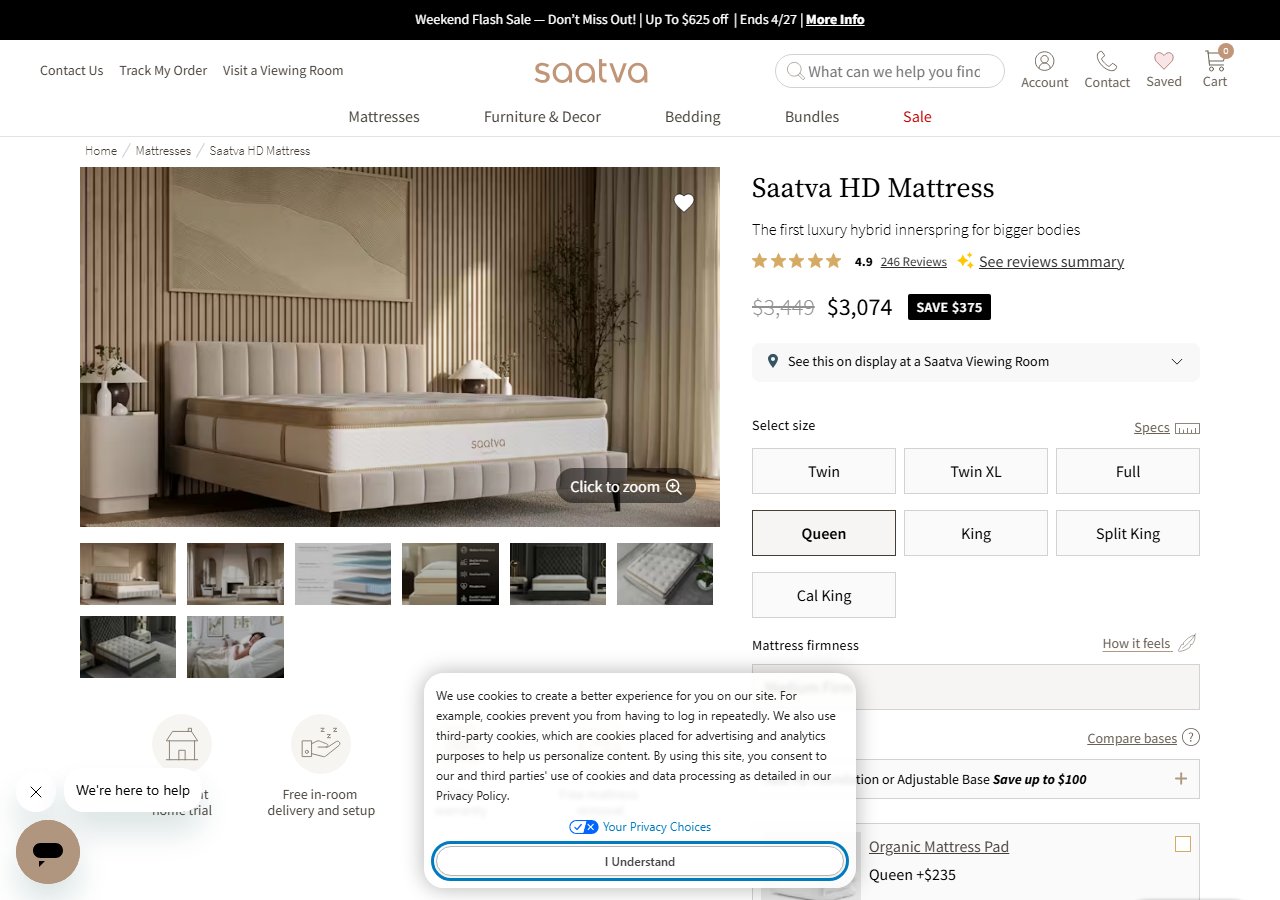
Saatva HD Mattress (Heavy-Duty)
$2,395-$3,995
See Price at Saatva →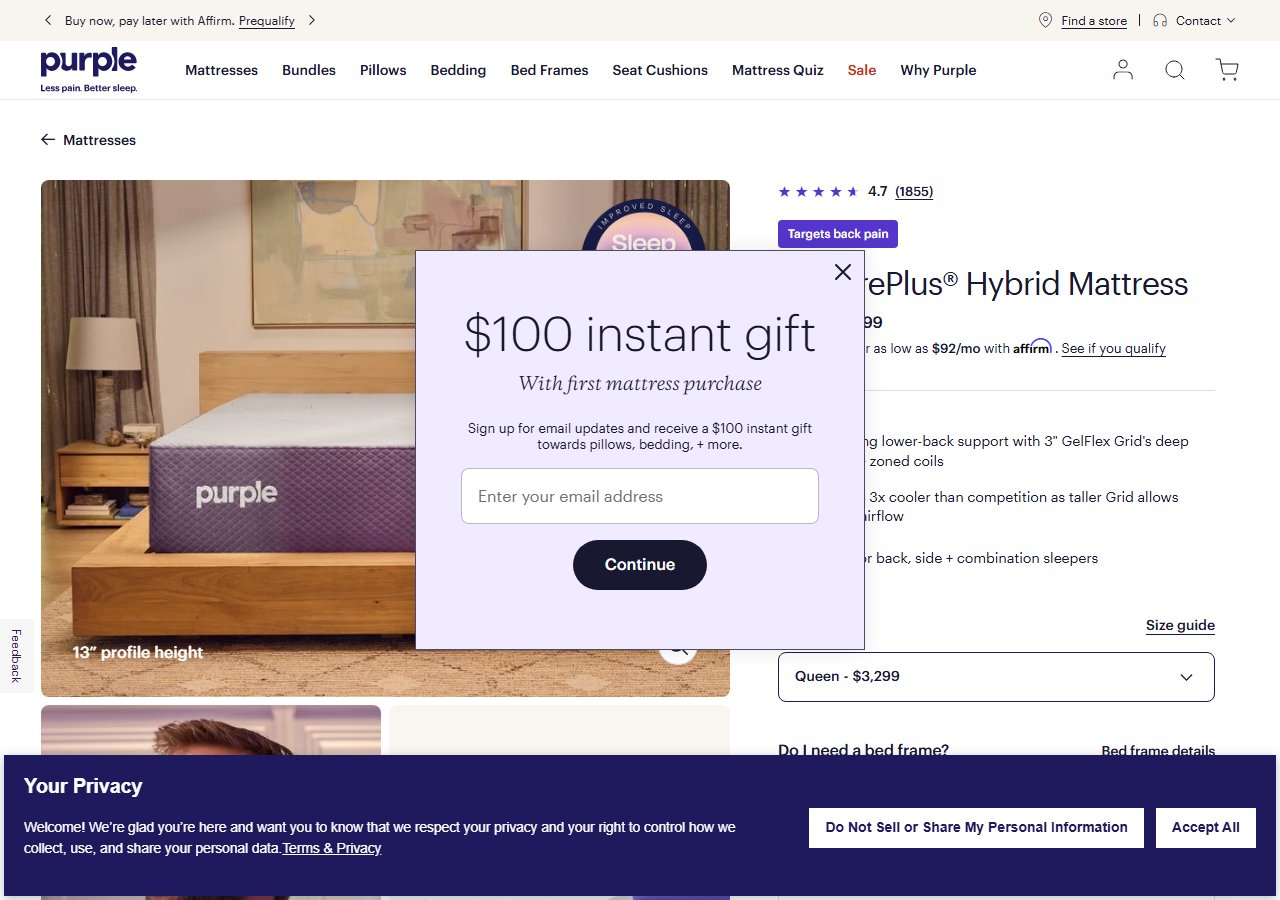
Purple Hybrid Premier Mattress
$2,499-$4,799
See Price at Purple →The data-to-intervention-to-product hierarchy, restated
The federal data on healthcare worker MSDs is not ambiguous. The BLS back-injury tracking shows the back as the leading injury site across all occupations. The SSA disability data shows MSDs as the leading driver of disability claims. The AHRQ cost data shows back pain as one of the most expensive conditions in U.S. healthcare. None of those numbers improve by selling a nurse a mattress. They improve when healthcare workers have access to accurate information about mechanism, evidence-based non-product interventions, clear clinical red flags, and — where products are genuinely indicated — honest guidance about which constructions match their specific biomechanical needs.
The hierarchy matters: position first, movement second, mechanical habits third, clinical evaluation when warranted, and sleep surface as a meaningful but bounded adjunct for workers who have done the other work. The workers for whom a better mattress actually changes the trajectory of their recovery are real. But they are a subset of the population with occupational back pain, not the majority. If this article helps more healthcare workers find the right level in that hierarchy — and get to the right intervention — it has done its job, regardless of whether any product gets purchased.
For those who have arrived at the product stage with clear eyes: the Saatva Loom & Leaf for serious chronic back pain in standard body weights, the Saatva HD for larger-framed workers whose current surface is failing under load, and the Purple Hybrid Premier for pressure-point-driven pain that conventional constructions have not addressed. Those are not affiliate recommendations dressed up as journalism. They are the three constructions whose engineering specifications most directly match the biomechanical needs this federal data describes.