The federal numbers behind a healthcare worker's aching back
If you are a nurse, surgical tech, physical therapist, or patient-care aide and your back hurts after a shift, you are not experiencing a personal failing — you are experiencing a documented occupational exposure. BLS Musculoskeletal Disorder tracking identifies the back as the most frequently injured body part across all U.S. occupations that result in days away from work. Healthcare and social assistance consistently ranks among the highest-incidence industries for nonfatal occupational injuries, with registered nurses and nursing assistants appearing repeatedly at the top of that list.
The downstream costs are staggering. AHRQ HCUP data identifies back pain as one of the most expensive conditions in U.S. healthcare measured by combined inpatient and outpatient spending — a bitter irony for the workers producing that data by treating other patients while managing their own spinal damage. AHRQ MEPS data shows that average annual personal healthcare expenditures for adults with chronic back conditions substantially exceed those for adults without such conditions. And at the population level, SSA Disability Insurance data identifies musculoskeletal disorders as the single largest category of new disability claims filed annually — meaning the trajectory from occupational MSD to functional limitation to disability is well-documented and more common than most HR departments acknowledge.
This article is not about alarming you. It is about giving you the same data-anchored framework an occupational medicine physician would use — starting with mechanism, moving through free interventions, flagging clinical red flags, and only then arriving at equipment that supports recovery.
Why healthcare work specifically destroys the lumbar spine
The biomechanical insult in healthcare is not one dramatic event. It is a cumulative loading pattern that compounds across years of 8- to 12-hour shifts. Three mechanisms drive the majority of the damage.
Patient handling loads exceed safe spinal limits repeatedly. The NIOSH Lifting Equation — the federal gold standard for quantifying manual material-handling risk — documents that patient transfers, repositioning tasks, and lateral patient moves in hospital and long-term care settings routinely exceed the recommended weight limits that protect spinal disc integrity. Unlike warehouse picking, which involves objects with defined weights and predictable geometry, patient handling involves dynamic, asymmetric, and often sudden loads. A 130-pound patient who resists or shifts mid-transfer creates spinal loading equivalent to a far heavier static load. NIOSH modeling shows that spinal compression forces during floor-to-chair transfers can exceed 6,000 newtons — roughly triple the 3,400-newton action limit NIOSH uses as its safe ceiling.
Sustained postures in awkward spinal positions accelerate disc degeneration. Surgical techs stand for 4–8 hours in fixed positions. ICU nurses lean over bedrails to perform assessments and procedures. Transport aides push loaded gurneys with handles set to the wrong height, creating sustained lumbar flexion under axial load. The intervertebral disc depends on cyclical loading and unloading — alternating compression and decompression — to pump nutrients in and waste products out. Sustained postures eliminate that pumping mechanism, accelerating the disc dehydration and annular fiber fatigue that precede herniation.
Shift work disrupts the hormonal environment that repairs spinal tissue overnight. This is the part that rarely appears in occupational safety training but is arguably the most important for a healthcare worker reading this. The spine repairs itself during sleep. Growth hormone release, which orchestrates musculoskeletal tissue repair, is concentrated in deep slow-wave sleep. Cortisol, which drives inflammatory processes including pain sensitization, should be lowest during overnight sleep. Rotating shift work — the pattern that governs perhaps half of hospital nursing — inverts both rhythms. CDC sleep data shows that approximately 35% of U.S. adults sleep fewer than the 7-hour threshold associated with elevated chronic disease risk. For rotating-shift nurses sleeping against their circadian rhythm during the day, effective restorative sleep hours are often structurally lower than that already-poor population average.
The interaction between these three mechanisms explains why approximately 20% of U.S. adults experience chronic pain with lower back as the leading location — and why the occupational concentration within healthcare is so pronounced. CDC arthritis prevalence data shows roughly 25% of U.S. adults carry a doctor-diagnosed arthritis diagnosis, with prevalence elevated in physically demanding occupations. For a nurse with early facet joint arthropathy from years of sustained posture, poor sleep quality is not merely an inconvenience — it is a physiological tax on the limited repair capacity they have left.
The cost equation that makes prevention urgent
BLS Employer Costs data shows that industries with high MSD incidence carry workers' compensation insurance rates 3 to 5 times higher than low-MSD industries — a cost that is ultimately passed back to workers through wage suppression and benefit design. CMS drug spending data identifies opioid and non-opioid pain medications among the most expensive drug categories in Medicare, reflecting the chronic-pain treatment burden that emerges when occupational MSDs go unaddressed. The individual financial exposure — lost wages, out-of-pocket treatment costs, potential disability — makes early intervention not just medically smart but economically necessary.
Try these first: free and low-cost interventions with federal evidence backing
The cheapest intervention is the one that does not require buying anything. Before evaluating sleep surfaces, work through the following evidence-based behavioral and ergonomic changes. Each is drawn from federal health research, not manufacturer marketing.
Daily walking is the most underused treatment in back pain management. An NIH NCCIH evidence review on low-back pain concludes that walking 30 minutes most days reduces chronic low-back pain as effectively as most non-drug clinical treatments. For healthcare workers who feel exhausted after a 12-hour shift, the idea of adding a 30-minute walk sounds counterintuitive. The mechanism explains why it works: walking provides the cyclical spinal loading and unloading that sustained clinical postures deny. It rehydrates discs, reduces inflammatory mediators, and improves the slow-wave sleep architecture that makes off-duty recovery productive. Even a 15-minute post-shift walk before sleep is meaningfully better than going directly to bed.
Lifting mechanics are trainable and most acute flares are preventable. OSHA's ergonomics guidance emphasizes hinging at the hips rather than the lumbar spine, keeping loads close to the body, and eliminating twisting under load. Most acute healthcare-worker back episodes are mechanical — a unguarded patient transfer, a moment of trunk rotation under load — and the movement pattern that produces the injury is rehearsable and correctable. Safe patient handling programs using ceiling lifts, lateral transfer boards, and proper team mechanics have federal evidence support, and advocating for these tools within your facility is a higher-leverage intervention than any mattress.
Sleep position is the largest free variable in overnight spinal recovery. NIH NIAMS back pain guidance recommends side-sleeping with a pillow between the knees, or back-sleeping with a pillow under the knees, to maintain lumbar neutral alignment during sleep. Both positions minimize sustained stretch on the posterior spinal structures — the facet capsules, interspinous ligaments, and paraspinal muscles — that are already inflamed after a shift. Stomach-sleeping creates sustained lumbar hyperextension and cervical rotation and should be avoided by anyone with chronic low-back or neck pain. This is free to implement tonight.
Replace a mattress when it is visibly failing, not on a marketing schedule. CDC sleep hygiene guidance frames the sleep environment as one input in a broader set of behavioral sleep practices. A mattress warrants replacement when it shows visible sag, when you wake stiffer than you went to bed consistently, or when it exceeds 7 to 10 years of age. Even the most precisely engineered sleep surface cannot compensate for irregular sleep schedules, poor sleep hygiene, or sedentary days. The mattress is an adjunct, not a solution.
For readers who have addressed sleep position, are walking regularly, have proper lifting mechanics dialed in, and are still waking with stiffness or pain — or whose current mattress is visibly degraded — the evidence does support evaluating a sleep surface purpose-built for spinal load distribution. The following section covers what to look for, why it matters biomechanically, and which specific products perform well for the healthcare-worker use case.
When to see a clinician — red flags that a mattress cannot address
Before spending money on a sleep surface, rule out the clinical presentations that require professional evaluation. A new mattress is appropriate for mechanical back pain driven by poor sleep surface support. It is not appropriate as a first response to these presentations:
- Pain that radiates below the knee, particularly with numbness, tingling, or burning — this pattern suggests nerve root involvement (radiculopathy) and requires clinical evaluation, not a softer mattress. NIH NINDS back pain guidance explicitly flags this as a prompt-referral criterion.
- Back pain following direct trauma — a patient fall, a vehicle accident, a slip on a wet floor. Structural injury (fracture, ligamentous disruption) must be excluded before attributing pain to sleep surface.
- Bowel or bladder changes concurrent with back pain — urinary retention or incontinence paired with back pain is a cauda equina syndrome flag and requires emergency evaluation.
- Unexplained fever with back pain — raises concern for discitis or spinal epidural abscess, both infectious processes that imaging and laboratory work are required to evaluate.
- Progressive leg weakness — any new lower-extremity weakness accompanying back pain is a neurological red flag requiring same-day or next-day evaluation.
If any of these apply, stop reading product reviews and contact a clinician. NIH NINDS is explicit that these presentations require imaging or referral, not conservative management.
What to look for in a sleep surface for healthcare-worker recovery
For the reader who has cleared clinical red flags, whose pain is consistent with mechanical back pain or position-related stiffness, and whose current mattress is aging or visibly compromised — here is what the biomechanical evidence supports in a sleep surface.
Zoned support matters more than firmness level. The lumbar spine needs more upward pressure (support) than the shoulder region to maintain neutral alignment in side-sleeping. A mattress with uniform firmness either supports the lower back and creates painful shoulder pressure points, or accommodates the shoulder and lets the lumbar spine sag into flexion. Zoned construction — differentiated firmness from shoulder to hip to leg — addresses both simultaneously. For healthcare workers who often alternate between side and back sleeping across a shift-recovery nap and a nighttime sleep, zoned support is particularly important because the biomechanical demand changes with position.
Memory foam distributes pressure well but traps heat and restricts movement. For healthcare workers who run hot after a high-exertion shift, traditional dense memory foam can create thermal discomfort that fragments sleep architecture — the opposite of the deep slow-wave sleep needed for tissue repair. Gel-infused or open-cell foam formulations address this partially. Hybrid constructions (foam comfort layers over individually wrapped coil support cores) address both pressure distribution and temperature regulation simultaneously, while adding the edge support and ease of movement that makes it less effortful to reposition during sleep.
Coil support systems with individually wrapped springs reduce motion transfer (relevant for healthcare workers sleeping next to partners who keep different schedules) and provide the dynamic response that allows comfortable repositioning without the sinking-in sensation that makes getting out of bed harder on an already-stiff back.
The specific picks for healthcare-worker back pain recovery
For healthcare workers with chronic back pain driven by the occupational loading patterns described above, three mattresses align well with the biomechanical requirements — two from Saatva, one from Purple.
The Saatva Loom & Leaf Memory Foam Mattress is the strongest premium memory-foam pick for healthcare workers who sleep hot but need the pressure-relief characteristics of foam. Saatva uses a 5-pound-density memory foam that provides the deep contouring needed to offload hip and shoulder pressure points, paired with a spinal zone support layer — a firmer lumbar band engineered specifically to maintain lumbar neutral alignment when side-sleeping. For nurses and techs whose lower back and hips bear the primary positional load during sleep, this construction directly addresses the failure mode of generic-firmness foam mattresses. The Loom & Leaf is available in Relaxed Firm and Firm, and most chronic-back-pain users find the Relaxed Firm appropriate unless they are strict back-sleepers.
For healthcare workers who are larger-framed — or who share a bed and want a surface that maintains its support geometry under higher combined loads — the Saatva HD Mattress is the purpose-built option. The HD is engineered for individuals up to 500 pounds with a reinforced support core and higher-gauge coil system that resists the progressive sag that standard mattresses develop under heavier loading. Spinal neutral alignment is a function of the mattress maintaining its designed geometry over time; a mattress that sags at the hip zone after 18 months of use provides no better lumbar support than a worn-out budget mattress regardless of its initial construction. The HD's heavy-duty build addresses that durability concern directly.
For healthcare workers whose primary complaint is pressure-point pain — hip pain, shoulder pain, the sensation of sleeping on a surface that is too firm regardless of firmness setting — the Purple Hybrid Premier Mattress takes a fundamentally different engineering approach. Purple's GelFlex Grid is a buckling-column polymer grid that collapses under concentrated pressure (like a hip or shoulder) while remaining firm under distributed load (like the lumbar region). This pressure-adaptive behavior is mechanically closer to how a custom-fitted orthopedic surface would work than either traditional foam or coil systems. The Hybrid Premier pairs the GelFlex Grid comfort layer with pocketed coils for support and cooling airflow. For healthcare workers who have tried multiple conventional foam or innerspring mattresses and still wake with hip or shoulder pain, the Purple's different mechanical approach is worth serious consideration.
Sleep Surfaces for Healthcare Workers With Chronic Back Pain
Each mattress below was selected for the specific biomechanical demands of healthcare shift work — zoned lumbar support, pressure distribution for side-sleepers, and durability under repeated nightly use by workers whose spines have already absorbed significant occupational loading.

Saatva Loom & Leaf Memory Foam Mattress
$1,695-$3,295
See Price at Saatva →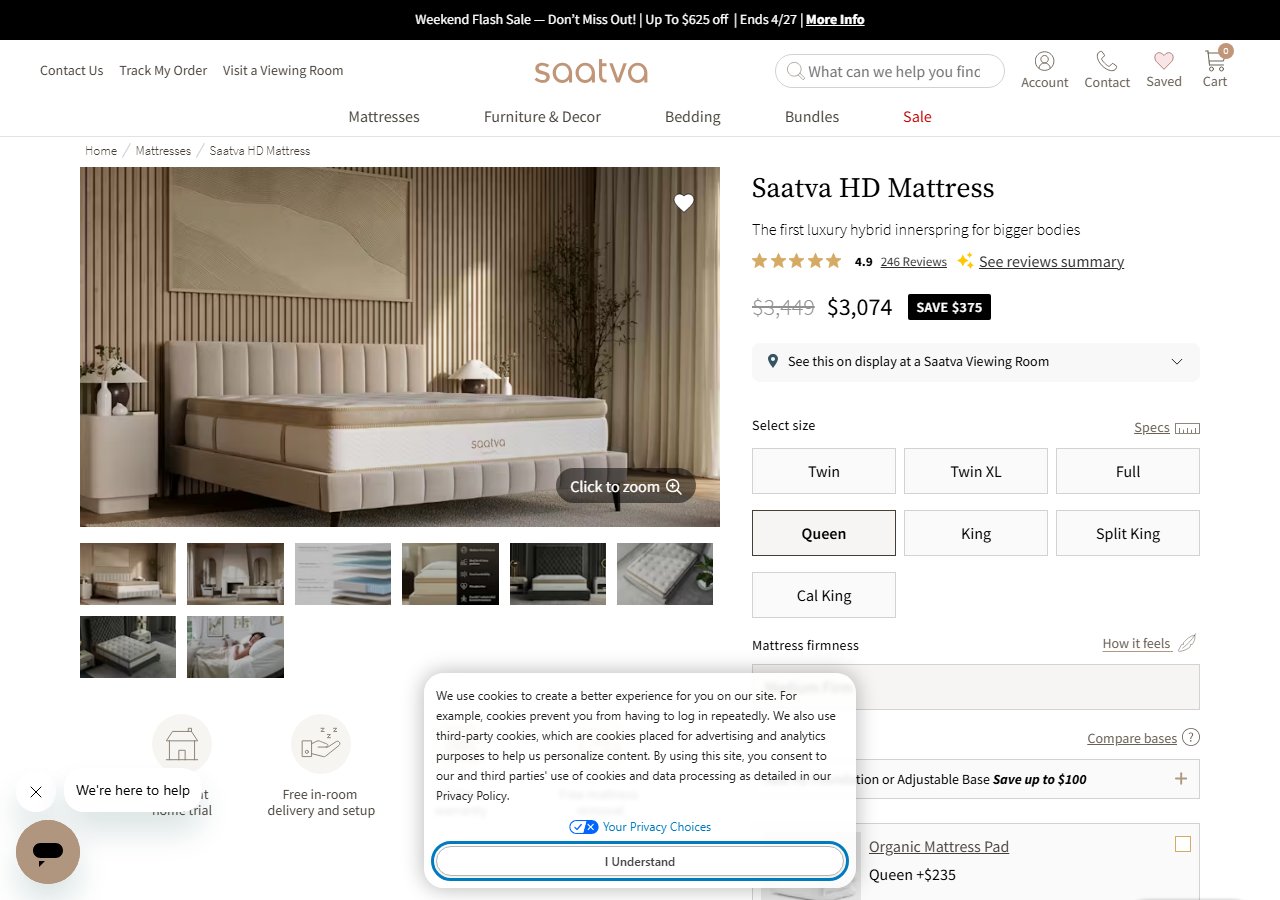
Saatva HD Mattress (Heavy-Duty)
$2,395-$3,995
See Price at Saatva →
Purple Hybrid Premier Mattress
$2,499-$4,799
See Price at Purple →Putting it together: the data-to-recovery hierarchy
Federal occupational health data tells a consistent story: healthcare work imposes spinal loading that exceeds safe biomechanical limits, fragmented shift sleep disrupts the hormonal environment that repairs that damage, and the long-term consequences — chronic pain, disability claims, escalating personal healthcare costs — are both predictable and, to a meaningful degree, modifiable.
The modification hierarchy runs in a specific order. Movement comes first: NIH NCCIH evidence shows walking is as effective as most non-drug treatments for chronic low-back pain. Ergonomics comes next: OSHA's lifting guidance and the NIOSH Lifting Equation define the movement mechanics that prevent acute flares. Sleep position — free to change tonight — is the third lever. A degraded or mismatched sleep surface is the fourth lever, addressed last because it is the most expensive and the least likely to produce meaningful change if the first three are ignored.
For healthcare workers who have worked through that hierarchy and are evaluating sleep surfaces: prioritize zoned support construction, hybrid foam-over-coil or grid-over-coil designs for temperature regulation, and durability appropriate to your body weight. The three products above represent different engineering approaches to the same biomechanical goal — choose based on your primary symptom pattern and sleep position.
What the SSA disability data and AHRQ cost data make clear is that the cost of inaction compounds over time. Occupational MSD treated early — with movement, mechanics training, clinical referral when indicated, and appropriate sleep-surface support — has a materially different long-term trajectory than occupational MSD managed with analgesics and hope. The federal data exists to inform that decision. Use it.