The shift-work back-pain crisis hiding in plain federal data
Every morning across the United States, nurses, respiratory therapists, surgical technicians, and patient-care aides clock out after 12-hour shifts carrying the equivalent of a moving job's worth of spinal load. They drive home, collapse into bed, and wake up four to six hours later — if circadian disruption and back pain allow even that. According to BLS Musculoskeletal Disorders by Occupation tracking, the back is the most commonly injured body part across every U.S. occupation that results in days away from work. Healthcare workers are not a footnote in that statistic. They are among its primary contributors.
This is not a story about workers who need better mattresses. It is a story about a structural mismatch between what the human spine is designed to tolerate and what a 12-hour acute-care shift demands — and about what happens in the roughly 6 to 8 hours of horizontal recovery time that follows. Getting that recovery window right matters clinically. Getting it wrong compounds an injury cycle that, at its endpoint, lands healthcare workers on SSA Disability Insurance rolls — where musculoskeletal disorders are the largest single category of new disability claims filed annually.
Why this happens: the biomechanics of shift-work spinal loading
The spine is not engineered for 12-hour continuous loading cycles. Intervertebral discs — the fluid-filled shock absorbers between vertebrae — rely on periods of unloading (primarily horizontal rest) to rehydrate via osmotic diffusion. During a standing or walking shift, axial compression on lumbar discs can range from roughly 500 to over 1,500 newtons depending on posture, and patient-handling tasks push that load far higher. The NIOSH Lifting Equation — the federal standard for evaluating manual material-handling risk — documents that patient repositioning, transfer, and lateral-assist tasks in healthcare routinely exceed safe spinal loading limits. A nurse repositioning a 200-pound patient in bed generates lumbar compressive forces that NIOSH's own model classifies as high-risk, even when proper body mechanics are used.
The compounding factor is circadian disruption. Shift workers — particularly those rotating between day and night schedules — experience persistent misalignment between their internal circadian clock and their sleep-wake cycles. That misalignment suppresses the slow-wave and REM sleep stages during which the body performs its primary tissue repair. CDC sleep data shows that approximately 35% of U.S. adults already sleep fewer than 7 hours per night — the threshold below which chronic disease risk rises significantly. Rotating shift workers routinely fall further below that threshold, often sleeping 5 to 6 hours in fragmented, poorly timed windows.
The downstream clinical picture is grim. CDC NCHS Data Brief 390 reports that approximately 20% of U.S. adults experience chronic pain, with the lower back as the single most common pain location. Among occupations with sustained physical demand, CDC Arthritis data documents that approximately 25% of adults carry a doctor-diagnosed arthritis diagnosis — a condition that accelerates under repetitive mechanical stress and inadequate recovery. For healthcare workers who spend years cycling through this load-and-insufficient-recovery loop, chronic lumbar pain is not bad luck. It is a predictable mechanical outcome.
The economic consequence follows the injury pattern. AHRQ HCUP data identifies back pain as one of the most expensive conditions in U.S. healthcare by total inpatient and outpatient spending. AHRQ MEPS data shows that adults with chronic back conditions carry substantially higher annual personal healthcare expenditures than those without. And CMS drug spending data identifies opioid and non-opioid pain medication as among the most expensive Medicare drug categories — a reflection of how undertreated chronic spinal pain ultimately flows into pharmaceutical dependency. BLS workers' compensation data shows that high-MSD industries carry workers' compensation rates 3 to 5 times higher than low-MSD sectors, meaning the cost is socialized across every employer in the industry.
The recovery window: why horizontal hours matter more for shift workers
For a sedentary office worker, a suboptimal mattress is a comfort problem. For a healthcare shift worker who has spent 12 hours on their feet repositioning patients and charting at awkward workstations, the horizontal recovery window is the primary physiological repair interval available to the intervertebral discs, paraspinal musculature, and peripheral joints. That distinction changes the stakes of sleep-surface selection.
The paraspinal muscles — the erector spinae, multifidus, and quadratus lumborum groups — act as the spine's active stabilization system throughout a shift. After prolonged loading, these muscles are both fatigued and in a mild state of protective guarding (low-grade spasm). A sleep surface that does not support lumbar lordosis — the natural inward curve of the lower back — during horizontal rest keeps those muscles in partial contraction throughout the night. The result is morning stiffness that is not simply a comfort complaint: it is evidence that the spine did not achieve the decompression it needed.
Conversely, a sleep surface that is too soft creates the opposite problem: the pelvis sinks deeper than the thorax, flattening or reversing lumbar lordosis and placing the posterior annulus of lumbar discs under sustained tensile stress. The ideal sleep surface for a worker with chronic lumbar loading is one that maintains spinal neutrality across all positions — supporting the lumbar curve without allowing pelvic drop, and distributing pressure across the shoulder and hip girdles without creating point-load hot spots that interrupt sleep.
Try these first: interventions that cost nothing
The cheapest intervention is the one that does not require buying anything. Before we evaluate sleep surfaces, four evidence-based interventions deserve priority — not as a disclaimer, but because the federal research base supporting them is stronger than the research base for any specific mattress brand.
Sleep position is the highest-leverage free variable available to a healthcare worker with back pain. NIH NIAMS guidance is explicit: side-sleeping with a pillow between the knees maintains hip-spine alignment and reduces lumbar rotation; back-sleeping with a pillow under the knees offloads the lumbar facet joints. Stomach-sleeping — common among shift workers who collapse face-down out of exhaustion — torques the lumbar spine and worsens chronic pain by placing the facet joints and posterior disc structures under sustained rotation. Changing sleep position costs nothing and can produce measurable morning-pain reduction within days.
Daily walking is supported by stronger evidence than most passive interventions, including new mattresses. NIH NCCIH's evidence review on low-back pain finds that 30 minutes of walking most days reduces chronic low back pain as effectively as most non-drug clinical treatments. This is a hard finding for shift workers who feel too exhausted to exercise after a 12-hour shift — but a 20-minute walk before the commute home, or after waking, serves both circadian anchoring and spinal decompression.
On-shift lifting mechanics remain the primary injury prevention lever. OSHA's ergonomics guidance — and the underlying NIOSH Lifting Equation — establishes that hinging at the hips, keeping loads close to the center of mass, and avoiding trunk rotation under load dramatically reduces lumbar compressive force. Most acute back episodes among healthcare workers are mechanical and traceable to a specific patient-handling event. Reviewing technique during low-acuity moments of a shift is time well spent.
When the mattress itself is the problem, the diagnostic criteria are clear. CDC sleep hygiene guidance and clinical consensus converge on three signals: visible sag or body impressions greater than 1 inch, waking consistently stiffer than you went to bed, or a mattress older than 7 to 10 years. If none of these apply, mattress replacement is unlikely to address the symptom. Even the most precisely engineered sleep surface cannot compensate for poor sleep hygiene, inadequate sleep duration, or unmanaged daytime loading.
For healthcare workers who have addressed position, movement, and mechanics — and who are sleeping on a worn or poorly fitting surface — a sleep surface upgrade becomes a legitimate clinical-adjunct investment. The research does not support the idea that any specific mattress cures back pain. It does support the idea that a surface that maintains spinal neutrality and reduces pressure-point disruption improves sleep continuity, and that improved sleep continuity is associated with reduced pain sensitization. That is a narrower claim than most mattress marketing makes, but it is the one the evidence actually supports.
When to see a clinician: red flags specific to shift-work spinal pain
Not all back pain is mechanical, and not all mechanical back pain is appropriate to manage with sleep-surface adjustments. NIH National Institute of Neurological Disorders and Stroke guidance on back pain identifies several presentations that require prompt clinical evaluation and imaging — not a new mattress:
- Pain that radiates below the knee, particularly with numbness, tingling, or a burning quality, suggests nerve root involvement (radiculopathy) that warrants clinical assessment before any self-management strategy.
- Back pain following a trauma — a patient fall, a dropped load, a lateral-assist that went wrong — should be evaluated for fracture or disc herniation before conservative management is attempted.
- Leg weakness associated with back pain is a red flag for cauda equina involvement or significant neurological compromise. This is a medical emergency.
- Bowel or bladder changes in the context of back pain represent the classic cauda equina syndrome presentation and require emergency evaluation.
- Back pain accompanied by fever, unexplained weight loss, or night sweats may indicate infectious or oncologic etiology and should not be attributed to shift fatigue.
For healthcare workers who have been experiencing back pain for more than 4 to 6 weeks without improvement from position changes, activity modification, and adequate rest, a clinician visit is appropriate. Physical therapy referral — particularly for programs that include specific lumbar stabilization exercise — has strong evidence support from NIH and AHRQ systematic reviews.
Where sleep-surface engineering enters the picture
For shift workers who have addressed the modifiable behavioral and mechanical variables and are sleeping on a surface that meets the replacement criteria above, the engineering of the sleep surface matters. Three constructions are worth understanding before evaluating any product.
Zoned lumbar support — coil or foam layers engineered with differentiated firmness zones — allows firmer support under the heavier lumbar and hip region while maintaining softer conformance under the shoulder and upper back. This is directly relevant to the shift worker who needs the lumbar spine supported without the shoulder girdle being compressed into a point that interrupts sleep. Zoned support is not a marketing term; it is a structural approach with a rational biomechanical basis.
Memory foam contouring provides pressure distribution across the hip and shoulder girdle that innerspring surfaces cannot match. For healthcare workers with lateral hip bursitis — common in workers who spend hours walking on hard surfaces — the pressure-relief property of high-density memory foam reduces the pain stimulus that causes position changes that fragment sleep. The Saatva Loom & Leaf Memory Foam Mattress is the premium memory-foam option in this category that takes this approach furthest, using layered organic cotton quilting, cooling gel memory foam, and a spinal zone Lumbar Crown support layer specifically engineered to maintain lumbar lordosis. For healthcare workers with documented chronic lumbar pain, this construction addresses the primary failure mode of conventional innerspring surfaces — lack of contoured lumbar support.
Load capacity and coil gauge matter for shift workers at the higher end of the weight spectrum — a population that includes a significant share of healthcare workers, given that the occupation attracts candidates across the full demographic range. Standard mattresses are typically engineered for up to 250 pounds per side. Workers above that threshold who sleep on standard mattresses experience accelerated foam compression and coil fatigue that eliminates the support properties within 2 to 3 years. The Saatva HD Mattress is engineered specifically for this gap — with individually wrapped coils in a heavier gauge and a reinforced perimeter that maintains edge support for workers who need to sit at the edge of the bed to put on compression stockings or footwear before a shift. For heavier-framed healthcare workers, this is not an upsell — it is a structural specification relevant to whether the mattress maintains its support geometry through a full 10-year service life.
Pressure-mapping grid technology represents a different engineering approach. The Purple Hybrid Premier Mattress uses a hyper-elastic polymer grid that neither sinks like foam nor pushes back like a traditional spring. The grid collapses under pressure points (hips, shoulders) and remains rigid under lighter areas (lumbar waist), producing a pressure-neutral map that is difficult to achieve with foam or coil alone. For healthcare workers with both lumbar pain and shoulder or hip pressure sensitivity — a combination common in workers who experience both axial spinal loading and prolonged walking on hard floors — this construction addresses two failure modes simultaneously. The tradeoff is price: at $2,499 to $4,799, it is the highest-priced option in this group.
Sleep Surfaces Engineered for Shift-Work Spinal Recovery
These three mattresses were selected for healthcare shift workers carrying chronic lumbar load — evaluated on zoned lumbar support architecture, pressure-point distribution, and structural durability across the full weight range present in the healthcare workforce.

Saatva Loom & Leaf Memory Foam Mattress
$1,695-$3,295
See Price at Saatva →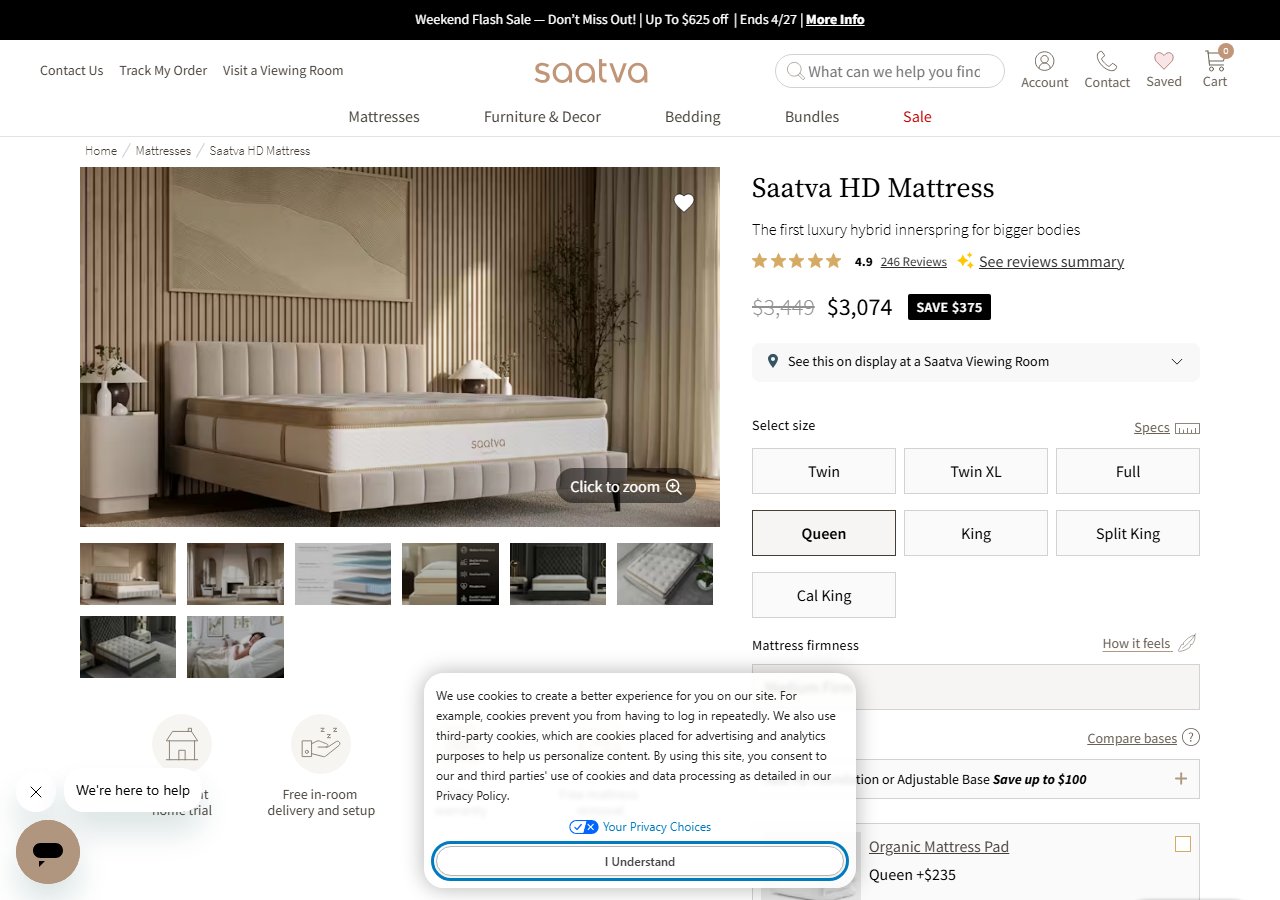
Saatva HD Mattress (Heavy-Duty)
$2,395-$3,995
See Price at Saatva →
Purple Hybrid Premier Mattress
$2,499-$4,799
See Price at Purple →How to match construction to your specific shift-work symptom profile
No single mattress construction is optimal for every healthcare worker's back-pain presentation. The selection logic should follow from the primary symptom:
Primary complaint: morning lumbar stiffness and aching that improves after moving around. This presentation is consistent with facet joint loading and disc rehydration deficit — both of which benefit from a surface that maintains lumbar lordosis throughout the night without excessive softness. Medium-firm to firm zoned support is the evidence-consistent choice. The Loom & Leaf's Lumbar Crown layer is directly relevant here.
Primary complaint: hip or shoulder pressure pain that causes frequent position changes and fragmented sleep. This presentation benefits from pressure-relief construction rather than firmness. The Purple Hybrid Premier's grid technology or the Loom & Leaf in its softer tension variant addresses this pattern.
Primary complaint: surface sag, edge collapse, or support failure associated with higher body weight. This is a structural-capacity problem, not a comfort problem. No amount of foam layering resolves a coil system that cannot maintain its geometry under sustained load. The Saatva HD is the only option in this group engineered from the coil up for extended-weight support.
All three profiles share one requirement: consistency of support through the full sleep cycle. Healthcare workers rarely sleep in one position — circadian disruption and pain guarding produce frequent repositioning. A mattress that performs well in one position but fails in another creates the fragmented sleep that is clinically equivalent to short sleep duration in terms of pain sensitization and recovery impairment.
The data-to-recovery hierarchy: a summary
The federal data on healthcare worker MSD is not abstract. It describes a predictable injury trajectory: cumulative spinal loading that exceeds NIOSH safety thresholds, compounded by insufficient and poorly timed recovery sleep, resolved too often by pharmaceutical pain management rather than structural intervention. CMS drug spending data reflects the downstream cost of that trajectory in Medicare opioid spending alone.
The intervention hierarchy the data supports is: correct mechanics first, optimize sleep position second, address sleep duration and circadian anchoring third, replace a worn sleep surface fourth, and select surface engineering that matches your specific symptom profile fifth. A new mattress sits at step four in a five-step hierarchy — it is a legitimate tool, but only after the upstream variables are managed.
For healthcare workers who are at step four or five, the distinction between a $900 conventional innerspring and a $1,695 to $3,995 zoned, contoured, or grid-engineered surface is not primarily a luxury question. It is a question of whether the surface maintains its support geometry across a 10-year service life and whether it can address the specific spinal load pattern that 12-hour acute-care shifts produce. On those criteria, the engineering gap between mass-market and purpose-built surfaces is real and measurable — even if the marketing that surrounds it is frequently not.