The federal data on warehouse back injuries is unambiguous
Start with the number that should appear on every warehouse safety board in America: according to BLS Musculoskeletal Disorders by Occupation tracking, the back is the single most commonly injured body part across all U.S. occupations with days away from work. Not wrists. Not knees. The back — and warehousing, distribution, and material-handling roles sit at the highest end of that injury distribution.
This is not a data artifact. The CDC NCHS Data Brief 390 reports that approximately 20% of U.S. adults experience chronic pain, with lower back pain as the most common location. For warehouse workers, that national average understates the reality significantly. Eight-hour and ten-hour shifts of repetitive lifting, pallet pulling, reach-and-stow motions, and extended standing on concrete floors create a cumulative spinal loading profile that the general population simply does not share.
The downstream costs are federal-data-documented and severe. SSA Disability Insurance reports identify musculoskeletal disorders as the largest single category of new disability claims filed annually — not cancer, not cardiovascular disease, but the category that warehouse work accelerates fastest. AHRQ HCUP data confirms back pain as one of the most expensive conditions in U.S. healthcare by total inpatient and outpatient cost. And AHRQ MEPS data shows that adults with chronic back conditions carry annual personal healthcare expenditures substantially higher than adults without such conditions.
For warehouse workers pulling consistent physical shifts, the question is not whether cumulative lumbar loading is occurring — it is whether the hours off the floor are being used to actually recover from it.
Why warehouse work damages lumbar tissue differently than desk work
Understanding why sleep surface matters for this specific population requires understanding the biomechanical mechanism — and it is not the same mechanism that affects office workers with sedentary low back pain.
The NIOSH Lifting Equation, the federal standard for evaluating manual material-handling risk, was developed specifically because warehousing-style tasks routinely exceed safe spinal loading limits. The equation calculates a Recommended Weight Limit (RWL) for any given lift, accounting for load weight, horizontal distance from the spine, vertical height, trunk rotation, coupling quality, and lift frequency. In real warehouse environments — where a worker may pull a 40-pound tote off a bottom shelf, rotate to place it on a conveyor, and repeat that pattern 200 times across a shift — the composite spinal compressive force can exceed 3,400 Newtons, the NIOSH action limit, by a significant margin.
What this means biologically: the intervertebral discs and the erector spinae muscle group absorb repeated compressive and shear loads throughout a shift. The L4-L5 and L5-S1 spinal segments — the lumbar junction where most warehouse-related back injuries cluster — experience the highest mechanical stress during forward flexion under load. After a full shift, the paravertebral musculature is fatigued, the discs are compressed, and inflammatory signaling is elevated.
This is the physiological state a warehouse worker brings to bed. The recovery window — typically 6 to 8 hours of sleep — is when intradiscal pressure drops to its lowest point, allowing disc rehydration. Paravertebral muscles release, spinal ligaments decompress, and the nervous system downregulates inflammatory markers. But this repair sequence is position-dependent and surface-dependent. A mattress that either collapses under body weight (excessive sag) or holds the lumbar spine in sustained lateral deviation (too-firm surface that creates pressure points at hip and shoulder) interrupts the exact recovery mechanics the body needs after high-load manual work.
There is a compounding factor specific to shift workers: the CDC sleep data showing that approximately 35% of U.S. adults sleep fewer than 7 hours per night is almost certainly an undercount for rotating-shift warehouse workers. Morning warehouse starts (4 a.m. to 6 a.m.) mean that workers who go to bed at 10 p.m. are getting five to six hours of sleep — below the threshold CDC associates with elevated chronic disease risk. Shortened sleep windows directly compress the recovery time available for the musculoskeletal repair described above.
BLS employer data reinforces why employers should care about this: industries with high MSD incidence carry workers' compensation insurance rates 3 to 5 times higher than low-MSD industries. The costs do not stay with the worker. They ripple through payroll costs, staffing capacity, and long-term disability exposure. CMS Drug Spending Dashboard data shows opioid and non-opioid pain medication spending among the most expensive Medicare drug categories — a downstream signal of how undertreated and unmanaged chronic musculoskeletal pain escalates into systemic healthcare cost.
The interventions that cost nothing — try these first
The cheapest intervention is the one that does not require buying anything. Before any product recommendation is made in this article, the federal evidence base is clear that behavioral, positional, and mechanical interventions have strong support for reducing chronic low back pain — and several of them are directly applicable to warehouse workers during their off-duty hours.
Sleep position matters more than most people realize. NIH guidance from the National Institute of Arthritis and Musculoskeletal and Skin Diseases identifies side-sleeping with a pillow between the knees, or back-sleeping with a pillow under the knees, as the positions most likely to maintain lumbar neutrality through the night. Stomach-sleeping — a common position among people who sleep on overly firm surfaces and shift to avoid pressure points — torques the lumbar spine into sustained hyperextension and worsens chronic pain.
Daily walking is a legitimate clinical intervention. The NIH NCCIH evidence review on low back pain finds that walking 30 minutes on most days reduces chronic low back pain as effectively as most non-drug clinical treatments. For warehouse workers who spend shifts on their feet but rarely in aerobic movement, post-shift or pre-sleep walking provides muscular decompression and endorphin-mediated pain modulation that no passive surface can replicate.
Lifting mechanics are rehearsable. OSHA ergonomics guidance is explicit: hinge at the hips, not the lumbar spine; keep loads close to the body; avoid rotational loading under weight. Most acute warehouse back episodes are mechanical — a single lift done with trunk rotation, or a forward-bent reach that loads the lumbar in flexion. The injury is preventable and the mechanics are trainable.
If your mattress is visibly sagging, that is a product problem, not a sleeping-position problem. CDC sleep hygiene guidance supports replacing a mattress if it shows visible sag, if you wake stiffer than you went to sleep, or if it is older than 7 to 10 years. But even the most expensive mattress available does not compensate for poor sleep hygiene, a sedentary lifestyle, or a work environment with unmanaged ergonomic hazards.
For the readers who have already addressed sleep position, walking routine, and lifting mechanics — and who are dealing with a mattress that is either aging out or clearly mismatched to their body weight and load profile — the question of which sleep surface actually supports lumbar recovery becomes practical and evidence-grounded. That is the question the next sections address.
When to see a clinician before you shop for anything
Some back pain patterns in warehouse workers are not sleep-surface problems. They are clinical problems that require imaging, referral, or urgent evaluation. Buying a new mattress for these symptoms wastes money and — more importantly — delays necessary care.
NIH National Institute of Neurological Disorders and Stroke back pain guidance is specific: seek prompt clinical evaluation for back pain that radiates below the knee (possible nerve root compression or disc herniation at L4-S1), back pain that follows direct trauma (falls, equipment impact, vehicle incidents), pain accompanied by leg weakness or numbness, any bowel or bladder changes associated with back pain onset (a potential emergency), or back pain with fever. These are red flags that represent structural, neurological, or infectious processes — not sleep ergonomics problems.
CDC arthritis data notes that approximately 25% of U.S. adults report doctor-diagnosed arthritis, with highest prevalence in physically demanding occupations. If a warehouse worker is experiencing morning stiffness lasting longer than 45 minutes — particularly in multiple joints, not just the lumbar spine — that pattern warrants rheumatologic evaluation before attributing the problem to the mattress.
What the sleep-surface research actually supports for lumbar recovery
With the behavioral and clinical filters applied, we can now address what sleep surface features are supported by the occupational biomechanics described above — and which products are built to those specifications.
The key variables for warehouse workers are not the same as for a 140-pound office worker with tension-pattern low back pain. Warehouse workers are disproportionately represented in higher body weight ranges — not because of sedentary lifestyle, but because manual labor builds lean mass, and the workforce includes a high proportion of workers over 200 pounds. A sleep surface that was designed around a 160-pound average sleeper will sag under a 230-pound warehouse worker, negating any lumbar support benefit.
The three features that matter most, based on the biomechanical profile described above:
1. Zoned lumbar support: A mattress that provides differential firmness — softer at the shoulder and hip to prevent lateral deviation, firmer at the lumbar core to maintain the natural lordotic curve — directly addresses the positional decompression needs of workers arriving home with fatigued paravertebral musculature.
2. Weight-appropriate coil or foam architecture: For workers above 200 pounds, standard coil counts and foam densities may compress past the support threshold under sustained body weight. Heavy-duty construction — higher coil gauges, denser foam bases, reinforced perimeters — maintains support geometry through the night.
3. Pressure relief at hip and shoulder contact zones: After a shift of sustained standing and load-bearing, hip and shoulder joints arrive with elevated inflammatory load. A surface that concentrates pressure at these zones interrupts sleep quality and prevents the lateral-rotation position changes that protect lumbar neutrality.
The Saatva Loom & Leaf — premium memory foam for serious lumbar pain
For warehouse workers whose primary complaint is chronic lumbar pain with significant muscular tension, the Saatva Loom & Leaf Memory Foam Mattress addresses the recovery profile directly. The Loom & Leaf uses a multi-layer memory foam construction with a cooling gel-infused comfort layer and a high-density foam support core engineered to provide the sustained lumbar contact that paravertebral muscles need during decompression. It is available in Relaxed Firm and Firm options — the Relaxed Firm is the appropriate starting point for most side-sleeping warehouse workers; Firm suits back sleepers with higher body weight.
Saatva's manufacturing approach uses an organic cotton cover and plant-based foam where possible, and the mattress is delivered white-glove (setup and old-mattress removal included), which matters for workers who should not be hauling a 100-pound mattress up stairs after a 10-hour warehouse shift. Price range is $1,695 to $3,295 depending on size.
The Saatva HD — engineered specifically for higher body weight
For warehouse workers above 250 pounds, or workers whose primary complaint is that their current mattress sags or creates a "hammock" effect by morning, the Saatva HD Mattress is the most purpose-built option in this list. Saatva built the HD specifically for heavy-duty use cases — the coil system uses tempered steel at a higher gauge than standard Saatva models, the foam layers are denser, and the perimeter reinforcement maintains edge support that prevents rollout compression for larger-frame sleepers.
This matters biomechanically: a mattress that loses edge support pushes a heavier-frame sleeper toward the center, concentrating body weight and increasing lateral spinal deviation through the night. The HD's reinforced architecture keeps the sleep surface level across the full usable width. Price range is $2,395 to $3,995.
The Purple Hybrid Premier — grid-based pressure relief for hip and shoulder loading
For warehouse workers whose primary complaint is pressure-point pain at the hips and shoulders — often workers who do sustained standing on hard floors and arrive home with hip joint inflammation — the Purple Hybrid Premier Mattress takes a different engineering approach. The Purple Grid comfort layer is a polymer grid structure rather than traditional foam; it collapses under direct point-load pressure (hips, shoulders) while remaining supportive under distributed load (the lumbar region). This pressure-differentiating behavior is particularly well-suited to workers with hip joint sensitivity who need pressure relief at contact points without sacrificing lumbar support.
The Hybrid Premier adds a coil support layer beneath the grid, increasing weight capacity and preventing the sinkage that can compromise spinal alignment in heavier sleepers. The grid also runs cooler than dense foam — a relevant factor for workers who run physically warm after an active shift. Price range is $2,499 to $4,799.
Sleep Surfaces Built for Warehouse-Worker Lumbar Recovery
These three mattresses were selected for their documented ability to address the specific pressure, weight-capacity, and lumbar-support needs of manual material-handling workers recovering from high-load shifts.

Saatva Loom & Leaf Memory Foam Mattress
$1,695-$3,295
See Price at Saatva →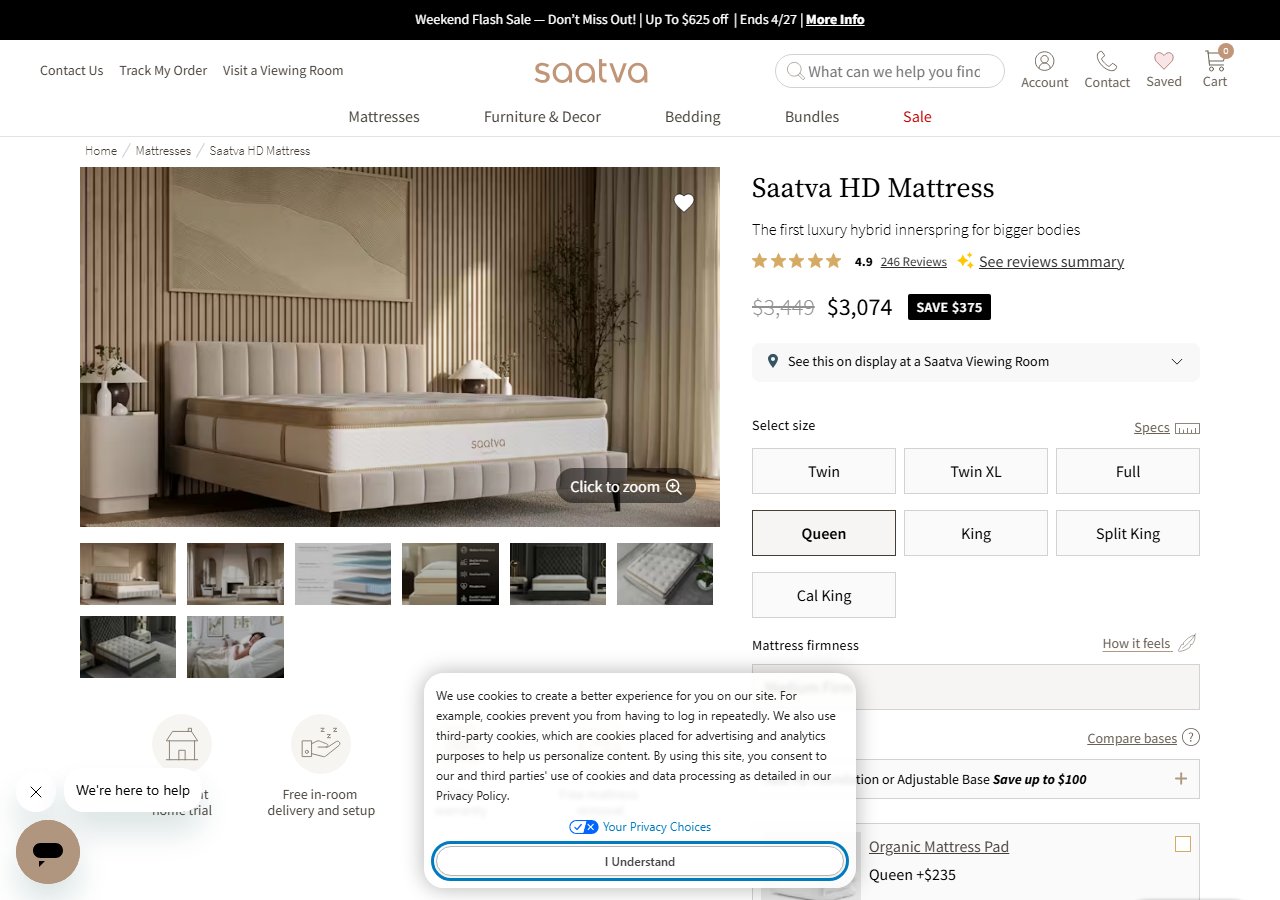
Saatva HD Mattress (Heavy-Duty)
$2,395-$3,995
See Price at Saatva →
Purple Hybrid Premier Mattress
$2,499-$4,799
See Price at Purple →What the federal data actually tells you to do
The hierarchy here is federal-data-supported and consistent across NIOSH, NIH, CDC, and BLS sources: the most effective interventions for warehouse lumbar health are behavioral and mechanical, not product-based. Fixing lifting mechanics at work, building a daily walking habit, correcting sleep position, and maintaining shift-appropriate sleep duration address the primary drivers of cumulative lumbar injury.
A mattress becomes a legitimate variable when the surface itself is actively interfering with recovery — visible sag, weight-architecture mismatch, pressure concentration that disrupts sleep continuity. At that point, the choice is not arbitrary. The biomechanical profile of warehouse work points toward specific features: zoned lumbar support, weight-appropriate construction, pressure relief at hip and shoulder contact zones.
The SSA disability data showing musculoskeletal disorders as the largest category of new disability claims is not inevitable. The interventions are documented. The mechanism is understood. The off-duty recovery window — those 6 to 8 hours on a surface that either supports or undermines spinal repair — is one of the few variables a warehouse worker controls entirely. Making it count is not a luxury decision. It is occupational health maintenance, backed by federal data, and available to anyone willing to address it systematically.