The federal data behind your back pain is more alarming than your foreman admits
If you work in a warehouse — picking orders, driving a forklift, loading trucks, stacking pallets — you already know your back takes punishment every shift. What you may not know is how precisely federal data quantifies that punishment, and how directly it connects to what happens to your body during the eight hours you're supposed to be recovering.
According to BLS Musculoskeletal Disorders by Occupation tracking, the back is the most common body part injured across all U.S. occupations with days away from work. That's not just warehousing — that's every job in America. Warehousing and storage, however, consistently rank among the top sectors for MSD incidence rates. The SOII (Survey of Occupational Injuries and Illnesses) data year after year shows transportation and warehousing workers experiencing nonfatal injury and illness rates that rival construction, a sector most people think of first when they picture workplace injury.
The mechanism isn't subtle. The NIOSH Lifting Equation — the federal standard for evaluating manual material-handling risk — documents that typical warehouse tasks routinely exceed recommended weight limits when you account for load distance from the body, asymmetric lifts, awkward postures, and high frequency. A picker lifting 50-pound totes at arm's length from a low shelf and rotating to place them on a conveyor isn't just lifting 50 pounds: the compressive and shear forces on the lumbar spine in that movement can be multiples of the actual object weight. Do that several hundred times over a 10-hour shift, and you understand why the injury data looks the way it does.
The financial consequences are equally stark. BLS Employer Costs for Employee Compensation data shows that industries with high MSD incidence carry workers' compensation insurance rates 3 to 5 times higher than low-MSD industries. That cost doesn't stay on the employer's ledger — it flows into wage negotiation, benefit structures, and the broader economic pressure on workers in these sectors. Meanwhile, AHRQ HCUP data identifies back pain as one of the most expensive conditions in U.S. healthcare by total inpatient and outpatient cost, and AHRQ MEPS data confirms that adults with chronic back conditions carry substantially higher annual personal healthcare expenditures than those without. The worker paying $40 in weekly co-pays for physical therapy and $80 per month in OTC pain relievers is living this data.
At the most serious end of the spectrum: SSA Disability Insurance reports consistently identify musculoskeletal disorders as the largest single category of new disability claims filed annually. For warehouse workers who feel persistent symptoms and keep pushing through, that long arc of federal data should register as a warning.
Why the back doesn't recover between shifts — the biomechanical logic
Understanding why off-duty hours matter requires a short detour into spinal physiology. The lumbar spine during a warehouse shift functions as both a structural column and a dynamic absorber. Intervertebral discs — the fibrocartilaginous cushions between vertebrae — are hydrophilic: they absorb fluid when unloaded (lying down) and express it under axial compression (standing, lifting). After a sustained shift of compressive loading, discs are measurably more compressed. Studies in occupational biomechanics consistently show that spinal height decreases by several millimeters over a full working day, recoverable only with sustained, pressure-free horizontal rest.
This is where sleep surface quality becomes an occupational health variable, not just a consumer comfort preference. If the sleep surface doesn't permit the spine to decompress — because it sags, because it forces an asymmetric posture, because it places concentrated pressure under the lumbar curve — the disc rehydration cycle is interrupted. The worker wakes the next morning with less intervertebral cushioning than they need before doing it all again. Repeat over years, and you have the structural substrate for disc degeneration, facet arthropathy, and eventually the chronic pain that CDC NCHS Data Brief 390 shows afflicts approximately 20% of U.S. adults, with lower back as the most common pain site.
Shift work compounds the problem. Warehouse operations frequently run 24-hour cycles with rotating shifts. Workers on overnight or rotating schedules fight circadian disruption that CDC sleep data shows is already widespread: roughly 35% of U.S. adults report sleeping fewer than 7 hours per night, the threshold below which chronic disease risk measurably rises. Sleep deprivation also blunts the body's inflammatory regulation — meaning accumulated muscular microtrauma from lifting has less physiological time to resolve. You're not just tired; you're chemically less able to repair the day's damage.
Additionally, CDC arthritis data shows approximately 25% of U.S. adults report doctor-diagnosed arthritis, with prevalence concentrated in occupations involving sustained physical demand. Warehouse workers in their 40s and 50s are more likely than same-age office workers to be in this group — and arthritis changes the calculus on sleep surface firmness, pressure distribution, and positional support in ways that go beyond personal preference.
The cheapest interventions don't require a credit card
Before we discuss equipment, it's worth stating plainly: the cheapest intervention is the one that requires no purchase. Federal occupational health guidance and clinical evidence both support a hierarchy in which behavioral and ergonomic changes precede equipment decisions. Workers who skip this step and go straight to buying often find that a new mattress sits on top of the same sedentary, mechanically risky daily pattern — and does proportionally less.
The four interventions below are drawn directly from NIH, OSHA, and CDC guidance. They are not preliminary caveats to be skimmed — they are the primary intervention tier, with evidence bases that rival or exceed most sleep-surface research.
Daily walking is perhaps the most evidence-supported free intervention for warehouse workers with chronic low back pain. The NIH National Center for Complementary and Integrative Health's evidence review on low back pain concludes that walking 30 minutes most days reduces chronic low back pain as effectively as most non-drug clinical treatments. That's a meaningful finding: not "walking helps a little" but "walking performs comparably to treatments people pay for." For a worker who spends a shift on their feet but rarely in sustained, fluid forward locomotion, intentional post-shift or pre-sleep walking may be the single highest-ROI behavioral change available.
Lifting and bending mechanics during the shift are where most acute episodes originate. OSHA ergonomics guidance is specific: hinge at the hips rather than the lumbar spine, keep loads close to the body, avoid twisting under load. Most acute back episodes are mechanical and — critically — rehearsable. Workers who internalize hip-hinge mechanics reduce the per-lift spinal load that accumulates into end-of-shift degeneration. No equipment required; this is a motor pattern.
Sleep position is the biggest free variable in off-duty spinal recovery. NIH National Institute of Arthritis and Musculoskeletal and Skin Diseases guidance on back pain recommends side-sleeping with a pillow between the knees or back-sleeping with a pillow under the knees — both positions that preserve lumbar neutral alignment. Stomach-sleeping torques the lumbar spine and consistently worsens chronic pain symptoms. For workers who currently stomach-sleep, changing that one habit — using a body pillow to make the side position sustainable — may reduce morning stiffness more than a mattress upgrade.
Mattress replacement triggers are worth naming explicitly. CDC sleep hygiene guidance draws the line clearly: if a mattress shows visible sag, if you consistently wake stiffer than you went to bed, or if it is older than 7 to 10 years, the surface itself has become the problem. Even the most expensive mattress on the market cannot undo poor sleep hygiene or inadequate movement during waking hours — but a genuinely degraded surface is a legitimate structural problem worth addressing.
For workers who have already adjusted their sleep position, are walking regularly, have addressed lifting mechanics, and are sleeping on a mattress that passes the sag-and-age test — and are still waking with lumbar stiffness or pain — a sleep surface upgrade enters the evidence-supported conversation. The products below were selected specifically for the load patterns and body-weight distributions common in warehouse work.
When to see a clinician first — federal red flag criteria
A new mattress is never the right response to certain back pain presentations. NIH National Institute of Neurological Disorders and Stroke guidance on back pain is clear about clinical red flags that require prompt medical evaluation rather than any self-directed intervention. If your back pain radiates below the knee, that's a nerve root sign that needs imaging. If pain follows a traumatic event — a fall, a vehicle accident, a sudden heavy lift — structural injury (fracture, disc herniation) needs to be ruled out before any sleep modification. Leg weakness, foot drop, or changes in bowel or bladder function alongside back pain are neurological emergencies. Fever with back pain can indicate spinal infection. None of these presentations are mattress problems.
More broadly: AHRQ MEPS data documents that adults with chronic back conditions already spend substantially more on healthcare annually than those without. Workers experiencing progressive symptoms — pain that worsens over weeks despite rest, pain that wakes them from sleep, unintentional weight loss alongside back pain — should be moving toward an occupational medicine specialist or primary care provider, not a mattress retailer. The CMS drug spending data showing opioid and non-opioid pain medication among the most expensive Medicare drug categories reflects a downstream cost of undertreated acute conditions that became chronic. Early clinical intervention is financially rational as well as medically appropriate.
Where sleep surface design actually matters for warehouse worker anatomy
With the non-product interventions established and clinical red flags identified, we can discuss sleep surfaces as what they actually are: one adjunct tool in a multi-factor recovery system, worth spending thoughtfully on when the other variables are addressed.
For warehouse workers specifically, three factors drive sleep surface selection in ways that differ from the general back-pain population:
Load tolerance and body-weight distribution. Warehouse work selects for physical capability. Workers in this sector trend toward higher body weights and more muscular mass than sedentary office workers. A mattress engineered for a 150-pound person will perform differently under a 220-pound person — it will compress more quickly through comfort layers to an underlying support core that may be too firm or too soft for that weight. Mattresses designed for higher weight ranges use denser foam formulations, heavier coil gauges, and deeper support cores that maintain their intended feel over a larger mass range.
The Saatva HD Mattress is explicitly engineered for this load profile — it's Saatva's heavy-duty build, designed for body weights up to 500 pounds, using a lumbar zone support layer that provides targeted reinforcement under the lower back. For a warehouse worker with a larger frame who has watched previous mattresses sag prematurely in the center, this is the construction approach that addresses the mechanical failure mode directly. Individually wrapped coils in two tiers prevent the motion transfer and lateral sag that accelerate with higher-weight use. The price range of $2,395 to $3,995 reflects the material density required to hold up under sustained load — this is not a margin play on luxury branding.
Pressure relief at concentrated contact points. After a shift of sustained mechanical loading, the lumbar spine and hips are the highest-pressure zones at sleep contact. Memory foam has the best-documented pressure-relief profile for these concentrated areas, because it conforms to body contour rather than creating localized high-pressure contact points. However, not all memory foam performs identically — density, ILD (indentation load deflection), and base foam composition all determine how the material behaves under sustained weight over time.
The Saatva Loom & Leaf Memory Foam Mattress is Saatva's premium memory foam build — a hand-crafted, gel-infused layered foam construction with a spinal zone support layer built directly into the design. The gel infusion addresses the thermal retention problem that leads many heavier sleepers to abandon memory foam (foam that traps heat disrupts sleep architecture, counteracting the recovery benefit). At $1,695 to $3,295 depending on size, the Loom & Leaf is the primary recommendation for warehouse workers with significant lumbar pain who are side or back sleepers and want the pressure-conforming properties of foam over the responsiveness of a hybrid.
Temperature regulation under sustained contact. This matters more for warehouse workers than it might seem. Physical laborers run hotter than sedentary workers — elevated resting muscle tension, higher metabolic baseline, and the residual heat from a physically active shift all elevate sleep temperature. Foam mattresses that don't manage heat actively can push core body temperature high enough to fragment sleep architecture. The Purple Hybrid Premier Mattress addresses this with Purple's GelFlex Grid — a polymer grid structure that doesn't conduct heat the way dense foam does, while simultaneously providing pressure relief through its column-buckling design. The Grid collapses under concentrated pressure points (shoulders, hips, lumbar) and stays firm under distributed support zones (legs, torso perimeter), creating a pressure map profile that's distinct from both coil and foam systems. For warehouse workers who run hot or have found that memory foam causes them to wake sweating, the Purple Hybrid Premier — at $2,499 to $4,799 — is the temperature-neutral pressure-relief option.
Sleep Surfaces Matched to Warehouse Worker Recovery Needs
These three mattresses were selected specifically for the load-tolerance, pressure-relief, and temperature-regulation demands of warehouse workers managing chronic lumbar strain — not for general audience appeal.

Saatva Loom & Leaf Memory Foam Mattress
$1,695-$3,295
See Price at Saatva →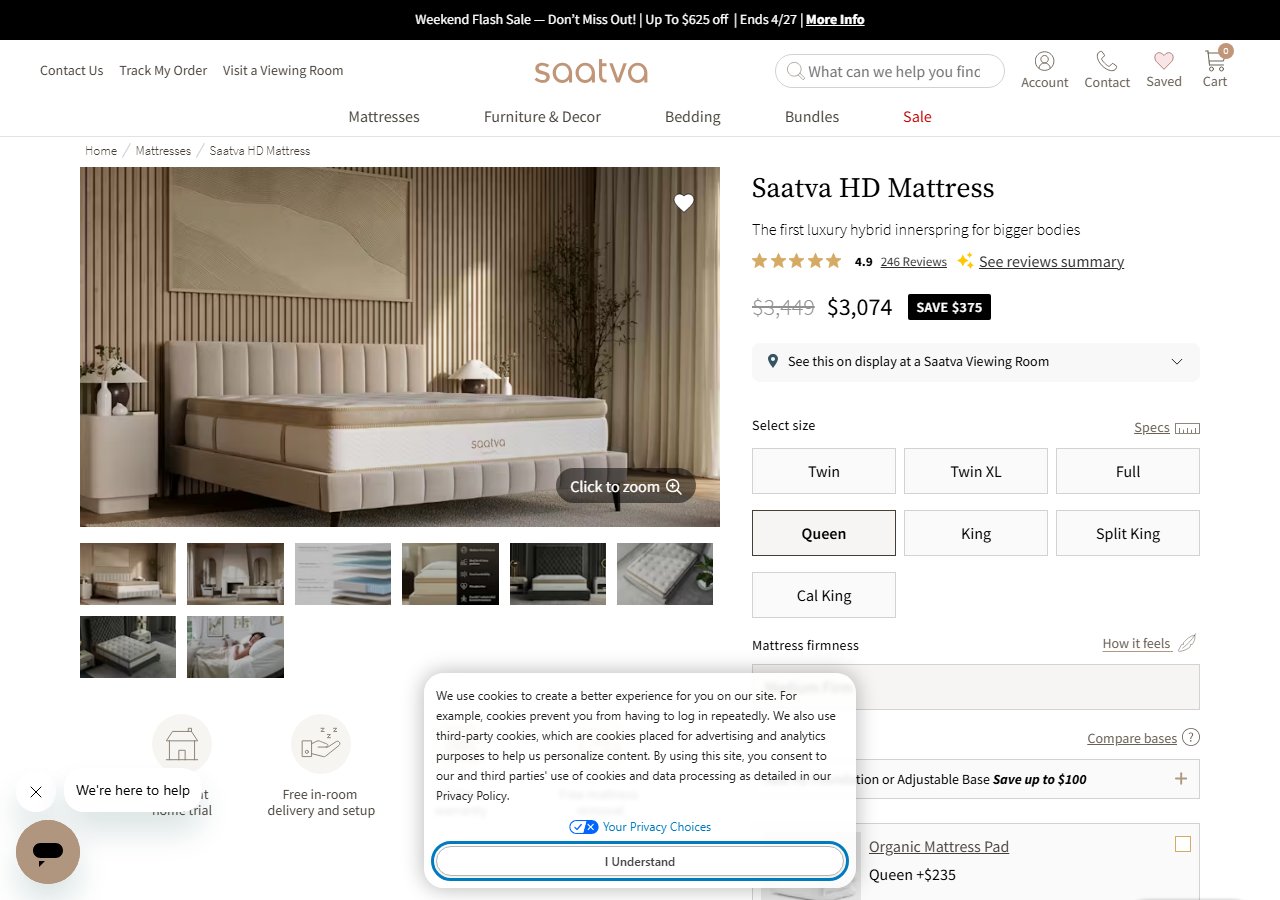
Saatva HD Mattress (Heavy-Duty)
$2,395-$3,995
See Price at Saatva →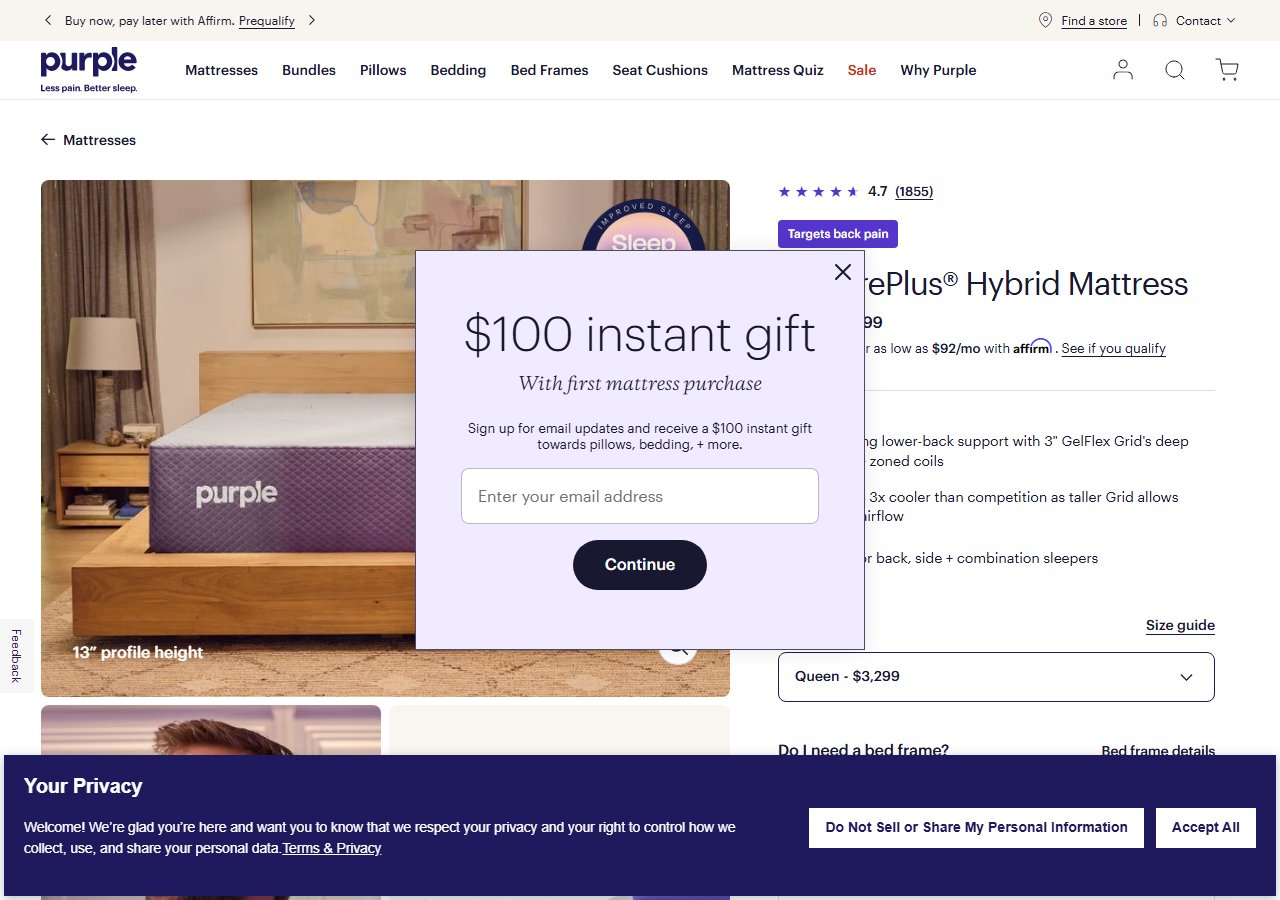
Purple Hybrid Premier Mattress
$2,499-$4,799
See Price at Purple →Putting it together: the federal data-to-recovery hierarchy
Let's be direct about what this article has argued and what it hasn't.
Federal data — BLS SOII, NIOSH Lifting Equation, CDC sleep surveillance, AHRQ MEPS and HCUP, SSA disability statistics — collectively paint a picture of warehouse work as one of the highest MSD-burden occupations in the U.S. economy. That burden doesn't end at the time clock. The spinal compression, cumulative disc loading, and inflammatory response from a full warehouse shift extend into off-duty hours, and the quality of physiological recovery during sleep is a legitimate occupational health variable.
The appropriate response to that data, in order of evidence strength and cost:
Adjust movement patterns first. Daily walking, hip-hinge mechanics, neutral sleep position — these are zero-cost interventions with federal evidence support that matches or exceeds most equipment claims.
Address clinical symptoms before equipment. Red-flag back pain requires medical evaluation. Workers experiencing neurological symptoms, pain following trauma, or progressive worsening need a clinician, not a mattress.
Evaluate the existing sleep surface objectively. Sagging, aging, and consistent wake-stiffness are legitimate indications for replacement. A degraded mattress is a mechanical problem.
When replacing, match construction to the biomechanical reality of warehouse work. Load tolerance, pressure relief, and temperature regulation are the three functional dimensions that matter most for this worker profile. The Saatva HD addresses load tolerance; the Saatva Loom & Leaf addresses pressure-conforming foam recovery; the Purple Hybrid Premier addresses heat and pressure simultaneously through grid technology.
None of these products are presented as cures for occupational MSD. The BLS data on back injury rates in warehousing reflects a systemic workplace exposure problem that individual consumer decisions cannot solve. What a worker can control is the quality of their off-duty recovery environment — and making that environment evidence-informed rather than marketing-driven is exactly what federal occupational health data supports.