The federal data on your back pain is unambiguous
If you work in a warehouse and your lower back hurts by the end of a shift, you are not unusual — you are statistically expected. BLS Musculoskeletal Disorders by Occupation tracking confirms that the back is the single most commonly injured body part across all U.S. occupations with days away from work. Not just in warehousing. Across every industry sector the Bureau of Labor Statistics monitors. Warehousing consistently sits among the highest-incidence sectors because the job is essentially a stress-test of the lumbar spine performed eight to twelve hours at a stretch.
The financial weight behind that injury rate is staggering. AHRQ's Healthcare Cost and Utilization Project (HCUP) identifies back pain as one of the most expensive conditions in U.S. healthcare by total inpatient and outpatient cost. AHRQ's Medical Expenditure Panel Survey (MEPS) reinforces this: adults with chronic back conditions carry annual personal healthcare expenditures that substantially exceed those of adults without back disorders. And CMS drug spending data shows opioid and non-opioid pain medication spending ranks among the most expensive Medicare drug categories — a direct downstream consequence of the chronic-pain treatment burden that warehouse-level spinal loading helps create.
The trajectory, if ignored, can become permanent. SSA Disability Insurance Reports identify musculoskeletal disorders as the largest single category of new disability claims filed annually in the United States. That is not a minor footnote. It means that the lower back pain a warehouse worker dismisses as a normal part of the job is the same category of injury that ends careers and produces disability claims at a scale no other condition matches.
Why this happens: the biomechanics of warehouse spinal loading
Understanding why warehouse work degrades the lumbar spine faster than most occupations requires a short anatomy detour. The lumbar vertebrae — L1 through L5 — are load-bearing structures, but they were not engineered for the repetitive, asymmetric, and often twisting loads that warehouse work applies hour after hour. The intervertebral discs that cushion those vertebrae have limited blood supply and repair themselves slowly. Every lift, every reach into a low bin, every awkward turn with a loaded pallet jack applies compressive and shear forces to those discs.
NIOSH's Lifting Equation — the federal standard for evaluating manual material-handling risk — documents that warehouse, construction, and healthcare tasks routinely exceed safe spinal loading limits. NIOSH defines a Recommended Weight Limit (RWL) and a Lifting Index (LI); when a task's LI exceeds 1.0, injury risk increases meaningfully. Most warehouse order-picking tasks, especially those involving floor-level retrieval or overhead placement, produce an LI well above that threshold. Workers doing 200 to 400 such lifts per shift are accumulating spinal stress that cannot be fully recovered during any single night of sleep — but the quality of that recovery sleep still matters enormously for how much damage compounds over months and years.
Shift work adds another layer of physiological damage. Circadian disruption — common among workers rotating between day, evening, and overnight shifts — degrades the body's ability to repair connective tissue during sleep. Growth hormone, which plays a central role in musculoskeletal repair, is secreted primarily during deep slow-wave sleep. Fragmented or shortened sleep reduces slow-wave sleep duration. CDC sleep data shows 35% of U.S. adults already sleep fewer than seven hours per night, the threshold below which chronic disease risk rises significantly. Among shift workers, that number is almost certainly higher. The result: the spine does not get the overnight recovery window it needs, so each shift starts from a slightly more degraded baseline than the last.
CDC NCHS Data Brief 390 puts the population-level outcome in focus: approximately 20% of U.S. adults experience chronic pain, with lower back as the most common site. Among warehouse workers and other sustained-demand occupations, the prevalence is higher. CDC Arthritis Data adds that approximately 25% of U.S. adults report doctor-diagnosed arthritis, with prevalence concentrated in physically demanding occupations — a condition that accelerates when joints are insufficiently recovered between loading cycles.
The cost of inadequate recovery is not abstract. BLS Employer Costs for Employee Compensation data shows that industries with high MSD incidence carry workers' compensation insurance rates 3–5 times higher than low-MSD industries. That premium ultimately reflects the aggregate cost of insufficient recovery — from insufficient rest time, insufficient biomechanical support during sleep, and insufficient intervention before acute injuries become chronic disabilities.
Try these first — the interventions that cost nothing
Before discussing mattress construction, it is worth being direct: the cheapest intervention is the one that does not require buying anything. A new mattress addresses one variable — the surface your spine rests on for seven to eight hours. The other 16 to 17 waking hours, including every lift, every step, and every seated recovery moment, are where the majority of spinal loading occurs. Federal occupational health guidance is consistent on this point: behavioral and movement-based interventions have the strongest evidence base for reducing chronic low back pain, and most of them are free.
Specifically, OSHA's ergonomics guidance emphasizes that most acute back episodes in warehousing are mechanical and rehearsable — meaning that relearning lift mechanics (hinge at the hips, not the lumbar spine; keep loads close to the body; avoid twisting under load) prevents the acute episodes that become chronic injuries. And NIH NCCIH's evidence review on low back pain concludes that walking 30 minutes most days reduces chronic low back pain as effectively as most non-drug clinical treatments. That is a federal evidence synthesis, not marketing copy. Movement is the primary lever.
Sleep position, similarly, is a free variable with meaningful impact. NIH back pain guidance from NIAMS recommends side-sleeping with a pillow between the knees, or back-sleeping with a pillow under the knees, to maintain lumbar neutrality overnight. Stomach-sleeping torques the lumbar spine and is consistently associated with worsened chronic back pain. If you currently stomach-sleep, retraining that habit — even partially — costs nothing and may reduce morning stiffness more than a mattress upgrade.
Finally, CDC sleep hygiene guidance offers a practical replacement rule for mattresses specifically: replace a mattress if it has visible sag, you wake stiffer than you went to bed, or it is older than 7–10 years. If none of those conditions apply, the mattress is probably not the primary variable. Even the most engineered sleep surface does not undo poor sleep hygiene or sedentary recovery days.
For warehouse workers who have already optimized sleep position, are walking regularly, and are using proper lift mechanics — and are still waking with significant lumbar stiffness — the mattress surface itself becomes the next variable worth addressing. The evidence for targeted mattress construction in back-pain management is real, though more limited than the evidence for movement. What the research does support clearly is that mattresses producing pressure points at the hips and shoulders create compensatory spinal misalignment during sleep, and that mattresses lacking adequate lumbar support allow the lower back to sink into flexion — exactly the opposite of the neutral spine position the back needs for overnight tissue repair.
When to see a clinician before buying anything
Some warehouse workers reading this article should see a physician before evaluating any sleep surface — because what they are experiencing is not a mattress problem. NIH's National Institute of Neurological Disorders and Stroke specifies the red flags that require prompt clinical evaluation: back pain that radiates below the knee, pain that developed following trauma, pain accompanied by leg weakness, and any back pain presenting alongside bowel or bladder changes or fever. These are not symptoms that a new mattress will address. They may indicate disc herniation with nerve compression, cauda equina syndrome, or systemic pathology — conditions where a delay in clinical care can produce permanent neurological damage.
If your back pain is dull, positional, and predictably worse after long shifts and better after rest, that pattern is consistent with mechanical low back pain — the most common presentation among warehouse workers — and is the context in which sleep surface evaluation makes sense. If the pain is sharp, unrelenting, wakes you from sleep regardless of position, or is accompanied by any of the red-flag symptoms above, stop reading product reviews and book a clinical appointment. The federal guidance is unambiguous on this hierarchy.
Where mattress construction actually matters for warehouse workers
With the mechanism, free interventions, and clinical red flags established, the question of mattress selection becomes more tractable. Warehouse workers have a specific set of requirements that differ from the general back-pain population in important ways.
First, body weight distribution matters more in this population. Order selectors, forklift operators, and receiving dock workers who are carrying extra mass from years of physical work — or who are simply larger-framed individuals — experience greater pressure on standard mattress support cores than the average consumer the mattress industry designs for. A mattress that provides adequate lumbar support for a 160-pound office worker may allow the hips of a 240-pound warehouse worker to sink through the comfort layer into the coil or foam core, producing the exact lumbar flexion that overnight recovery is supposed to reverse.
Second, pressure relief at the hips and shoulders is critical for side-sleepers — and side-sleeping is what federal guidance recommends for back pain. A mattress that is too firm will create pressure points at the greater trochanter (the hip's bony prominence) and the shoulder, causing the sleeper to unconsciously shift positions repeatedly throughout the night. That fragmented sleep reduces slow-wave sleep duration, which reduces growth hormone secretion, which reduces musculoskeletal repair. A mattress that is appropriately pressure-relieving allows those bony landmarks to sink just enough into the comfort layer while the lumbar spine remains supported.
Third, heat retention is a practical concern for shift workers who may be returning home from a physically demanding shift with an elevated core body temperature. Foam mattresses that trap heat can disrupt sleep onset and sleep quality in this population in ways that may not affect the general population.
With those specific requirements in mind, three mattress constructions stand out for the warehouse worker profile.
The Saatva Loom & Leaf Memory Foam Mattress is the premium memory foam pick for warehouse workers experiencing serious lumbar fatigue. Loom & Leaf uses high-density memory foam with a spinal zone support insert — a targeted firm layer beneath the lumbar region that resists the hip sinkage that causes overnight lumbar flexion. The American Chiropractor Association has recognized Saatva's design approach, and the mattress ships with a free in-home setup that includes removal of your old mattress, which matters for workers who do not need another heavy-lifting task on a recovery day. At $1,695–$3,295 depending on size, it is a meaningful investment, but one that should be evaluated against AHRQ MEPS data showing that chronic back condition sufferers carry substantially higher annual healthcare costs — costs that a functional sleep surface may help reduce over time.
For warehouse workers who are larger-framed, heavier, or simply putting more total load through a mattress than average, the Saatva HD Mattress was specifically engineered for this load pattern. The HD is rated for higher weight capacities than standard mattresses and uses a dual-layer coil system — individually wrapped coils over a high-gauge tempered steel base coil layer — that maintains consistent lumbar support under higher compression than a single-coil or all-foam system can provide. This is the only mattress on this list explicitly designed around heavy-duty use cases, which maps directly to the body composition profile of many experienced warehouse workers. At $2,395–$3,995, it sits at the higher end of the range, but for workers who have experienced premature support-core failure in standard mattresses — the sag and dip that CDC's sleep hygiene guidance flags as a replacement signal — the HD's engineering addresses the root cause rather than the symptom.
The third option, the Purple Hybrid Premier Mattress, approaches the pressure-relief problem from a different materials science direction. Purple's GelFlex Grid — a polymer grid structure rather than a foam layer — simultaneously provides pressure relief at the hip and shoulder while maintaining firmness at the lumbar spine. This is mechanically distinct from traditional memory foam: the grid collapses under point pressure (at bony prominences) while remaining rigid under distributed pressure (along the lumbar region). For warehouse workers who sleep hot or who find traditional memory foam traps them in a single position, the open structure of the GelFlex Grid provides airflow that foam cannot match. At $2,499–$4,799, it is the premium pressure-relief option on this list, and it makes most sense for side-sleeping workers who find firm mattresses produce hip and shoulder soreness on top of their existing lumbar complaints.
Mattresses Built for Warehouse Worker Lumbar Recovery
Each of these mattresses was selected for the specific load patterns, body composition ranges, and sleep position requirements documented in federal occupational health data for warehouse workers — not for the general back-pain population.

Saatva Loom & Leaf Memory Foam Mattress
$1,695-$3,295
See Price at Saatva →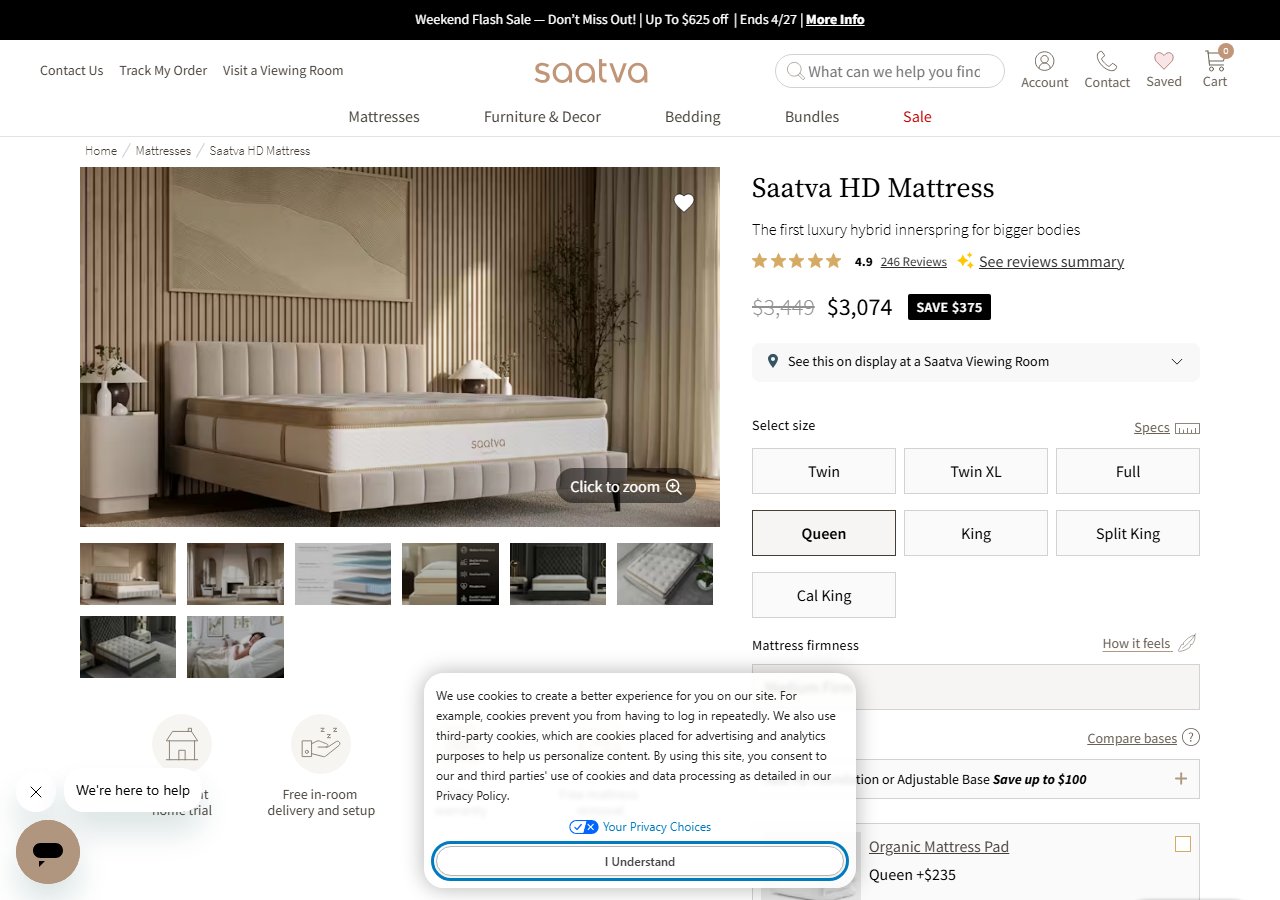
Saatva HD Mattress (Heavy-Duty)
$2,395-$3,995
See Price at Saatva →
Purple Hybrid Premier Mattress
$2,499-$4,799
See Price at Purple →The data-to-intervention hierarchy: what to take away
Federal data from BLS, NIOSH, CDC, AHRQ, and SSA tells a consistent story about warehouse work and spinal health: the loading is real, the cumulative damage is real, and the downstream cost — in healthcare expenditure, workers' compensation premiums, and disability claims — is among the highest of any occupational injury category in the country. That context matters when evaluating any intervention, including sleep surface selection.
A mattress is not a treatment. It does not undo spinal loading, does not replace movement, does not substitute for clinical evaluation when red flags are present. What a properly matched mattress does is remove one variable that compounds the injury cycle: the eight hours per night during which the spine either recovers in a supported neutral position, or degrades further in an unsupported flexed one.
For warehouse workers, the hierarchy is: fix your lift mechanics first (OSHA), walk daily (NIH NCCIH), optimize sleep position (NIH NIAMS), replace a visibly sagged or chronically stiffness-producing mattress (CDC), see a clinician if red flags are present (NIH NINDS), and then — if a mattress upgrade is warranted — choose one engineered for the specific load patterns, body composition, and sleep position that warehouse work produces. The three options evaluated here — the Saatva Loom & Leaf, the Saatva HD, and the Purple Hybrid Premier — each address one or more of those specific variables in ways that general-population mattresses do not.