The federal data on warehouse back injuries is blunt
If you work in a warehouse and your lower back aches every morning, you are not experiencing bad luck. You are experiencing a statistically predictable outcome of one of the most physically demanding occupations in the American economy. According to BLS Musculoskeletal Disorder tracking, the back is the single most commonly injured body part across all U.S. occupations that result in days away from work. Warehousing and storage consistently ranks among the highest-incidence sectors in that data. These are not soft findings from a small sample — they are surveillance numbers drawn from the BLS Survey of Occupational Injuries and Illnesses (SOII), which covers hundreds of thousands of establishments annually.
The financial scale of this problem is equally stark. AHRQ HCUP data identifies back pain as one of the most expensive conditions in U.S. healthcare measured by total inpatient and outpatient cost. AHRQ MEPS data shows that average annual personal healthcare expenditures for adults with chronic back conditions substantially exceed those for adults without such conditions. And at the system level, SSA Disability Insurance data identifies musculoskeletal disorders — the category that includes chronic back conditions — as the single largest source of new disability claims each year in the United States. The stakes are not abstract.
Why warehouse work breaks the lumbar spine specifically
Understanding why this happens requires a brief detour into biomechanics, because the mechanism is what determines both the intervention and the sleep surface choice.
The lumbar spine — the five vertebrae between the ribcage and the pelvis — is designed to bear compressive load in a neutral, slightly lordotic (inward-curved) position. Warehouse work systematically violates that condition in three compounding ways.
First: repetitive high-load lifting. The NIOSH Lifting Equation was developed specifically to quantify spinal compression during manual material handling. It expresses acceptable lift limits in terms of a Recommended Weight Limit (RWL) and a Lifting Index (LI). When the LI exceeds 1.0, workers are at elevated risk for lumbar injury. NIOSH documentation is explicit: tasks across warehousing, construction, and healthcare routinely produce Lifting Index scores above 1.0, and often well above it. A worker pulling orders, loading trailers, or moving palletized freight is frequently exceeding the compressive loading threshold the spine can sustain without cumulative microtrauma.
Second: sustained posture without recovery. Warehouse shifts often run 10 to 12 hours. Sustained forward flexion — bending repeatedly to pick from lower racks, leaning into conveyor belts, hunching over scanning equipment — loads the posterior disc annulus repeatedly without allowing the nucleus pulposus (the gel center of the spinal disc) to rehydrate. Over hours and years, this degrades disc height and load-sharing capacity. The intervertebral discs are not vascularized; they depend on cyclical compression and decompression — movement — to absorb nutrients. Sustained static posture starves them.
Third: vibration from equipment. Forklift operation and order-picker use expose the spine to whole-body vibration (WBV), a risk factor for lumbar disc degeneration that is separate from static load. European occupational health guidelines have set WBV exposure limits precisely because the evidence linking it to disc pathology is robust. U.S. OSHA has not promulgated a WBV standard, but the underlying biology is not jurisdiction-dependent.
The cumulative result of these three stressors is a lumbar spine that arrives home at the end of a shift in a state of compression, microtrauma, and fatigue — and then has to recover during whatever hours of sleep the worker gets. CDC sleep data shows approximately 35% of U.S. adults report sleeping fewer than 7 hours per night, the threshold the CDC associates with elevated chronic disease risk. For shift workers — who disproportionately include warehouse employees — the sleep deficit is often worse, compounded by irregular schedules, overnight shifts, and the physiological difficulty of sleeping against the circadian clock.
This is the compounding trap: the occupation degrades the spine, the sleep deficit prevents adequate tissue recovery, and the worker wakes up less recovered than they went to bed. CDC NHANES data confirms that approximately 20% of U.S. adults experience chronic pain, with lower back as the most common pain site. Among workers in physically demanding occupations, that prevalence is concentrated further. CDC arthritis surveillance places doctor-diagnosed arthritis prevalence at approximately 25% of U.S. adults, with incidence highest in occupations involving sustained physical demand — precisely the profile of warehouse work.
The employer-side costs are also measurable. BLS Employer Compensation Cost data shows that industries with high MSD incidence carry workers' compensation insurance rates 3-5 times higher than low-MSD industries. The back injury burden is priced into the cost structure of warehousing as a sector — which means it is not an aberration, it is the baseline expectation. And at the individual level, CMS drug spending data identifies opioid and non-opioid pain medication as among the most expensive Medicare drug categories, reflecting the downstream treatment burden of untreated chronic musculoskeletal pain.
The cheapest intervention is the one that does not require buying anything
Before any conversation about sleep surfaces, four interventions deserve priority attention. Not because products are ineffective, but because interventions that cost nothing — and that address the mechanism directly — are always the correct first step. A $3,000 mattress placed under a worker who still lifts with a rounded lumbar spine and sleeps on their stomach will not produce meaningful recovery gains.
Lift mechanics are rehearsable. OSHA's ergonomics guidance is unambiguous: hinge at the hips rather than the lumbar spine, keep loads close to the body's center of mass, and avoid twisting under load. Most acute back episodes are mechanical — they result from a specific movement pattern that can be identified and corrected. The intervention cost is zero. The injury rate reduction when lifting mechanics are systematically improved in warehousing operations is well-documented in NIOSH literature.
Sleep position is the biggest free variable in off-duty recovery. NIH guidance from the National Institute of Arthritis and Musculoskeletal and Skin Diseases recommends side-sleeping with a pillow between the knees, or back-sleeping with a pillow under the knees, to maintain spinal neutrality during sleep. Stomach-sleeping torques the lumbar spine into extension and cervical rotation simultaneously — a position that sustains mechanical load on the posterior disc elements for the entire sleep cycle. Changing sleep position costs nothing and can reduce morning stiffness within days.
Daily walking outperforms most passive interventions. The NIH National Center for Complementary and Integrative Health evidence review on low back pain concludes that walking 30 minutes on most days reduces chronic low back pain as effectively as most non-drug clinical treatments. This is counterintuitive to workers who spend their shifts on their feet — but the distinction matters. Warehouse movement is asymmetric, repetitive, and load-bearing. Walking is rhythmic, bilateral, and self-paced. It promotes disc rehydration, activates the paraspinal stabilizers without imposing high compressive load, and has a meaningful effect on systemic inflammation. It is not the same as the movement workers are already doing.
Mattress replacement criteria are specific. CDC sleep hygiene guidance and clinical consensus both point to visible sag, waking stiffer than you went to bed, or a mattress older than 7-10 years as the threshold for replacement. Before spending anything, assess whether the current sleep surface meets these criteria. A mattress that is structurally intact but sitting on a broken or inadequate foundation — a sagging box spring, a platform bed with wide slat gaps — can fail to deliver its rated support regardless of construction quality.
For workers who have addressed sleep position, lifting mechanics, and daily movement — and who are still waking stiff, still not recovering between shifts, and sleeping on a mattress that meets the replacement criteria above — a sleep surface upgrade is a legitimate investment in occupational health. The evidence base for mattress firmness and back pain is not as robust as physical therapy trials, but the sleep surface is the literal foundation of the recovery window. For a worker logging 10- to 12-hour physically demanding shifts, that window is not optional.
When to see a clinician before you buy anything
Some back pain presentations in warehouse workers are not sleep-surface problems. They are medical problems that require imaging, referral, or urgent care — and no mattress addresses them.
NIH National Institute of Neurological Disorders and Stroke back pain guidance identifies a specific set of red flags that warrant prompt clinical evaluation rather than self-management. These include back pain that radiates below the knee (suggesting nerve root involvement or disc herniation with radiculopathy), pain that follows significant trauma, pain accompanied by leg weakness or sensory changes, and pain that comes with bowel or bladder dysfunction — the last of which can indicate cauda equina syndrome, a surgical emergency. Fever with back pain raises the possibility of spinal infection. Night pain that wakes you from sleep and does not respond to position change can indicate a space-occupying lesion.
For warehouse workers specifically, the occupational exposure to high repetitive spinal load raises the prior probability of disc pathology compared to sedentary workers. A worker in their 40s or 50s with years of warehouse experience reporting progressively worsening sciatica — pain, numbness, or tingling that tracks down the leg along a dermatomal pattern — needs an MRI and a physiatrist or orthopedic spine evaluation, not a new mattress. The mattress may help with sleep comfort once the structural diagnosis is established, but it is not the primary intervention.
The rule of thumb: if the pain is new, severe, worsening, or accompanied by any of the neurological or systemic red flags above, see a clinician first. If the pain is chronic, positional, worse in the morning and improves with movement, and has been evaluated without finding a structural emergency — that is the profile where sleep surface, sleep position, and movement interventions have the strongest evidence base.
Where sleep surfaces fit into the recovery picture
For warehouse workers who have cleared the clinical threshold — chronic mechanical low back pain without red flags, sleeping on a mattress that meets replacement criteria — the question becomes what sleep surface construction best supports lumbar recovery.
The biomechanical requirements are specific to this reader. Warehouse workers tend to be heavier than the average sleep study participant (physical labor selects for larger body mass), they may sleep irregularly due to shift schedules, and their lumbar spines arrive at bedtime in a state of compression fatigue rather than simple disuse stiffness. The sleep surface needs to do three things: maintain spinal neutrality across varying sleep positions, provide adequate pressure relief at the shoulders and hips to allow side-sleeping without shoulder impingement, and sustain those properties over time under higher body weight loads.
The Saatva Loom & Leaf Memory Foam Mattress is the premium memory foam pick for warehouse workers with serious chronic back pain who side-sleep or combination-sleep. Saatva constructs it with a 4-pound density memory foam comfort layer — denser than the 2-3 pound foam used in most mass-market mattresses — which means the contouring is pressure-responsive rather than just soft. The lumbar zone includes a spinal zone support insert that maintains the natural lordotic curve under the lower back while the comfort layers decompress the hip and shoulder. For a worker whose posterior disc elements have been under flexion load for 10 hours, sleeping in a position that finally allows the lumbar curve to restore is not a luxury — it is tissue recovery. The Loom & Leaf comes in Relaxed Firm and Firm options; for warehouse workers, Relaxed Firm is typically the right call unless the worker is above 230 pounds, in which case Firm provides better sag resistance.
For larger-framed workers — the worker who weighs 220, 250, or more pounds and has watched standard mattresses develop body impressions within two years — the Saatva HD Mattress is the most purpose-built option on this list. Saatva HD is engineered specifically for heavy-duty use: it uses a dual-tempered steel coil system with a higher coil count and wire gauge than the standard Saatva Classic, plus a Lumbar Zone Active support system targeting the L1-L5 region directly. The weight capacity is rated to 500 pounds per side. This is not marketing language for a minor construction upgrade — it is a meaningfully different mattress built for a body type and body weight that standard mattress QC does not optimize for. A 270-pound forklift operator who has gone through two mid-tier mattresses in four years is not buying the wrong mattress firmness; they are buying mattresses not built for their load.
The Purple Hybrid Premier Mattress takes a different engineering approach that is worth understanding for warehouse workers who run hot or who have pronounced hip or shoulder pain alongside their lumbar issues. Purple's GelFlex Grid is a polymer grid structure — neither foam nor coil — that responds to pressure by collapsing under high-pressure points (hips, shoulders) while remaining rigid under low-pressure areas (lumbar, calves). The result is pressure relief without the sinking sensation that makes deep foam feel supportive initially but difficult to reposition from during the night. The Hybrid Premier adds a pocketed coil support layer beneath the grid, which improves edge support and makes the surface feel more responsive under the weight of heavier users. For a warehouse worker who runs hot on a memory foam surface or who finds the immobilizing quality of deep foam worsens morning stiffness, the Purple grid system offers a meaningfully different pressure-relief mechanism.
Sleep Surfaces Built for Warehouse Worker Lumbar Recovery
These three mattresses were selected specifically for the load patterns, body types, and sleep position needs of warehouse workers recovering from chronic lumbar strain — not for general audiences.

Saatva Loom & Leaf Memory Foam Mattress
$1,695-$3,295
See Price at Saatva →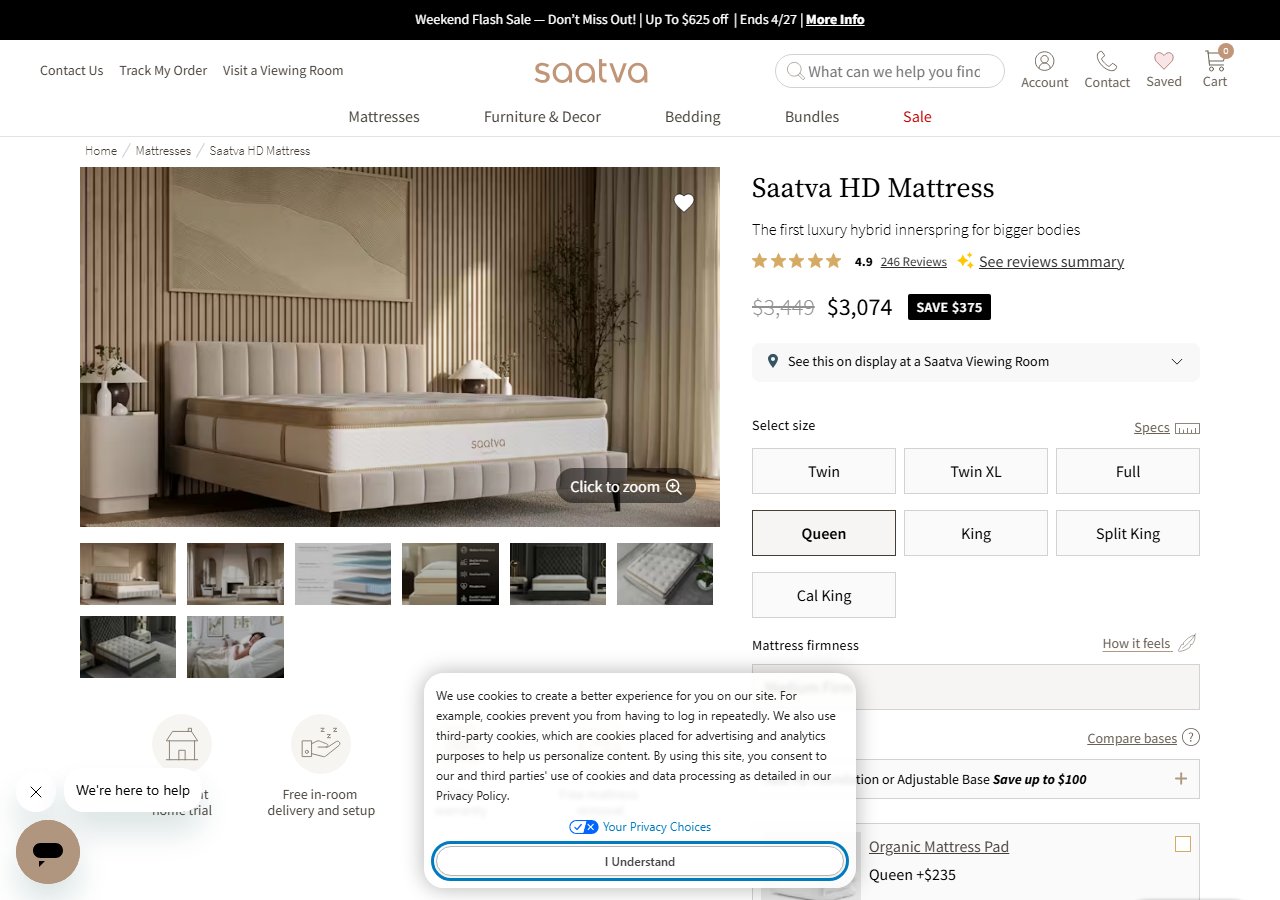
Saatva HD Mattress (Heavy-Duty)
$2,395-$3,995
See Price at Saatva →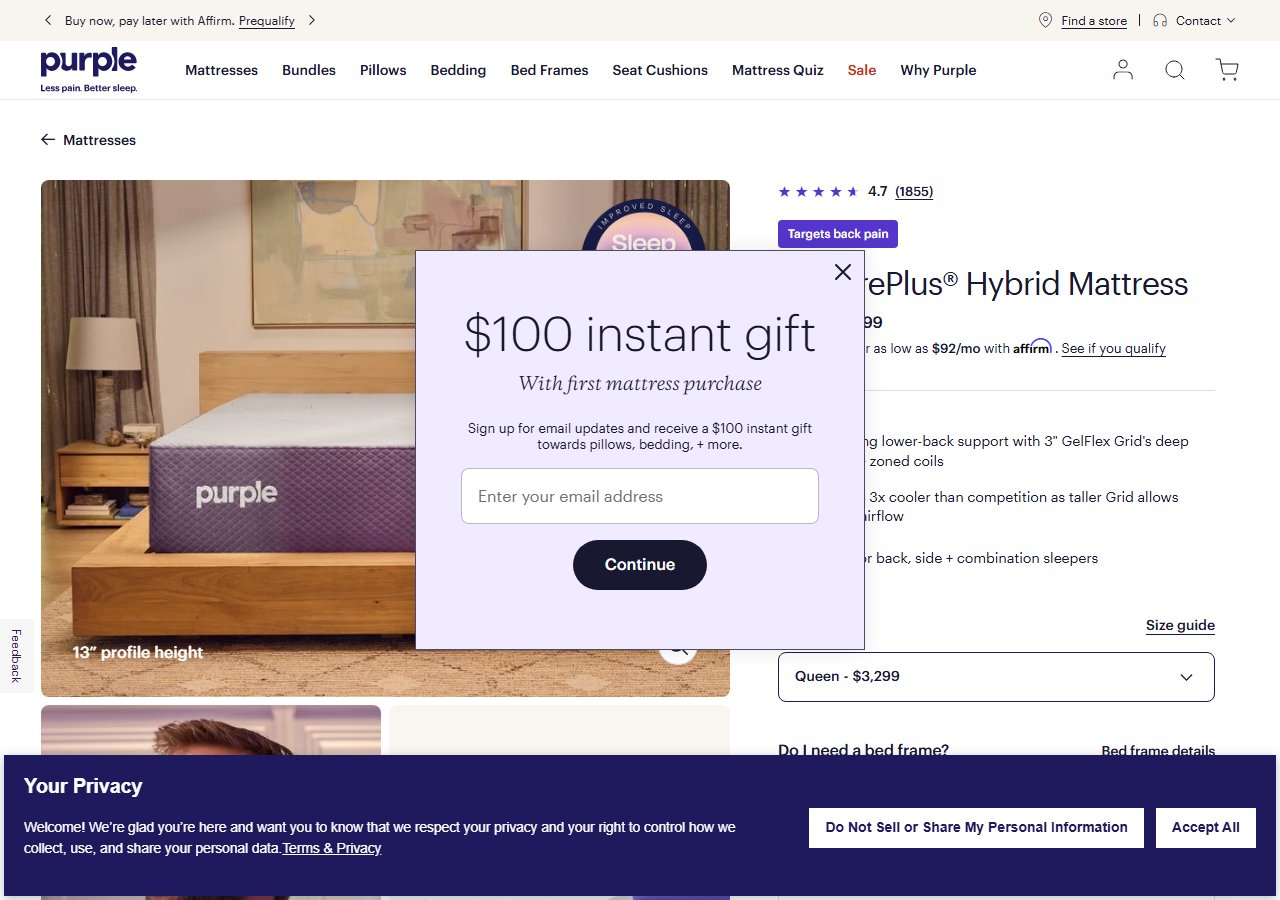
Purple Hybrid Premier Mattress
$2,499-$4,799
See Price at Purple →Putting it together: the data-to-intervention-to-product hierarchy
The federal data creates a clear picture. BLS injury surveillance documents that warehouse work produces back injuries at rates that should be treated as occupational hazards, not individual bad luck. The NIOSH Lifting Equation explains the mechanism: spinal load during manual material handling routinely exceeds safe limits. CDC sleep data shows that the recovery window — the 7-plus hours of sleep where disc rehydration and tissue repair occur — is itself compressed for a third of the U.S. adult population, and likely for more among shift workers. The downstream costs, catalogued by AHRQ, SSA, and CMS, are enormous.
The intervention hierarchy follows from the mechanism. Fix lifting mechanics — the OSHA-documented approach — first, because it addresses the injury at the point of generation. Optimize sleep position — the NIH-recommended approach — next, because it costs nothing and directly affects the lumbar loading environment during the recovery window. Walk 30 minutes daily — the NIH NCCIH evidence-reviewed intervention — because it is as effective as most non-drug clinical treatments for chronic low back pain. Evaluate whether the current mattress meets replacement criteria using CDC sleep hygiene guidance. Seek clinical evaluation if any red flags are present, per NIH NINDS criteria.
Then — and only then — consider a sleep surface built for the specific biomechanical demands of warehouse work. The Saatva Loom & Leaf for workers with serious chronic back pain who need zoned lumbar support. The Saatva HD for workers above 220 pounds who have watched standard mattresses fail under their load. The Purple Hybrid Premier for workers whose primary complaint is pressure-point pain or heat retention that disrupts sleep architecture. None of these are magic. All of them are tools — high-quality tools — that perform meaningfully better than a worn-out or unsuitable sleep surface when the worker has also addressed the behavioral and occupational inputs that the federal data identifies as primary drivers.
Back injuries in warehouse work are predictable. The recovery path, mapped by federal data and occupational health science, is also predictable. The workers who navigate it best are the ones who treat the whole system — not just the mattress.