The Federal Data Behind Your Morning Back Pain
If you work in a warehouse and wake up every morning feeling like you slept on concrete, you are not imagining things — and you are not alone. BLS Musculoskeletal Disorders by Occupation data identifies the back as the single most common body part injured across all U.S. occupations resulting in days away from work. Warehousing and storage — an industry built on repetitive lifting, twisting, pulling, and sustained standing — sits near the top of every MSD incidence table the Bureau of Labor Statistics publishes. The pain that wakes you at 3 a.m. is not a personal failure. It is a predictable output of a job that loads your lumbar spine beyond its engineering tolerances, eight to twelve hours a day, often on rotating shifts that fragment the sleep your body needs to repair that load.
This article is not a shopping guide with a thin data veneer. It is a data journalism piece that starts where the science starts: mechanism, then free interventions, then clinical red flags, then — and only then — the question of whether a different sleep surface can help the workers who have already tried everything else.
Why Warehousing Is Uniquely Destructive to the Lumbar Spine
Understanding why your back hurts requires understanding what happens to the spine during a warehouse shift — and what the federal government has actually measured about it.
The NIOSH Lifting Equation is the most widely cited federal tool for quantifying spinal load during manual material handling. When a task's Recommended Weight Limit (RWL) is exceeded — which NIOSH documents happens routinely in warehousing, construction, and healthcare — compressive forces on the L4-L5 and L5-S1 intervertebral discs exceed safe thresholds. Over a single shift this is manageable. Over months and years of shifts, the cumulative mechanical insult accelerates disc degeneration, facet joint wear, and paraspinal muscle fatigue that does not fully resolve between shifts. That is the biomechanical mechanism. It is not complicated; it is just relentless.
The economic consequences are just as relentless. AHRQ's Medical Expenditure Panel Survey documents that adults with chronic back conditions carry substantially higher annual personal healthcare costs than adults without those conditions. AHRQ HCUP data places back pain among the most expensive conditions in U.S. healthcare by total inpatient and outpatient spend. And when chronic pain drives workers toward pharmaceutical management, CMS Drug Spending Dashboard data shows that opioid and non-opioid pain medications are among the most expensive Medicare drug categories — a cost the entire system absorbs when occupational back injury becomes chronic disease.
From a workers' compensation angle, BLS Employer Costs for Employee Compensation data documents that industries with high MSD incidence carry workers' compensation insurance rates 3–5 times higher than low-MSD industries. That premium does not protect workers from the injury — it just redistributes its cost. And SSA Disability Insurance reports identify musculoskeletal disorders as the single largest category of new disability claims filed annually. For warehouse workers, that is not a hypothetical trajectory. It is the documented endpoint of unmanaged cumulative spinal loading.
The Sleep Problem Inside the Back Pain Problem
Here is what makes the warehouse worker's situation specifically difficult: the window when spinal disc tissue rehydrates, paraspinal muscles repair micro-tears, and inflammatory cytokines clear is during sleep. Specifically, during the hours of horizontal, unloaded rest that allow intradiscal pressure to drop and nutrient diffusion into avascular disc tissue to occur. Shorten or degrade that window and you send a worker back onto the floor with incompletely recovered spinal tissue.
CDC sleep data shows that approximately 35% of U.S. adults report sleeping fewer than 7 hours per night — the threshold the CDC associates with elevated chronic disease risk. Among shift workers, that number is substantially worse. Rotating shifts, overnight schedules, and irregular start times disrupt circadian rhythm in ways that reduce both sleep duration and slow-wave sleep depth — the sleep stage most associated with physical recovery. A warehouse worker on a 4 a.m. shift start who is also managing chronic low back pain is fighting a two-front war: degraded sleep quality compounds the incomplete physical recovery from the previous shift, which produces more pain, which further degrades sleep quality. The clinical term for this is pain-sleep comorbidity. The lived experience is waking up more exhausted than when you went to bed.
CDC NCHS Data Brief 390 reports that approximately 20% of U.S. adults experience chronic pain, with the lower back as the most common site. Among physically demanding occupations, that prevalence is not distributed randomly — it clusters in exactly the jobs that involve the sustained, high-load, repetitive movement the NIOSH Lifting Equation flags as hazardous. And CDC Arthritis data shows that roughly 25% of U.S. adults report doctor-diagnosed arthritis, with prevalence concentrated in occupations involving sustained physical demand — a description that fits warehousing precisely.
The point of all this federal data is not to depress you. It is to establish that your morning back stiffness and your poor sleep quality are not independent problems. They are the same problem, and the sleep surface you spend 7–8 hours on is one variable in that system — a variable worth examining, but only after you have addressed the free variables first.
Try These First: Free Interventions That Federal Data Actually Supports
The cheapest intervention is the one that does not require buying anything. Before any product discussion, here are the evidence-backed, cost-zero changes that the federal research base supports for warehouse workers managing lumbar pain. These are not filler advice. They are the interventions that the NIH, NIOSH, CDC, and OSHA have documented as effective — and the ones that a good occupational therapist would tell you before recommending any equipment.
Sleep position is the highest-leverage free variable most people never change. NIH National Institute of Arthritis and Musculoskeletal and Skin Diseases guidance is explicit: side-sleeping with a pillow between the knees, or back-sleeping with a pillow under the knees, maintains spinal neutrality through the night. Stomach-sleeping hyperextends the lumbar spine and rotates the cervical spine — a position that degrades the very recovery the body is trying to accomplish during sleep. If you are a stomach sleeper with chronic low back pain, this is the first change to make, and it costs nothing.
Daily walking is a more powerful intervention than most workers expect. NIH NCCIH's evidence review on low back pain finds that walking 30 minutes on most days reduces chronic low back pain as effectively as most non-drug clinical treatments. For warehouse workers who spend their shifts on their feet, this sounds counterintuitive — but the biomechanics are different. Walking at a self-selected pace, on non-industrial surfaces, without load, promotes lumbar disc rehydration, maintains paraspinal muscle tone, and reduces the inflammatory load that accumulates from high-intensity, high-load shift work. The movement is the medicine.
Lifting mechanics matter even outside the warehouse. Most acute lumbar episodes in manual-handling workers happen not on the clock but during off-shift activities — carrying groceries, moving furniture, picking up a child — because workers who are already fatigued from a shift revert to poor mechanics. OSHA's ergonomics guidance is clear: hinge at the hips, not the lumbar spine; keep loads close to the body; avoid twisting under load. These mechanics are rehearsable. A worker who ingrains them in the off-hours will accumulate less total spinal load over time.
Mattress condition itself is an intervention threshold worth examining. CDC Sleep Hygiene guidance provides a practical heuristic: if your mattress has visible sag, if you wake consistently stiffer than when you went to bed, or if it is older than 7–10 years, the mattress is likely degrading rather than supporting recovery. No mattress on the market — regardless of price — will overcome poor sleep hygiene, sedentary recovery days, or a job that loads the spine beyond safe limits. But a sagging mattress actively works against spinal neutrality during the only hours when the spine is unloaded.
For warehouse workers who have genuinely addressed sleep position, incorporated daily movement, and replaced a mattress that was visibly compromised — and who are still waking with significant lumbar stiffness — the question of which sleep surface features best support lumbar recovery becomes worth examining seriously. That is the population this product section is written for.
When to See a Clinician Before Changing Anything Else
A new mattress is not appropriate for every presentation of back pain. Some symptoms require imaging and clinical assessment before any other intervention, and buying equipment for these presentations can delay necessary care.
NIH National Institute of Neurological Disorders and Stroke back pain guidance identifies specific presentations that require prompt clinical evaluation. These red flags — detailed in the clinical_red_flags_md section of this article — include back pain that radiates below the knee (which may indicate nerve root compression requiring imaging), pain that follows acute trauma, back pain accompanied by leg weakness or numbness, and any back pain combined with changes in bowel or bladder function or fever. These presentations may indicate conditions ranging from herniated disc with radiculopathy to more serious spinal pathology. Do not purchase a new mattress for these symptoms. See a clinician.
For warehouse workers specifically, it is also worth noting that SSA Disability Insurance data places musculoskeletal disorders at the top of new disability claim categories annually. Early clinical intervention — before a mechanical back problem becomes a chronic degenerative one — is the single most effective way to avoid that trajectory. Occupational medicine physicians and physical therapists who specialize in manual-handling occupations can assess functional movement patterns, identify mechanical contributors beyond the sleep surface, and provide targeted rehabilitation that no mattress can replicate.
Where Sleep Surface Choice Actually Fits In
For the warehouse worker who has addressed the free variables and cleared the clinical red flags, the sleep surface becomes a legitimate variable to optimize. Here is what the biomechanics of lumbar recovery during sleep actually require, and how specific product features map to those requirements.
Spinal neutrality under load distribution: A sleep surface that is too firm creates point-loading at the sacrum, greater trochanters, and shoulders — forcing the lumbar spine into an unsupported arch. A surface that is too soft allows the heaviest body segment (the pelvis) to sink, creating lateral lumbar flexion that is held for the entire sleep duration. For workers with musculoskeletal demands that already strain L4-S1 daily, either failure mode compounds the on-shift insult rather than reversing it.
Weight capacity and durability: Warehouse workers frequently have above-average body weight — both from muscle mass in physically demanding occupations and from the body composition shifts that accompany chronic pain and disrupted sleep. Standard consumer mattresses are engineered to the median American adult; they are not validated for the loading patterns that larger workers or higher-BMI workers create. A mattress that compresses beyond its rated performance range within the first year is a mattress that is actively degrading lumbar support.
Pressure relief at specific anatomical landmarks: The hip-to-waist differential in side-sleeping workers creates differential pressure requirements across the lateral body. Memory foam and pressure-relief grid technologies distribute this load differently than innerspring systems do, and the research on lateral lumbar alignment during sleep favors surfaces that allow the shoulder to sink while supporting the waist — rather than treating both as a single loading zone.
With those requirements established, three products address them specifically for the warehouse worker population:
The Saatva Loom & Leaf Memory Foam Mattress is the premium memory foam pick for warehouse workers managing serious lumbar pain. Loom & Leaf uses high-density memory foam — rather than the lower-density foam common in budget memory foam beds — which means the surface maintains its support profile for longer under the loading patterns that heavier or more physically active workers create. It is available in both a Relaxed Firm and a Firm configuration, which allows workers with different sleep positions and body weights to select the appropriate spinal support profile. At $1,695–$3,295 depending on size, it is a significant investment — but for a worker whose back pain is already generating substantial healthcare expenditure (as AHRQ MEPS data documents), it is a rational one.
For warehouse workers who are larger-framed, heavier, or who have found that standard mattresses consistently underperform within the first year, the Saatva HD Mattress is the purpose-engineered option. Saatva built the HD specifically for higher body weights — with reinforced edge support, a higher-gauge coil system, and foam layers rated for the additional compressive load that heavier workers create. Where a standard mattress marketed to 250-pound users might perform adequately in its first year but degrade rapidly in year two, the HD is engineered to maintain its support profile at elevated load ranges over a multi-year lifespan. For the warehouse worker who has burned through two or three mattresses in five years and assumed the mattresses were fine, the HD is worth examining closely. It is priced at $2,395–$3,995 — the price reflects the engineering and materials required for genuine durability at higher weight ranges.
The Purple Hybrid Premier Mattress takes a different technical approach to pressure relief. Purple's proprietary GelFlex Grid is a hyper-elastic polymer grid that collapses under pressure points (shoulders, hips, sacrum) while remaining supportive elsewhere — a behavior that conventional foam and spring systems cannot replicate because they cannot selectively differentiate pressure zones. For warehouse workers who sleep hot (a common complaint among physically active workers who run warm) or who experience specific hip and sacral pressure points from side-sleeping with lumbar pain, the GelFlex Grid's temperature-neutral, pressure-selective design is worth the premium. Priced at $2,499–$4,799, the Purple Hybrid Premier is the high-end pressure-relief option in this list.
Sleep Surfaces Engineered for Warehouse Worker Lumbar Recovery
These three mattresses were selected for warehouse workers managing chronic lumbar load — evaluated specifically for spinal neutrality, weight-range durability, and pressure relief at the anatomical sites most stressed by manual material-handling work.

Saatva Loom & Leaf Memory Foam Mattress
$1,695-$3,295
See Price at Saatva →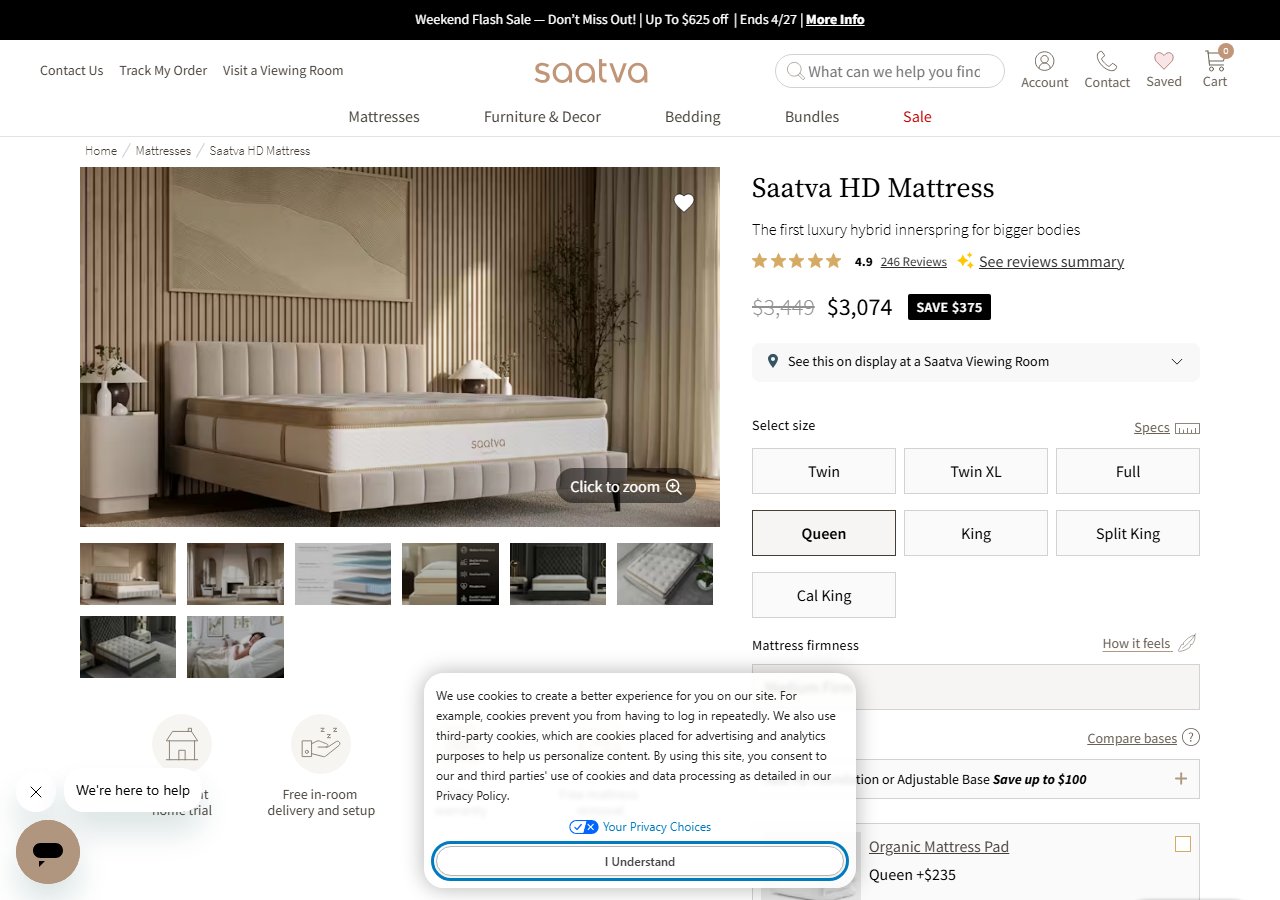
Saatva HD Mattress (Heavy-Duty)
$2,395-$3,995
See Price at Saatva →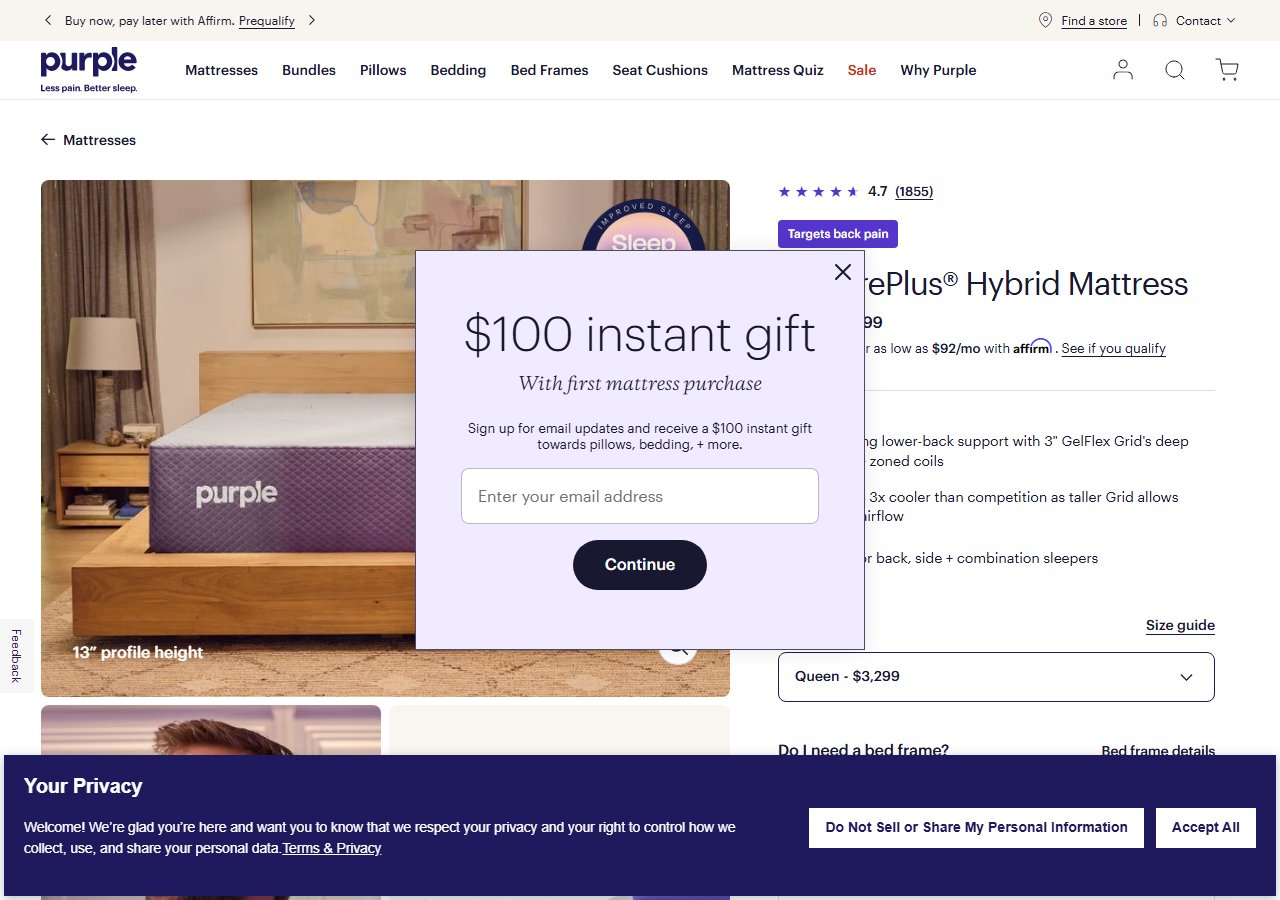
Purple Hybrid Premier Mattress
$2,499-$4,799
See Price at Purple →Putting the Data Together
The federal data tells a coherent story. BLS MSD tracking documents that warehouse and manual-handling workers sustain lumbar injuries at the highest rates in the U.S. workforce. NIOSH Lifting Equation data explains why: the tasks are biomechanically hazardous by design. CDC sleep data documents that the off-shift recovery window is already compromised for a third of U.S. adults — and shift workers fare worse. AHRQ expenditure data shows that when back pain becomes chronic, the personal financial cost is substantial. And SSA disability data shows what the endpoint looks like when the cycle is not interrupted.
The intervention hierarchy this data supports is: free first (sleep position, daily walking, lifting mechanics, mattress condition audit), clinical second (for red-flag presentations), equipment third (for workers who have exhausted the free interventions and need targeted support for lumbar recovery during sleep). A sleep surface that supports spinal neutrality, distributes load appropriately for the worker's body weight, and maintains its performance profile over years of use is a legitimate part of that third tier. The Saatva Loom & Leaf, Saatva HD, and Purple Hybrid Premier each address specific subsets of the warehouse worker population's needs — memory foam support, heavy-duty engineering, and pressure-selective relief, respectively.
None of them are the first step. All of them, for the right worker, can make a measurable difference in the quality of recovery that off-shift sleep provides. That is what the data actually supports — and it is a narrower, more honest claim than the mattress industry typically makes.