The Injury Burden Warehousing Doesn't Advertise
Here is the number that should be on every warehouse orientation poster but never is: BLS Employer Costs for Employee Compensation data shows that industries with high musculoskeletal disorder (MSD) incidence carry workers' compensation insurance rates 3 to 5 times higher than low-MSD industries. Insurance actuaries have already priced the injury risk your body absorbs every shift. The employers paying those premiums know exactly what the work does to a human spine. What's less clear is whether the workers do — and whether they know what happens off the clock matters almost as much as what happens on it.
This article is specifically for people who pick, pack, sort, load, or manage inventory in U.S. warehouses and distribution centers. Not desk workers with occasional back tightness. Not recreational athletes with sports injuries. Warehouse workers: people who move hundreds of units per shift, stand on concrete for eight to twelve hours, bend and twist under load repeatedly, and then go home to recover in whatever hours remain before the next shift. The federal data on this population is consistent and damning, and it has direct implications for how you should think about off-duty recovery — including your sleep surface.
Why Warehouse Work Breaks Your Lower Back: The Biomechanics
The mechanism is not mysterious. The NIOSH Lifting Equation, the federal standard for evaluating manual material-handling risk, documents that warehousing tasks routinely exceed safe spinal compressive load limits. The equation calculates a Recommended Weight Limit (RWL) based on task variables: load weight, horizontal distance from the body, vertical lift height, asymmetry (twisting), lift frequency, and grip quality. In real warehousing environments — where workers are pulling from floor-level shelves, reaching overhead, twisting to place items on conveyors, and repeating these motions hundreds of times per shift — multiple variables simultaneously exceed the equation's safe thresholds.
What this means physiologically: the lumbar intervertebral discs, particularly L4-L5 and L5-S1, absorb compressive and shear forces that exceed their design tolerances across a full shift. The posterior spinal musculature — erector spinae, multifidus, quadratus lumborum — fatigues progressively, transferring more load to passive structures (ligaments, facet joints, disc annuli) as the shift progresses. The result is a cumulative mechanical insult that doesn't fully resolve between shifts unless recovery conditions are adequate.
This is confirmed at the population level by BLS Musculoskeletal Disorders by Occupation tracking, which identifies the back as the most common body part injured across all U.S. occupations with days away from work. Warehousing and transportation storage consistently rank among the highest-incidence sectors in this dataset. The SSA Disability Insurance data reflects the downstream consequence: musculoskeletal disorders are the single largest category of new disability claims annually in the United States. Warehouse workers are not an edge case in that statistic — they are a core contributor.
And the healthcare cost is substantial. AHRQ HCUP data ranks back pain among the most expensive conditions in U.S. healthcare by total inpatient and outpatient cost. AHRQ Medical Expenditure Panel Survey data shows that adults with chronic back conditions spend significantly more on personal healthcare annually than adults without such conditions. The CMS Drug Spending Dashboard identifies opioid and non-opioid pain medications among the most expensive Medicare drug categories — a direct reflection of the chronic-pain treatment burden that musculoskeletal injuries generate over decades.
The population context: CDC NCHS Data Brief 390 reports that approximately 20% of U.S. adults experience chronic pain, with the lower back as the most common pain location. For warehouse workers operating under the mechanical conditions documented by the NIOSH Lifting Equation, the trajectory toward chronic pain is not an accident — it is a predictable outcome of sustained biomechanical overload without adequate recovery.
Off-Duty Recovery: Why Sleep Is the Underrated Variable
Recovery from musculoskeletal load stress happens primarily during sleep. Intervertebral discs rehydrate during recumbency — they are avascular structures that rely on fluid imbibition during off-loading to restore height and mechanical integrity. Spinal musculature undergoes repair and protein synthesis during deep sleep stages. Systemic inflammation markers, which are elevated by sustained physical labor, down-regulate during adequate sleep. None of this happens efficiently at the kitchen table or on the couch.
CDC sleep data shows that approximately 35% of U.S. adults report sleeping fewer than 7 hours per night — the threshold the CDC associates with elevated chronic disease risk. For warehouse workers already carrying high cumulative spinal load, inadequate sleep is not just a wellness metric. It is a direct amplifier of injury risk on the next shift. Fatigued workers have slower neuromuscular reaction times, reduced proprioceptive accuracy, and less capacity to recruit stabilizing musculature under load — exactly the conditions that produce the acute back injuries the BLS tracks.
The CDC Arthritis data adds another dimension: approximately 25% of U.S. adults report doctor-diagnosed arthritis, with prevalence concentrated in occupations involving sustained physical demand. Warehouse workers are overrepresented in this group, and arthritis in the facet joints and sacroiliac joint creates its own sleep disruption pattern — morning stiffness that peaks within the first hour of waking, directly correlated with time spent in suboptimal sleep positions on inadequate support surfaces.
Try These First: Free and Low-Cost Interventions That Actually Work
The cheapest intervention is the one that does not require buying anything. Federal occupational health guidance identifies several high-return, zero-cost interventions for warehouse workers with back pain that consistently outperform passive equipment upgrades when applied consistently. Before any discussion of sleep surfaces, equipment, or clinical treatment, these are the interventions the evidence supports.
Lifting and bending mechanics are the most upstream intervention available. OSHA's Ergonomics Solutions guidance is specific: hinge at the hips, not the lumbar spine; keep loads close to the body's center of mass; avoid twisting under load; use team lifts for loads above safe individual thresholds. Most acute warehouse back episodes are mechanical in origin and, critically, are rehearsable — the motor pattern that protects the lumbar spine can be learned and made automatic. Workers who master the hip hinge pattern protect their discs across thousands of repetitions that would otherwise accumulate damage.
Daily walking is the most evidence-supported active intervention for chronic low back pain. NIH NCCIH's evidence review on low back pain concludes that 30 minutes of walking most days reduces chronic low back pain as effectively as most non-drug clinical treatments. This is counterintuitive to workers who feel they have already been on their feet all day — but purposeful walking at a self-selected pace engages the posterior kinetic chain differently than reactive warehouse movement and maintains the lumbar mobility that shift work tends to compress.
Sleep position is the biggest free variable for off-duty spinal recovery. NIH back pain guidance from NIAMS recommends side-sleeping with a pillow between the knees, or back-sleeping with a pillow under the knees, as the positions most likely to keep the spine in a neutral alignment. Both options reduce shear forces on the lumbar discs during the recumbency period when disc rehydration occurs. Stomach-sleeping torques the lumbar spine, increases facet joint compression, and worsens chronic pain patterns — and it requires no equipment to stop doing it. A $4 pillow positioned correctly between the knees provides more spinal benefit than most sleep accessories marketed as back pain solutions.
Knowing when to replace a mattress is a free diagnostic that most workers overlook. CDC Sleep Hygiene guidance establishes practical replacement criteria: visible sag or body impressions, waking stiffer than you went to bed, or a mattress older than 7 to 10 years. If none of these conditions apply, behavioral interventions — sleep position, duration, consistency — should be optimized before attributing back pain to the sleep surface.
For workers who have genuinely worked through the free interventions — who have corrected their lifting mechanics, added daily movement, optimized sleep position, and are still sleeping on a structurally adequate mattress — the sleep surface itself becomes a legitimate variable to examine. The research on mattress firmness and back pain is less robust than the interventions above, but the structural logic is sound: a surface that cannot maintain spinal neutrality across a full sleep cycle amplifies, rather than resolves, the mechanical stress accumulated during a warehouse shift. What follows is an evidence-framed look at which mattress constructions are most relevant for this specific population.
When to See a Clinician: Red Flags That Override Equipment Decisions
Some back pain presentations should not be managed with sleep surface changes, movement, or any other self-directed intervention. NIH National Institute of Neurological Disorders and Stroke back pain guidance identifies specific red flags that warrant prompt clinical evaluation — conditions where imaging, specialist referral, or urgent care is the appropriate next step, not a new mattress.
For warehouse workers specifically, the risk of dismissing serious pathology as routine occupational soreness is real. A herniated disc that has progressed to nerve compression, a vertebral fracture from a fall or struck-by incident, or a spinal infection presenting as back pain with fever all carry the same surface presentation as routine mechanical back pain in the early stages. The distinguishing features are in the neurological signs and systemic symptoms, not the pain intensity. Any worker experiencing back pain accompanied by leg weakness, numbness below the knee, changes in bladder or bowel control, or pain following a traumatic event should see a clinician before pursuing any self-directed intervention. These are not mattress problems.
Where Products Help — and What to Look For
For the warehouse worker whose back pain is mechanical, chronic, and adequately managed clinically — who has optimized sleep position, movement, and lifting mechanics, and whose current mattress is more than 7 years old or visibly sagging — sleep surface construction matters. Three specific properties are relevant for this population.
Zoned support matters because warehouse workers carry their mechanical stress asymmetrically. The lumbar region needs firmer support to prevent the hips from sinking and creating spinal flexion during side sleep; the shoulder region needs softer contouring to allow the shoulder girdle to sink without forcing lateral spinal curvature. Mattresses with differentiated firmness zones — firmer under the lumbar and hip, softer under the shoulders — maintain the neutral spinal alignment that the NIH NIAMS sleep position guidance is designed to achieve.
Body weight accommodation is a non-negotiable variable for many warehouse workers. Standard mattress constructions are designed for a median body weight of roughly 130 to 180 pounds. Workers above 250 pounds who sleep on standard constructions will often experience premature compression of comfort layers, excessive sink at the hips, and the exact lumbar flexion they are trying to avoid. Heavy-duty constructions with reinforced coil systems and higher-density foam cores are the engineering response to this biomechanical reality.
Pressure relief at the hip and shoulder contact points reduces the positional pain that disrupts sleep continuity. A warehouse worker whose hip pain wakes them at 3 a.m. does not complete adequate slow-wave sleep — the stage where the most tissue repair and inflammation resolution occurs. Pressure-relieving surface layers that distribute load across a wider contact area reduce localized pressure spikes that interrupt sleep architecture.
With those criteria established, three mattresses are worth examining for this population.
The Saatva HD Mattress is the most directly engineered pick for warehouse workers who are heavier or who carry substantial muscular mass. Saatva builds the HD with a reinforced lumbar zone, a tempered steel coil system rated for heavier loads, and a two-stage comfort layer designed to prevent the premature hip sink that standard constructions produce under sustained weight. For workers above 250 pounds — a category for which most mattress reviews provide inadequate guidance — the HD addresses the structural failure mode that produces lumbar flexion during side sleep. It is the first recommendation for this population because the load accommodation problem it solves is the most common unaddressed variable in warehouse worker sleep.
For workers in the standard weight range who present primarily with lumbar pain and pressure sensitivity — a pattern consistent with facet joint involvement or disc-mediated referred pain — the Saatva Loom & Leaf Memory Foam Mattress offers a dense memory foam construction with a firmness option that supports lumbar neutrality without the pressure spikes that firmer innerspring constructions can create at the hip and shoulder. Memory foam's conforming properties are particularly relevant for side-sleeping warehouse workers whose primary complaint is hip or shoulder pain interrupting sleep continuity. The Loom & Leaf's temperature-regulation treatment addresses the heat retention issue that standard memory foam creates — relevant for workers who already run hot from high-output shifts.
For workers whose primary complaint is pressure-point pain rather than broad lumbar support failure — a pattern more common in lighter workers or those with significant hip arthritis — the Purple Hybrid Premier Mattress uses a proprietary grid polymer surface layer that does not compress under load the way foam does. Instead, it collapses selectively at pressure-point contact zones while maintaining support under the lumbar region. The result is a pressure-relief profile that performs well across different sleep positions, which is relevant for workers whose pain causes frequent position changes during the night.
Sleep Surfaces Engineered for Warehouse Worker Physical Recovery
Each mattress below was selected for structural properties specifically relevant to workers managing high cumulative spinal load: zoned lumbar support, body-weight accommodation, and pressure relief at the contact points that interrupt warehouse workers' sleep.

Saatva Loom & Leaf Memory Foam Mattress
$1,695-$3,295
See Price at Saatva →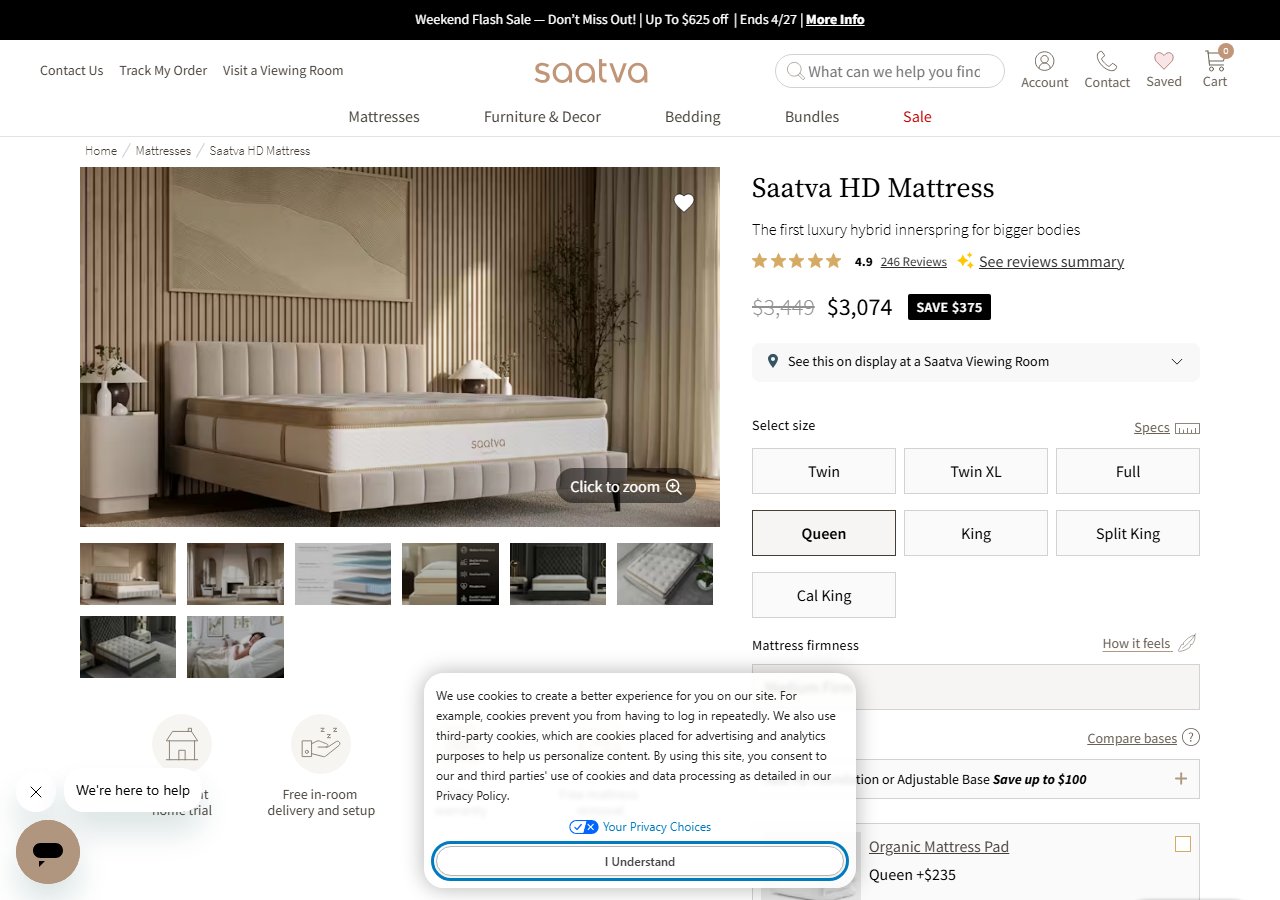
Saatva HD Mattress (Heavy-Duty)
$2,395-$3,995
See Price at Saatva →
Purple Hybrid Premier Mattress
$2,499-$4,799
See Price at Purple →Putting the Evidence Hierarchy Together
Federal occupational health data draws a consistent picture for warehouse workers: high mechanical spinal load per shift, inadequate between-shift recovery, and predictable downstream costs measured in lost workdays, disability claims, and healthcare expenditure. The BLS tracks the injury. The SSA tracks the disability. The AHRQ tracks the healthcare cost. At every level of that data hierarchy, the outcome is worse than it needs to be — and off-duty recovery quality is a lever that workers control.
The hierarchy of interventions maps directly to the evidence. Lifting mechanics come first because they act on the injury mechanism directly. Daily movement comes second because it is the most effective non-drug chronic pain intervention in the NIH evidence base. Sleep position comes third because it is free, immediately implementable, and directly affects the disc rehydration that determines next-shift spinal resilience. Mattress evaluation comes last — after the behavioral variables are optimized — because the sleep surface is the amplifier of good sleep position habits, not a substitute for them.
Workers who follow that sequence, see a clinician for any red-flag symptoms, and then make an informed mattress choice based on their weight, sleep position, and pain pattern are operating with the best available evidence. That is what the federal data, read carefully, actually recommends.