The Federal Data Behind Your Morning Back Pain
If you work in a warehouse and wake up every morning feeling like your lower back aged ten years overnight, you are not imagining it — and the federal data backs you up. According to BLS Musculoskeletal Disorders by Occupation tracking, the back is the single most common body part injured across all U.S. occupations with days away from work. Warehousing, transportation, and material handling occupations are responsible for a disproportionate share of that burden. These are not soft-tissue sprains that resolve in a week. For a substantial portion of warehouse workers, back injuries become chronic conditions that follow them off the clock, into their vehicles, and directly into bed — where the quality of recovery either arrests the damage or accelerates it.
The scale of the economic fallout underscores how serious this is. AHRQ HCUP data identifies back pain as one of the most expensive conditions in U.S. healthcare by total inpatient and outpatient cost. AHRQ's Medical Expenditure Panel Survey confirms that adults with chronic back conditions spend substantially more on personal healthcare annually than those without. And SSA Disability Insurance data shows musculoskeletal disorders are the single largest category of new disability claims filed each year. The trajectory from warehouse back strain to chronic pain to disability is not hypothetical — it is a documented pathway that tens of thousands of American workers travel every year.
The costs cascade to employers as well. BLS Employer Workers' Compensation data shows industries with high musculoskeletal disorder incidence carry workers' compensation insurance rates 3–5 times higher than low-MSD industries. Warehousing and logistics employers know this math. But the worker absorbs the physical cost regardless of who writes the insurance check.
Why Warehouse Work Specifically Destroys the Lumbar Spine
To understand why sleep surface matters for warehouse workers specifically, you first have to understand what those workers are doing to their spines during the shift. The lumbar spine — the five vertebrae of the lower back — is designed for movement, but not for repetitive compressive load applied at mechanical disadvantage. Warehouse work applies exactly that kind of load, repeatedly, for eight to twelve hours at a stretch.
The NIOSH Lifting Equation is the federal engineering standard for safe manual material handling. It calculates a Recommended Weight Limit based on task variables including horizontal distance from the body, vertical position of the lift, asymmetric twisting, frequency, and coupling quality. When researchers apply the NIOSH Lifting Equation to real warehouse tasks — pulling cases from floor-level pallet positions, loading conveyor belts, handling irregularly shaped returns — the recommended weight limits are routinely exceeded, sometimes by a factor of two or three. The equation does not just flag a risk. It quantifies a cumulative mechanical insult that adds up across every shift, every week, every year of a warehouse career.
The biomechanical mechanism is straightforward but worth stating plainly. When a worker bends forward at the lumbar spine (instead of hinging at the hips) to pick up a 40-pound case, the erector spinae muscles must generate force at a severe mechanical disadvantage. Biomechanical models estimate lumbar disc compression forces during this type of lift can exceed 770 pounds of force — well above the NIOSH Action Limit. Repeated across hundreds of lifts per shift, this compressive loading accelerates disc dehydration, reduces intervertebral disc height, and increases the likelihood of disc herniation and facet joint arthropathy. Add awkward twisting, which warehouses require constantly for stacking and conveyor loading, and the torsional stress compounds the compressive damage.
What happens at night is the other half of the equation. The intervertebral discs have no direct blood supply. They depend on a diffusion process — alternating loading and unloading — to exchange nutrients and waste products with adjacent vertebral endplates. During sleep, when spinal compression is relieved, discs rehydrate. This is why you are measurably taller in the morning than in the evening. For warehouse workers, who have been compressing their discs under load for an entire shift, the overnight rehydration window is not optional maintenance — it is critical repair. A sleep surface that places the spine in a mechanically disadvantaged position during those hours is not just uncomfortable; it is interrupting the only physiological recovery window a manual laborer has.
Layer the shift-work dimension on top of that. CDC sleep data shows approximately 35% of U.S. adults already report sleeping less than 7 hours per night — the threshold below which chronic disease risk elevates significantly. Shift workers, including the substantial portion of the warehouse workforce on overnight or rotating schedules, sleep fewer hours and at lower quality than day workers, according to the same CDC surveillance data. CDC NHANES data shows approximately 20% of U.S. adults experience chronic pain, with lower back as the most common location. When you cross-reference shift work with chronic back pain prevalence, you get a population that is sleeping poorly, recovering poorly, and returning to a physically demanding job with a musculoskeletal system that never fully reset.
CMS drug spending data identifies opioid and non-opioid pain medication among the most expensive Medicare drug categories — a downstream reflection of the chronic-pain treatment burden that begins, in many cases, with undertreated occupational back injuries. For warehouse workers, addressing the recovery environment is not wellness culture. It is an economic imperative.
The Cheapest Intervention Is the One That Does Not Require Buying Anything
Before discussing sleep surfaces, it is worth being direct: the most powerful interventions available to a warehouse worker with chronic back pain are behavioral, not commercial. Federal health agencies have spent considerable resources studying what actually reduces chronic low-back pain in working adults, and the evidence points to habits and mechanics before it points to products.
Lifting and bending mechanics are the upstream intervention that matters most. OSHA's ergonomics guidance is explicit: hinge at the hips, keep loads close to the body, avoid twisting under load. Most acute back episodes in warehouse settings are mechanical events — meaning they are produced by a specific movement pattern, and they can be reduced by rehearsing better patterns. This is not intuitive advice. It requires conscious re-training, and it is genuinely hard to maintain at the end of a ten-hour shift. But no mattress undoes the damage of 400 mechanically disadvantaged lifts per day.
Daily walking is the second evidence-based free intervention. An NIH NCCIH evidence review found that walking 30 minutes most days reduces chronic low back pain as effectively as most non-drug clinical treatments. This is a peer-reviewed finding that frequently surprises people who assume chronic back pain requires passive treatment. The mechanism involves both muscular stabilization of the lumbar spine and the loading-unloading cycle that disc rehydration depends on. A warehouse worker who logs 15,000 steps on shift but sits in a car for an hour each way and then lies immobile for seven hours is not getting therapeutic movement — the shift steps are compressive load, not rehabilitative motion.
Sleep position is the biggest free variable in the off-duty recovery window. NIH guidance on back pain is clear: side-sleeping with a pillow between the knees or back-sleeping with a pillow under the knees maintains spinal neutral alignment during sleep. Stomach-sleeping creates extension and rotation at the lumbar spine that worsens chronic pain. This single positional change costs nothing and can meaningfully reduce morning stiffness independent of what surface a worker sleeps on.
Mattress replacement timing matters as well. CDC sleep hygiene guidance recommends replacing a mattress when it shows visible sag, when you wake stiffer than you went to bed, or when it exceeds 7–10 years of use. Even the most expensive mattress on the market does not undo poor sleep hygiene or sedentary recovery habits. But a mattress with a 3-inch central sag is actively working against lumbar neutrality during the only repair window a manual laborer has.
For readers who have already addressed mechanics, movement, and sleep position — and who are sleeping on a mattress that is either sagging, too soft, too firm, or simply past its service life — a purpose-built sleep surface becomes a legitimate tool in the recovery stack. The interventions above do not stop being relevant once you buy a mattress. They remain the foundation. The mattress is the surface on which that foundation either gets supported or undermined.
When to See a Clinician — Not a Mattress Review
Before any product discussion, the clinical red flags deserve explicit attention. NIH National Institute of Neurological Disorders and Stroke guidance on back pain identifies specific presentations that require prompt medical evaluation rather than ergonomic or sleep surface adjustments. A new mattress does not treat radiculopathy, spinal stenosis, or a fracture. Attempting to manage those conditions with a sleep surface while avoiding clinical care is a documented pathway to worsened outcomes.
The presentations that require a clinician are: back pain that radiates below the knee (suggesting nerve root involvement); back pain that follows significant trauma or a fall; pain accompanied by leg weakness, numbness, or tingling; any change in bowel or bladder function associated with back pain; and back pain accompanied by fever or unexplained weight loss. CDC arthritis data notes that approximately 25% of U.S. adults report doctor-diagnosed arthritis, with prevalence concentrated in physically demanding occupations — warehouse workers with arthritic changes in facet joints can present with similar symptom patterns that require imaging to differentiate. If any of these red flags apply, the next step is a primary care provider or occupational medicine specialist, not a consumer product purchase.
For workers whose back pain is chronic, diffuse, mechanical in nature, and worsened by poor sleep — without any of the red flags above — evidence-based sleep surface selection is a reasonable and well-supported component of a recovery strategy.
What the Evidence Supports in a Sleep Surface for Warehouse Workers
Warehouse workers are not average sleepers with average recovery needs. They are adults who have spent their shift applying compressive spinal loads that routinely exceed NIOSH recommended limits, who may carry higher body mass than the average population given the physical demands of the work, and who are often sleeping on irregular schedules that reduce total sleep time. The sleep surface considerations relevant to this population differ meaningfully from the considerations relevant to a sedentary desk worker with occasional back stiffness.
The relevant engineering dimensions are: support core firmness (does the mattress maintain spinal neutral alignment under a heavier body mass at rest?), pressure relief layer (does the comfort layer distribute contact pressure across the sleep surface to reduce ischemic load on bony prominences and soft tissue?), edge support (is the mattress stable at the perimeter, so workers who sleep near the edge or use the bed to get in and out are not on a collapsing surface?), and durability under sustained load (does the mattress maintain its structural properties across years of use by a worker whose body mass may be above average?).
Three products are worth examining through this lens for warehouse workers specifically.
The Saatva Loom & Leaf Memory Foam Mattress is the premium memory foam pick for workers whose primary complaint is pressure sensitivity and point-load pain after long shifts. Memory foam's viscoelastic properties distribute body weight across a larger surface area than traditional innerspring constructions, reducing peak pressure at the hips and shoulders — the two bony prominences that create the highest contact pressure for side sleepers, which is the clinically recommended position for lumbar pain. The Loom & Leaf uses a multi-layer foam architecture with a high-density base, which matters for workers who have experienced the mid-mattress sag that undermines spinal neutrality over time. At a price point of $1,695–$3,295, it is a meaningful investment — but AHRQ MEPS data on chronic back condition healthcare costs puts that investment in context. One avoided epidural steroid injection or one fewer MRI would cover the mattress cost.
The Saatva HD Mattress is the most directly engineered product on this list for the warehouse worker population specifically. Saatva's HD is engineered for sleepers up to 500 pounds, with a reinforced coil system designed to maintain its rated firmness and edge support under sustained body mass loads that standard mattresses are not designed to handle. This matters for warehouse workers for two reasons: many physically active warehouse workers carry higher body mass than the sedentary average, and even average-weight workers who have experienced lumbar compression all day benefit from a support core that does not deflect under load. A mattress that feels adequately firm in a showroom floor test can develop a functional sag zone under a 220-pound sleeper within two years. The HD's reinforced perimeter and dual-coil architecture are specifically designed to prevent that failure mode. At $2,395–$3,995, it is the highest-priced option on this list, but for workers in the 200–350 pound range, it is the only product here that is structurally specified for their actual load.
The Purple Hybrid Premier Mattress takes a different engineering approach through its proprietary GelFlex Grid comfort layer. Rather than foam or traditional pillow-top construction, the grid allows pressure points to sink through while supporting adjacent areas — a pressure-distribution mechanism that performs differently from memory foam and may suit warehouse workers who find dense memory foam traps heat during sleep (a common complaint among workers who run physically warm after demanding shifts). The hybrid construction beneath the grid provides the coil-based support that keeps the spine from hammering into the mattress, while the grid handles the pressure relief that reduces soft-tissue load at the hips and shoulders. At $2,499–$4,799, it is the broadest price range on the list, reflecting the significant size variation across its lineup.
Sleep Surfaces Engineered for Warehouse Worker Lumbar Recovery
These three mattresses were selected specifically for warehouse workers dealing with chronic lumbar load: evaluated for support core integrity under sustained body mass, pressure relief at high-contact zones, and structural durability across years of use by physically demanding workers.

Saatva Loom & Leaf Memory Foam Mattress
$1,695-$3,295
See Price at Saatva →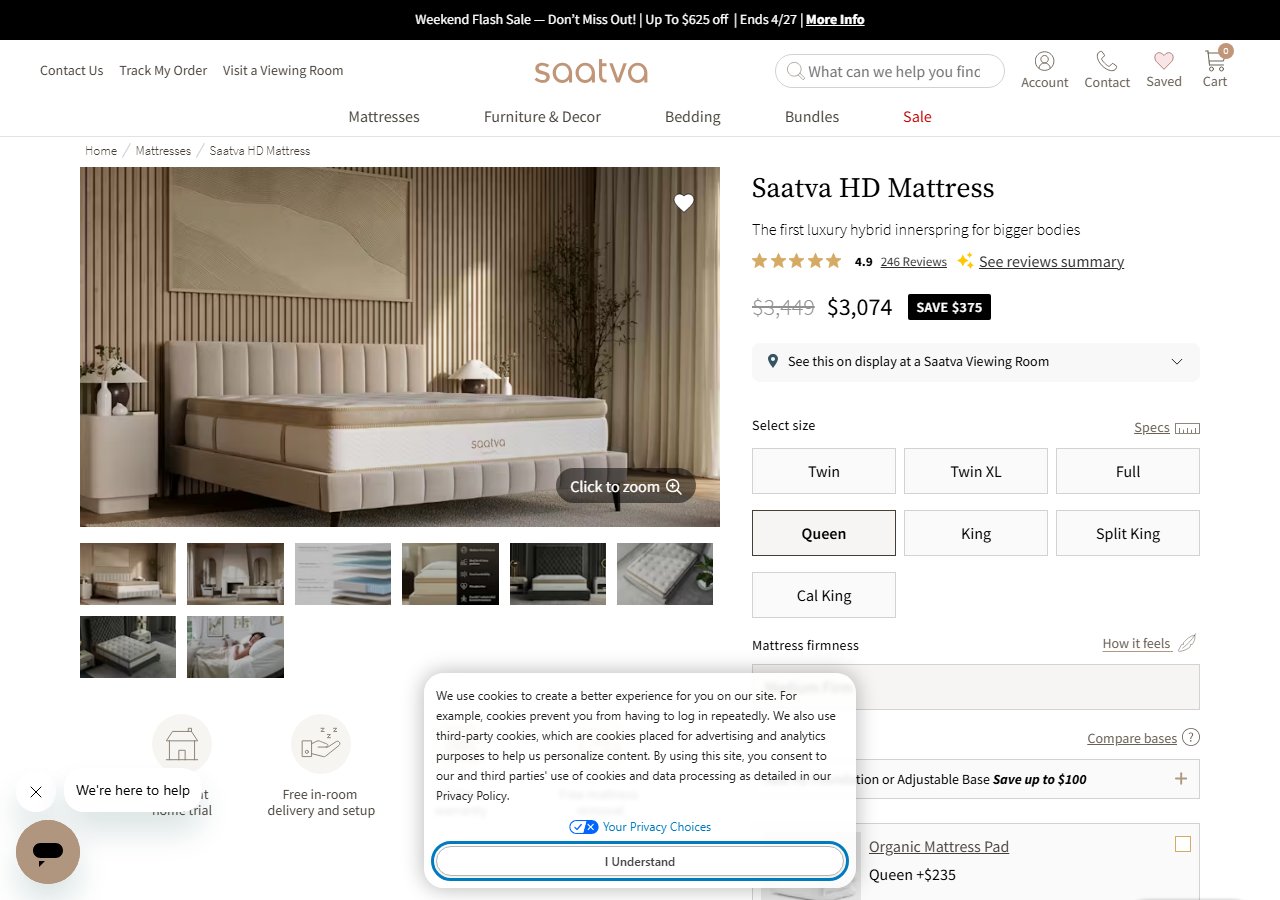
Saatva HD Mattress (Heavy-Duty)
$2,395-$3,995
See Price at Saatva →
Purple Hybrid Premier Mattress
$2,499-$4,799
See Price at Purple →How to Choose Between These Three Products
The decision is not complicated if you apply the warehouse worker framework directly. If your primary symptom is pressure pain — you wake with hip or shoulder soreness from contact with the surface, and your current mattress feels like it is concentrating load rather than distributing it — the Saatva Loom & Leaf is the best fit. If you are over 200 pounds and your current mattress has developed a visible sleep impression within a few years, the Saatva HD is the structurally appropriate choice. If you sleep hot and find memory foam uncomfortable regardless of its pressure-relief properties, the Purple Hybrid Premier is worth evaluating specifically for its heat-neutral grid construction.
None of these products replaces the interventions outlined above. But for a warehouse worker sleeping on a mattress that is undermining the only lumbar decompression window the body gets in a 24-hour cycle, a structurally appropriate sleep surface is not a luxury purchase. It is a recovery tool with documented functional rationale.
The Data-to-Recovery Hierarchy That Actually Works
The federal data tells a consistent story. BLS MSD tracking documents the injury. The NIOSH Lifting Equation explains the mechanism. NIH NCCIH evidence points to free behavioral interventions first. NIH clinical guidance defines the red flags that require medicine, not mattresses. And AHRQ cost data contextualizes the economic stakes of leaving chronic back pain unaddressed.
The intervention hierarchy for a warehouse worker with chronic lumbar pain is: fix the lifting mechanics, add daily walking, correct the sleep position, replace a sagging mattress when its structural life is exhausted. A purpose-built sleep surface — one engineered for the load characteristics and recovery needs of a worker who has been exceeding NIOSH recommended weight limits for eight hours — is the final layer in that stack, not the first. Workers who reach that layer with everything else already in place are the ones who actually notice the difference.