The back injury that starts at work and finishes in bed
If you work in a U.S. warehouse, your back is statistically the most likely part of your body to put you out of work. BLS Musculoskeletal Disorders by Occupation data confirms that the back is the single most common body part injured across all occupations with days away from work — and warehousing, transportation, and material-handling sectors consistently rank among the highest-incidence industries in that dataset. These are not soft-tissue sprains you walk off in a weekend. Many are cumulative-loading injuries that build over months and years of shift work, repeated lifts, and insufficient recovery.
The part of this equation that federal data is only beginning to capture: the recovery window happens in bed. Your discs rehydrate overnight. Your spinal erector muscles repair microtears during deep sleep stages. Your facet joints decompress when you're horizontal and fully unloaded. If the surface you're sleeping on is misaligned, too soft, too firm, or simply worn out, you are spending 6–8 hours per night reinforcing the exact spinal mechanics that the next shift will punish again.
This article does not start with mattress recommendations. It starts with mechanism, federal data, and the free interventions that should come first. The sleep surface question comes later — and only after you understand why it matters and what clinical signs mean you need a provider, not a purchase.
Why warehousing loads the lumbar spine so aggressively
The NIOSH Lifting Equation is the federal standard for evaluating manual material-handling risk. It calculates a Recommended Weight Limit (RWL) based on load weight, horizontal reach distance, lift height, asymmetrical rotation, grip quality, and lift frequency. When the actual weight being lifted exceeds the RWL — expressed as a Lifting Index above 1.0 — spinal loading is considered unsafe. NIOSH documents that manual material-handling tasks across warehousing, construction, and healthcare routinely exceed these limits. In practice, this means warehouse workers are regularly applying compressive and shear forces to their lumbar spine that federal ergonomics guidance classifies as injurious.
The mechanism is specific. The lumbar intervertebral discs — particularly L4-L5 and L5-S1, the segments responsible for transferring load between the spine and pelvis — are avascular. They receive nutrients through diffusion, a process that depends heavily on alternating compression and decompression cycles. During a warehouse shift, these discs are under sustained compressive load for hours. The decompression and rehydration phase happens primarily at night, in a horizontal position, when the discs can absorb fluid and recover height. Interfere with that recovery — with a sagging mattress, poor sleep posture, or truncated sleep duration — and the discs enter the next shift already partially compromised.
Compounding this: warehouse work rarely involves just lifting. Concrete floors transmit vibration. Workers stand on hard surfaces for full shifts, which loads the lumbar facet joints in extension. Reaching into low shelving or high racks introduces asymmetric spinal loading that the NIOSH equation specifically flags as high-risk. The cumulative picture is one of a spine that is mechanically stressed across multiple planes, repeatedly, with inadequate recovery.
The downstream costs of this pattern are not abstract. AHRQ HCUP data identifies back pain as one of the most expensive conditions in U.S. healthcare by total inpatient and outpatient cost. AHRQ Medical Expenditure Panel Survey data shows that adults with chronic back conditions carry substantially higher annual personal healthcare expenditures than those without. And SSA Disability Insurance data identifies musculoskeletal disorders as the single largest category of new disability claims filed annually — meaning the trajectory from repetitive warehouse loading to long-term disability is a documented, federal-data-confirmed pathway.
BLS Employer Costs for Employee Compensation data adds an economic layer: industries with high MSD incidence carry workers' compensation insurance rates 3–5 times higher than low-MSD industries. The financial pressure is real and documented. But none of that pressure changes the fundamental biomechanical reality: the spine needs to recover, and sleep is the primary vehicle for that recovery.
Chronic pain prevalence and the warehouse worker profile
CDC NCHS Data Brief 390 reports that approximately 20% of U.S. adults experience chronic pain, with the lower back as the most common pain location. That is one in five adults — but among workers in high-physical-demand occupations, the rate is almost certainly higher. CDC Arthritis data shows that approximately 25% of U.S. adults report doctor-diagnosed arthritis, with prevalence concentrated in occupations involving sustained physical demand. Warehousing checks every box in that description: sustained load, repetitive motion, hard-surface standing, and limited positional variety over the course of a shift.
Sleep deprivation worsens pain sensitivity through well-documented neuroendocrine pathways. CDC sleep data shows approximately 35% of U.S. adults already report sleeping fewer than 7 hours per night — the threshold the CDC associates with elevated chronic disease risk. For warehouse workers on rotating shifts, the sleep deprivation problem is structural: overnight shifts suppress melatonin, shift changes disrupt circadian rhythm, and workers often sleep during daytime hours with reduced environmental control. Sleeping on a mismatched or worn sleep surface compounds the problem further.
The pain-sleep relationship operates as a feedback loop. Inadequate sleep lowers pain thresholds, making the next shift feel more painful. That heightened pain disrupts the following night's sleep. Over weeks and months, workers on this cycle move from acute mechanical back pain toward chronic sensitization — a state that is significantly harder and more expensive to treat. CMS Drug Spending Dashboard data identifies opioid and non-opioid pain medication spending among the most expensive Medicare drug categories, a downstream reflection of how poorly the U.S. healthcare system manages this cycle upstream.
Try these first — the interventions that cost nothing
The cheapest intervention is the one that does not require buying anything. Before evaluating any sleep surface, warehouse workers dealing with lumbar pain should audit the variables they can change for free. Federal guidance from NIH, NIOSH, OSHA, and CDC provides specific, evidence-grounded recommendations that are frequently more impactful than equipment changes — particularly for workers whose pain is mechanical and recent rather than chronic and degenerative.
Daily walking is the most underrated tool available. NIH NCCIH evidence review on low back pain finds that walking 30 minutes most days reduces chronic low back pain as effectively as most non-drug clinical treatments. This matters for warehouse workers specifically because shift work often leaves workers exhausted enough to avoid movement on off-days — which is the worst response biomechanically. Active recovery through walking promotes disc nutrition, reduces inflammatory signaling, and maintains the neuromuscular tone that protects the spine under load.
Sleep position is a free variable with significant biomechanical consequences. NIH NIAMS back pain guidance recommends side-sleeping with a pillow between the knees, or back-sleeping with a pillow under the knees, as the positions that best maintain lumbar neutrality. Stomach sleeping — common among workers who collapse into bed exhausted — places the lumbar spine in sustained extension and increases facet joint loading throughout the night. Correcting sleep position costs nothing and can produce measurable relief within days.
Lifting mechanics are the upstream intervention. OSHA Ergonomics guidance recommends hinging at the hips rather than the lumbar spine, keeping loads close to the body, and avoiding rotational movement under load. Most acute warehouse back episodes are mechanical and preventable with deliberate technique. Workers who are already managing chronic pain sometimes abandon proper mechanics when fatigued — which is precisely when injury risk is highest.
Mattress replacement criteria: before evaluating which mattress to buy, evaluate whether your current mattress has failed. CDC Sleep Hygiene guidance provides the criteria: if the mattress has visible sag, if you consistently wake stiffer than you went to bed, or if it is older than 7–10 years, the sleep surface itself is likely contributing to lumbar loading rather than relieving it. Even the most expensive mattress cannot compensate for poor sleep hygiene or inadequate sleep duration.
For workers who have addressed sleep position, increased daily movement, audited their lifting mechanics, and are sleeping on a mattress that is less than 7–10 years old with no visible sag — and who are still waking with lumbar stiffness, hip pain, or shoulder discomfort after sleeping — a sleep surface upgrade becomes a legitimate tool. The following section covers what to look for, and which surfaces are specifically engineered for the load profile warehouse workers bring to bed.
When to see a clinician — red flags that no mattress addresses
Some back pain presentations require imaging, specialist referral, or urgent evaluation. A new mattress is not a treatment for these conditions, and delaying evaluation to try a product recommendation is genuinely dangerous. NIH National Institute of Neurological Disorders and Stroke back pain guidance identifies specific presentations that require prompt clinical attention rather than self-management.
For warehouse workers specifically, the red flags that warrant same-day or next-day evaluation include: pain that radiates below the knee (suggesting nerve root compression or disc herniation with neurological involvement), back pain that follows a traumatic event such as a fall from height or equipment collision, any episode accompanied by leg weakness or numbness (which suggests cord or root compromise), and back pain combined with fever (which raises the possibility of spinal infection, rare but serious). Additionally, any bowel or bladder dysfunction — loss of control, new difficulty initiating, or saddle-area numbness — represents a potential cauda equina emergency and warrants emergency department evaluation without delay.
If your back pain is bilateral, worsening at rest, worst in the early morning hours and improving with movement, and you are under 45, that pattern is more consistent with inflammatory arthritis (including ankylosing spondylitis) than mechanical back pain, and requires rheumatologic evaluation rather than ergonomic adjustment. These clinical distinctions matter: approximately 25% of U.S. adults carry doctor-diagnosed arthritis per CDC Arthritis data, and the conditions within that category require very different management approaches.
Where the sleep surface actually matters
For warehouse workers whose back pain is mechanical — cumulative spinal loading from shift work, not a red-flag neurological presentation — the sleep surface is a legitimate recovery tool. The engineering specifications that matter are different from what most mattress marketing emphasizes. Warehouse workers need a surface that provides zoned lumbar support rather than uniform firmness, maintains spinal neutrality through a full range of sleeping positions including lateral positions (where hip and shoulder width create pressure differentials that cheaper foam fails to manage), and is durable enough to maintain its support profile under heavier body weights and sustained nightly use.
The three surfaces we evaluated for this article were selected specifically for warehouse workers' biomechanical needs — not general comfort ratings.
The Saatva HD Mattress is the most directly engineered option for this reader. Saatva's HD variant is built for heavier-duty use: it uses a higher-density foam base, a reinforced coil-on-coil innerspring architecture with a heavier-gauge support core, and is designed to maintain its support profile for workers whose body weight and nightly use patterns exceed what standard-weight mattresses are tested for. For warehouse workers at higher body weights — common given the physical demands of the job and the metabolic shifts that accompany shift work and sleep disruption — the HD's construction is specifically calibrated to avoid the premature sagging that is the primary way a sleep surface begins contributing to lumbar pain rather than relieving it. Standard mattresses are typically load-rated for 250–300 lbs per side; the Saatva HD is rated higher, and the coil gauge reflects that.
The Saatva Loom & Leaf Memory Foam Mattress addresses a different profile: warehouse workers who run hot, prefer the conforming feel of memory foam, and need a surface that contours around pressure points — shoulders, hips, lumbar — without the heat retention problems that plagued first-generation memory foam products. The Loom & Leaf uses a dual-layer memory foam system with a spinal zone gel pad centered under the lumbar region, which applies targeted support directly to the L4-L5 and L5-S1 segments that warehouse loading most commonly stresses. It is available in two firmness options (Relaxed Firm and Firm), which allows workers at different body weights to select the resistance profile appropriate for their spinal neutrality needs. Workers on the lighter end of the weight spectrum typically achieve better lumbar neutrality on the Relaxed Firm; heavier workers generally need the Firm variant to prevent excessive sinkage that throws the lumbar out of neutral.
The Purple Hybrid Premier Mattress brings a fundamentally different pressure-distribution mechanism: the GelFlex Grid, a polymer grid structure that collapses under pressure points (shoulders, hips) but remains firm under flatter surface areas (lower back), providing pressure relief and lumbar support simultaneously rather than trading one for the other. This is particularly relevant for warehouse workers who are side sleepers — the most common sleep position recommended for lumbar pain management — because the grid's differential response allows the shoulder to sink enough to maintain spinal alignment without letting the hip drop through. The Hybrid Premier adds a pocketed coil support core beneath the grid for edge support and motion isolation, both of which matter for workers sharing a bed whose partners notice every shift-change alarm and 4 a.m. departure.
Sleep Surfaces Engineered for Warehouse Lumbar Recovery
These three mattresses were selected specifically for warehouse workers' biomechanical demands: heavy-duty durability, zoned lumbar support, and pressure-point management for workers who side-sleep as recommended by NIH back pain guidance.

Saatva Loom & Leaf Memory Foam Mattress
$1,695-$3,295
See Price at Saatva →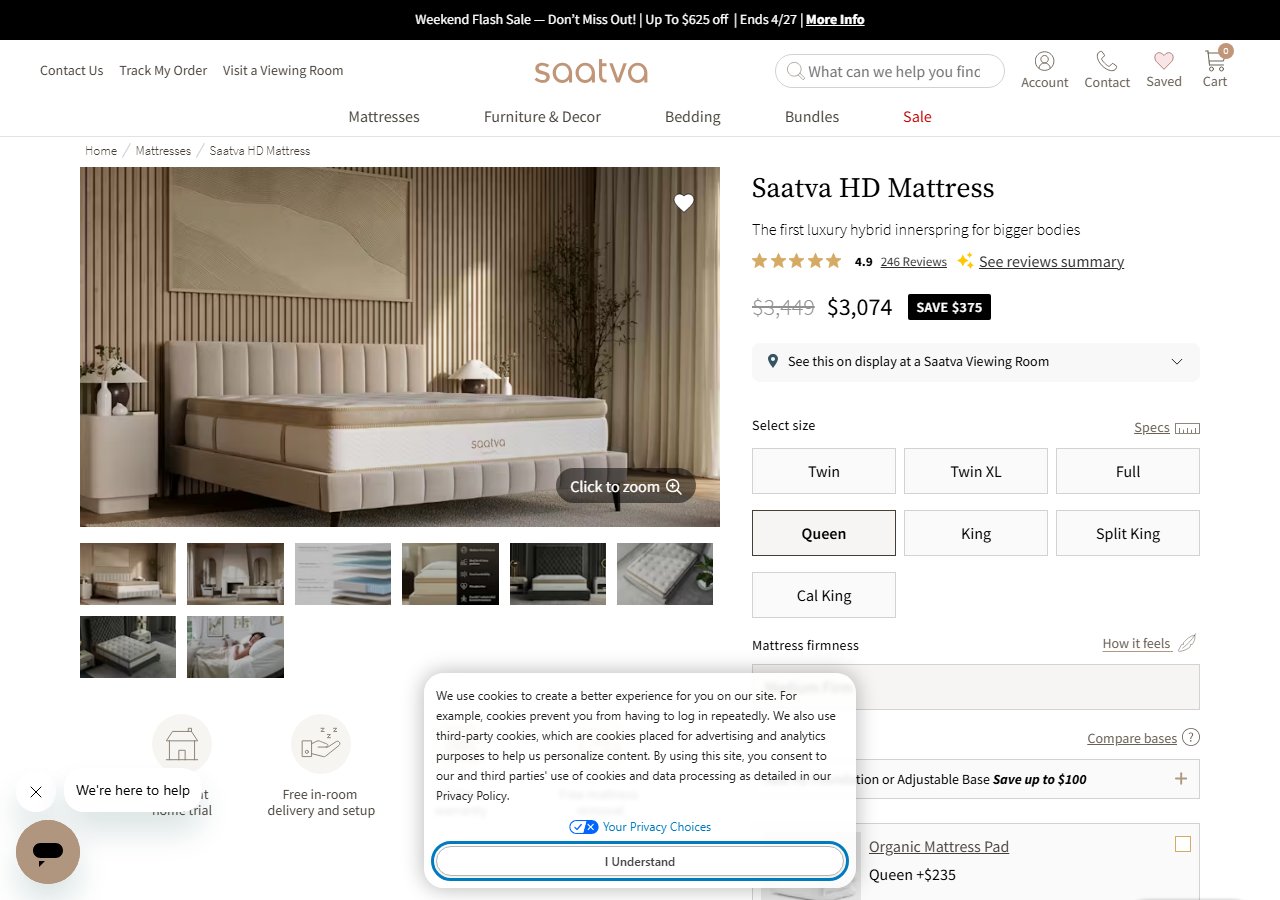
Saatva HD Mattress (Heavy-Duty)
$2,395-$3,995
See Price at Saatva →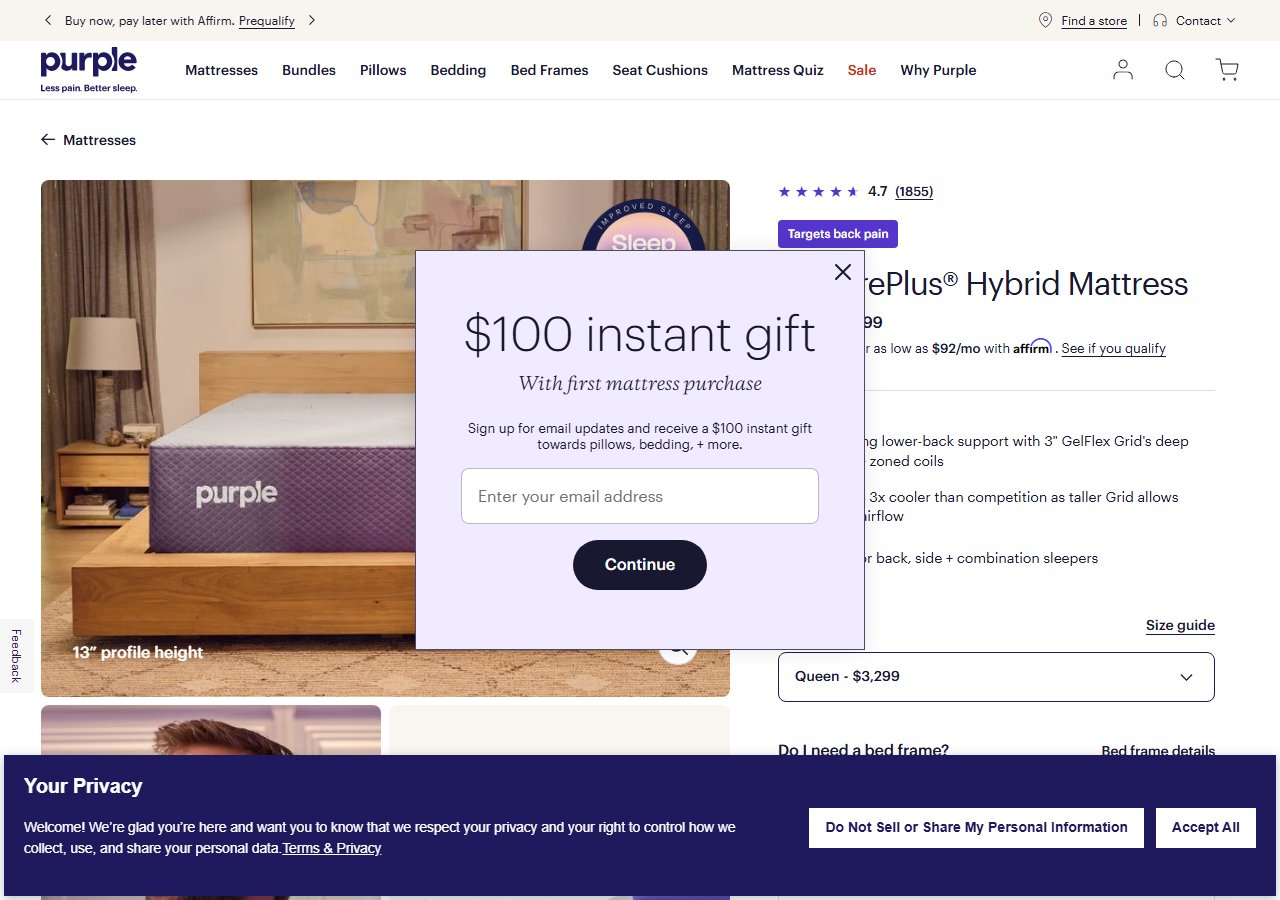
Purple Hybrid Premier Mattress
$2,499-$4,799
See Price at Purple →Making the choice: which surface matches your specific situation
The product decision for a warehouse worker is not primarily about brand preference — it is about matching construction specifications to your body mechanics and sleep patterns.
If you are at a higher body weight (roughly 230 lbs or above), work a shift that has you collapsing into bed fully exhausted, and need a mattress that will maintain its structural integrity over years of heavy nightly use, the Saatva HD is the most defensible engineering choice. The premium is real, but the cost-per-night over a 10-year lifespan on a mattress that does not sag is lower than replacing a cheaper mattress every 3–4 years.
If your primary complaint is heat during sleep combined with lumbar morning stiffness — common among workers running metabolically hot from physical exertion — the Saatva Loom & Leaf provides the targeted lumbar zone gel pad alongside better temperature regulation than most foam-dominant competitors. The dual-firmness option also allows you to right-size the resistance for your body weight.
If you are a confirmed side sleeper whose shoulder and hip pressure points prevent you from achieving the lateral position that NIH recommends for lumbar neutrality — because your current mattress doesn't accommodate the differential — the Purple Hybrid Premier is worth the premium specifically because the grid technology solves that differential pressure problem mechanically rather than relying on foam density alone.
The hierarchy that federal data actually supports
The evidence hierarchy for warehouse lumbar pain — assembled from NIOSH, BLS, CDC, NIH, AHRQ, and SSA data — looks like this: lifting mechanics and movement come first because they address the source of loading. Sleep position comes second because it is free, immediately modifiable, and directly governs overnight spinal mechanics. Sleep duration comes third because the CDC's 7-hour threshold is a hard minimum for tissue repair and pain regulation. Sleep surface quality comes fourth — not because it doesn't matter, but because it cannot compensate for failures in the first three categories.
What the data also shows is that the consequences of ignoring this hierarchy are severe and well-documented. SSA Disability Insurance data identifies MSDs as the largest category of new disability claims. AHRQ HCUP data puts back pain among the costliest U.S. healthcare conditions. CMS drug spending data shows pain medication costs escalating as chronic pain becomes systemically undertreated upstream.
A mattress that supports spinal neutrality during the 7–8 hours your discs need to rehydrate is not a luxury purchase for a warehouse worker. It is part of the recovery infrastructure that keeps the lumbar spine functional across a career. The federal data supports taking that seriously. The interventions listed in this article — free, accessible, and evidence-grounded — should be your first move. The sleep surface should be your last upgrade, made deliberately and matched to your specific biomechanical profile.