The federal data picture warehouse workers are rarely shown
If you spend a shift pulling orders, loading trailers, or moving pallets, you already know your back takes a beating. What you may not know is how precisely that beating is documented in federal occupational health data — and what the research says you can actually do about it off the clock.
BLS Musculoskeletal Disorders by Occupation data is unambiguous: the back is the most commonly injured body part across all U.S. occupations that result in days away from work. Warehousing, transportation, and material handling consistently rank among the highest-MSD industries in the BLS Survey of Occupational Injuries and Illnesses (SOII). This is not a statistical artifact — it reflects the cumulative spinal loading that defines the work.
The downstream costs are substantial. AHRQ HCUP data identifies back pain as one of the most expensive conditions in U.S. healthcare by combined inpatient and outpatient cost. AHRQ's Medical Expenditure Panel Survey shows that adults with chronic back conditions spend significantly more on personal healthcare annually than adults without such conditions — a gap that compounds over a warehouse career. And at the population level, SSA Disability Insurance data identifies musculoskeletal disorders as the single largest category of new disability claims each year. The back does not just hurt — it ends careers.
Understanding why requires a look at what actually happens to your lumbar spine during a warehouse shift — and what happens (or fails to happen) during the eight hours you spend horizontal afterward.
Why warehouse work specifically destroys the lumbar spine
The lumbar spine — the five vertebrae between the ribcage and pelvis — is engineered for load-bearing, but it has limits. Those limits are precisely defined in the NIOSH Lifting Equation, the federal standard for safe manual material handling. The equation calculates a Recommended Weight Limit (RWL) and a Lifting Index (LI) for any given lift. An LI above 1.0 means the task poses elevated risk of lumbar injury. NIOSH's own documentation confirms that manual material-handling tasks in warehousing, construction, and healthcare routinely exceed these safe limits — often significantly.
Here is the biomechanical sequence that follows: When you lift a heavy box off a conveyor — especially with any torso rotation, which is nearly unavoidable in fast-paced warehouse environments — the compressive force on the L4-L5 and L5-S1 disc spaces can exceed 3,000 Newtons. Repetitive loading at that level accelerates disc dehydration, facet joint wear, and paraspinal muscle fatigue. After 10 hours of that stimulus, the structural tissues of the lumbar spine are in a temporary state of mechanical compromise.
This is not dramatic language. It is what the OSHA ergonomics literature describes as the mechanism behind work-related MSD accumulation: small, repeated overloads that exceed the tissue's recovery capacity over time. The key phrase is recovery capacity. Tissue does not fail because of a single heavy lift (usually). It fails when cumulative loading outpaces off-shift repair.
Off-shift repair is overwhelmingly nocturnal. Intervertebral discs are avascular — they receive nutrients and rehydrate through diffusion during non-weight-bearing periods, primarily sleep. The supine or lateral positions you occupy while sleeping are the primary window for lumbar disc recovery. If the sleep surface you're on does not support neutral spinal alignment — if it sags under your hips, creates pressure points at your shoulders, or forces your spine into a bent-lateral curve — the recovery window is compromised.
CDC data on sleep and sleep disorders shows that approximately 35% of U.S. adults already report sleeping fewer than 7 hours per night, the threshold the CDC associates with elevated chronic disease risk. Warehouse workers on rotating shifts or overnight schedules frequently fall below even that threshold, compressing an already short recovery window into poor-quality sleep on surfaces that may actively work against lumbar recovery.
The result is what occupational health researchers call the "load-recovery imbalance": more tissue stress per shift than the overnight period can repair. Extend that imbalance over months and years, and you get the chronic low back pain prevalence the CDC NCHS Data Brief 390 documents — roughly 20% of all U.S. adults living with chronic pain, lower back as the most common site.
The good news embedded in that mechanism: the recovery side of the equation is modifiable. You cannot always control lift weights or conveyor speeds. You can control how you sleep.
The economic argument for taking recovery seriously
Before getting into specific interventions, it is worth understanding the financial stakes — because the healthcare system is not well-aligned to help you here.
CMS Drug Spending Dashboard data shows that opioid and non-opioid pain medications represent some of the most expensive drug categories in Medicare by total spending. That spending reflects what happens when the primary treatment for chronic back pain becomes pharmacological management rather than structural prevention. The medications treat the symptom; they do not address the load-recovery imbalance.
From the employer side, BLS Employer Costs for Employee Compensation data shows that industries with high MSD incidence carry workers' compensation insurance rates 3 to 5 times higher than low-MSD industries. That premium is ultimately socialized across wages and benefits. Workers in high-MSD industries are, in a real sense, subsidizing their own injury risk through suppressed compensation growth.
And CDC Arthritis data finds that roughly 25% of U.S. adults report doctor-diagnosed arthritis, with concentration in physically demanding occupations. Arthritis is not a sudden-onset condition — it is the slow accumulation of joint stress without adequate recovery. The same principle that makes warehouse work a spine-stress environment also makes it an arthritis-accelerant if recovery habits are not actively managed.
The cheapest intervention is the one that doesn't require buying anything.
Try these first — free and low-cost interventions with federal backing
Before evaluating any product, warehouse workers with back pain should audit four variables that cost nothing to change. These are not placeholders — the NIH evidence base for each of these interventions is comparable to or stronger than the evidence for most passive products.
Sleep position is the most underutilized free variable in lumbar recovery. NIH National Institute of Arthritis and Musculoskeletal and Skin Diseases guidance recommends side-sleeping with a pillow between the knees — which keeps the pelvis level and prevents the top hip from pulling the lumbar spine into lateral flexion — or back-sleeping with a pillow under the knees, which flattens the lumbar curve and reduces disc pressure. Stomach-sleeping torques the lumbar spine and should be avoided by anyone with chronic low back pain. A $5 pillow placed correctly can have a measurable effect on morning pain levels.
Daily walking has a stronger evidence base than most passive interventions. NIH NCCIH's evidence review on low back pain finds that walking 30 minutes on most days reduces chronic low back pain as effectively as most non-drug clinical treatments. The mechanism is multifactorial: walking loads the spine in a rhythmic, controlled way that promotes disc nutrient exchange, activates paraspinal stabilizers, and reduces the inflammatory signaling associated with sedentary recovery. If you come off a 10-hour warehouse shift and spend the rest of your day fully sedentary, you are not recovering — you are stagnating.
Lifting mechanics are a trainable skill. OSHA's ergonomics guidance documents that most acute back episodes are mechanical and preventable: hinge at the hips not the lumbar spine, keep loads close to the body's center of mass, eliminate rotation under load where possible. This applies both at work and at home — the weekend you throw your back out moving furniture is mechanically indistinguishable from a warehouse lift gone wrong.
Mattress replacement criteria are more specific than most people realize. CDC sleep hygiene guidance and orthopedic consensus both support replacing a mattress if it shows visible sag, if you consistently wake stiffer than you went to bed, or if it is older than 7 to 10 years. An aged, sagging mattress actively impedes lumbar recovery — it allows the pelvis to sink below the shoulder line, creating a lateral banana curve in the spine that loads the facet joints for 7 to 8 hours. That said, even the best mattress cannot compensate for poor sleep position, inadequate sleep duration, or fully sedentary off-shift hours.
For warehouse workers who have already implemented the above — correct sleep position, regular walking, solid lifting mechanics — and are still waking with significant lumbar stiffness or pain, the sleep surface becomes a legitimate equipment question. This is especially true for workers who are heavier than average body weight, who sleep with a partner, or whose current mattress is visibly compromised. At that point, the mattress is not a luxury upgrade; it is an occupational health asset.
When to see a clinician — red flags that require more than a mattress
Not all back pain in warehouse workers is mechanical MSD. Some presentations require prompt medical evaluation, and no sleep surface intervention is appropriate as a first response to these symptoms.
NIH National Institute of Neurological Disorders and Stroke guidance on back pain identifies several red-flag presentations: back pain that radiates below the knee (suggesting nerve root compression or disc herniation severe enough to involve the sciatic nerve), back pain following direct trauma, pain accompanied by leg weakness or numbness, any bowel or bladder dysfunction associated with back symptoms, and back pain with fever or unexplained weight loss. These are not presentations to self-manage with equipment changes. They require imaging and clinical evaluation.
The financial pressure to avoid medical care is real for warehouse workers — particularly those without comprehensive insurance coverage or with high-deductible plans. But the AHRQ HCUP data on back pain treatment costs reflects a healthcare system in which delayed diagnosis of serious spinal pathology (cauda equina syndrome, spinal stenosis, disc herniation requiring surgical intervention) ultimately costs far more than early evaluation. If any of the red flags above apply to your situation, the right next step is a clinician visit, not a product purchase.
Where the sleep surface actually matters — and what construction features count
For mechanical low back pain in warehouse workers — the most common presentation — the sleep surface is a legitimate recovery variable. But not all mattresses labeled "for back pain" are engineered for the specific load profile of a warehouse worker's body and sleep needs.
Here is what the biomechanics actually require: a surface that keeps the lumbar spine in a neutral curve (neither hyperextended nor flexed), supports the heavier pelvic region without allowing it to sink below the shoulder line, and provides enough pressure relief at the shoulders and hips to maintain the lateral sleep position that most orthopedic guidance recommends. For heavier workers — a meaningful portion of the warehouse labor force — this also means a mattress with support layers rated for elevated weight capacity without progressive sag.
Memory foam, in its modern high-density formulations, is well-matched to this load profile. It conforms to the hip and shoulder contours, distributes weight broadly to reduce point loading, and slows the rate of sag degradation compared to traditional polyfoam. The Saatva Loom & Leaf Memory Foam Mattress is the premium memory foam option in this analysis — a hand-tufted, multi-layer construction using high-density support foam beneath a gel-infused memory foam comfort layer, at a price range of $1,695–$3,295 depending on size. For warehouse workers who run hot from physical labor and are concerned about the heat-trapping reputation of traditional memory foam, the gel layer is a meaningful engineering distinction. Saatva also offers white-glove delivery and removal of your old mattress — not a trivial benefit for someone whose back is already compromised.
For warehouse workers at higher body weights — the Saatva HD is a purpose-built option worth examining specifically. The Saatva HD Mattress is engineered for users up to 500 pounds, using a reinforced coil-on-coil support system with a lumbar zone technology that provides targeted firmness in the center third of the mattress — exactly where a heavier sleeper's pelvis will make contact. It retails between $2,395–$3,995. The reason a dedicated heavy-duty construction matters for warehouse workers specifically: a standard mattress, even a premium one, will reach its support threshold faster under a heavier body, and sag-related spinal misalignment at night is the precise mechanism this article is trying to interrupt. A mattress designed from the coil count up for elevated weight capacity is not a niche product — it is a functionally different piece of equipment.
For workers whose primary complaint is hip and shoulder pressure pain from side sleeping — which is common in workers who have jarred or compressed their hips during long standing and walking shifts — pressure-map differentiation matters more than firmness specifications. The Purple Hybrid Premier Mattress uses Purple's proprietary GelFlex Grid, a polymer grid structure that is mechanically distinct from foam in how it handles pressure: it collapses under concentrated load points (hips, shoulders) while remaining firm under distributed load areas (lumbar, thoracic). The result is a surface that can simultaneously provide lumbar support and shoulder relief in side sleeping — a combination that standard foam firmness ratings do not capture well. It ranges from $2,499–$4,799.
These three options address different mechanical profiles within the same warehouse-worker population. The selection logic is straightforward: if your primary issue is heat retention and you want a premium conforming foam, start with the Loom & Leaf. If you are at the higher end of the weight spectrum and concerned about long-term support degradation, the Saatva HD is the purpose-built option. If hip and shoulder pressure points are your dominant sleep complaint, the Purple Hybrid Premier's grid architecture is worth the premium.
Mattresses engineered for warehouse worker lumbar recovery
These three mattresses were selected based on construction features that directly address the spinal load profiles, weight-support requirements, and pressure-relief needs documented in federal occupational health data for warehouse workers.

Saatva Loom & Leaf Memory Foam Mattress
$1,695-$3,295
See Price at Saatva →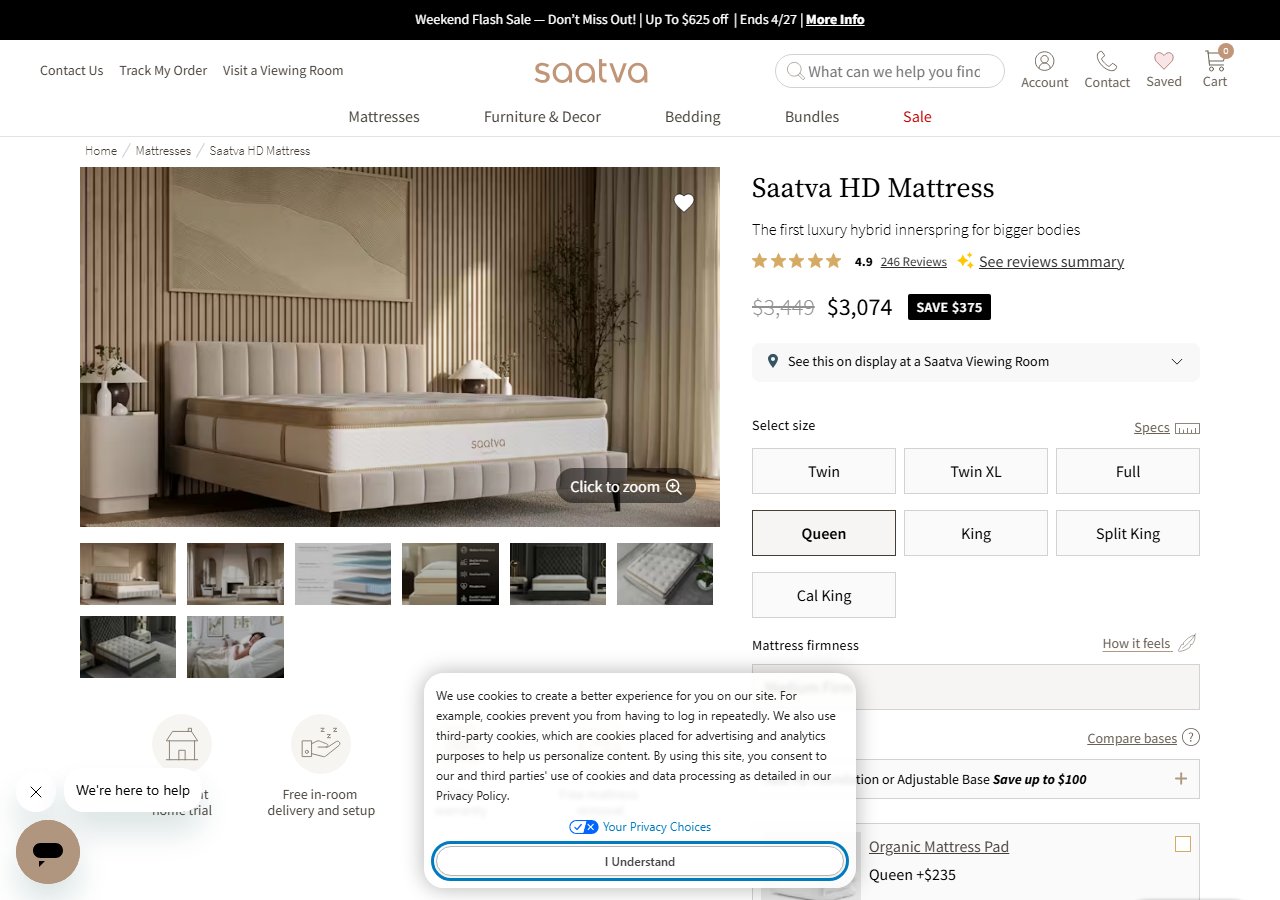
Saatva HD Mattress (Heavy-Duty)
$2,395-$3,995
See Price at Saatva →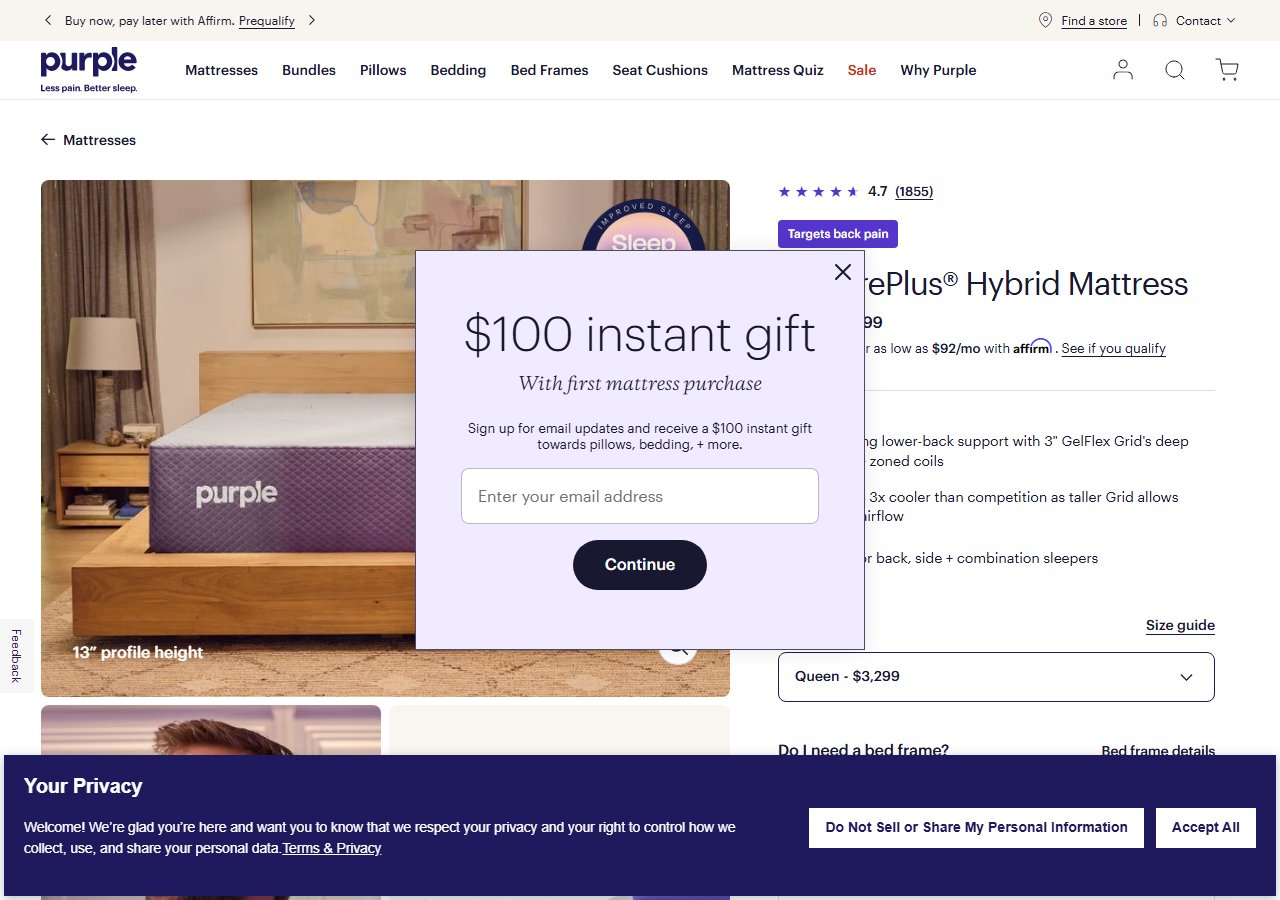
Purple Hybrid Premier Mattress
$2,499-$4,799
See Price at Purple →What the data hierarchy tells us about investment priorities
The federal data reviewed in this article supports a clear intervention hierarchy for warehouse workers managing chronic low back pain:
First: Modify sleep position — free, implementable tonight, and supported by NIH guidance with no downside risk.
Second: Add 30 minutes of daily walking to your off-shift routine — the NIH NCCIH evidence review rates this comparable to most non-drug clinical treatments for chronic low back pain.
Third: Audit and correct lifting mechanics, both at work (within the constraints of your job) and at home — OSHA documents that most acute back episodes are mechanical and preventable.
Fourth: If your mattress is older than 7 to 10 years, shows visible sag, or consistently leaves you stiffer than you started, replace it — but with a surface specifically engineered for your body weight and sleep position, not just one marketed with back-pain language.
Fifth: If you present any of the clinical red flags identified by NIH — pain radiating below the knee, leg weakness, bowel or bladder changes, post-trauma pain, or fever with back pain — see a clinician before taking any other step.
The total annual healthcare cost differential between adults with and without chronic back conditions, per AHRQ MEPS data, represents real money leaving warehouse workers' households — money that compounds over careers. The interventions above — especially the free ones — are not wellness noise. They are documented levers in the load-recovery equation that determines whether chronic back pain progresses or stabilizes.
Warehouse work is demanding in ways that most desk-job occupational health guidance does not address. The BLS data, the NIOSH lifting standards, the CDC sleep research — taken together, they outline a population under serious and documented musculoskeletal stress. The off-shift hours are not just downtime. They are the only window available for tissue repair. Managing that window deliberately, starting with position and movement and ending with equipment when warranted, is not optional for workers who intend to still be working — and walking without pain — ten years from now.