The Federal Data Behind Your Sore Back
If you work in a warehouse — picking orders, moving pallets, operating forklifts, unloading trailers — you already know the feeling: you clock out after eight or ten hours and your lumbar spine feels like it absorbed every repetition. What you may not know is that federal data confirms exactly what your body is telling you. The BLS Musculoskeletal Disorders by Occupation tracking consistently finds that the back is the single most injured body part across all U.S. occupations with days away from work. Not the shoulder, not the knee — the back. And within that universe, warehousing, transportation, and material-handling occupations cluster at the top of the incidence table year after year.
This is not a lifestyle complaint. It is a federally documented occupational hazard with a measurable economic footprint. SSA Disability Insurance data identifies musculoskeletal disorders as the largest single category of new disability claims filed annually in the United States. AHRQ HCUP data positions back pain as one of the most expensive conditions in U.S. healthcare by total inpatient and outpatient cost. And AHRQ MEPS data shows that adults living with chronic back conditions carry substantially higher annual personal healthcare expenditures than those without — costs that accumulate over a career.
This article is not going to sell you something in the first paragraph. It is going to walk you through the mechanism of warehouse-specific back loading, the free interventions that federal research says should come first, the clinical warning signs that mean you need a doctor not a mattress, and finally — for workers who have already done the free work — which sleep surfaces are actually engineered for the load patterns your job imposes on your spine.
Why Warehouse Work Breaks Down the Lumbar Spine
Understanding the injury mechanism matters because it tells you what recovery actually needs to address. The NIOSH Lifting Equation — the federal standard for assessing manual material-handling risk — documents that tasks common across warehousing routinely exceed the recommended weight limits that protect the spine from cumulative compressive loading. The equation calculates a Recommended Weight Limit (RWL) based on load weight, horizontal distance from the body, vertical position at lift start and finish, asymmetry of the lift, and lift frequency. In real warehouse conditions — pulling cases from the floor level of a pallet, reaching into a deep trailer, twisting to place product on a conveyor — the Lifting Index (actual load divided by the RWL) frequently exceeds 1.0, the threshold above which injury risk climbs meaningfully.
What this means biomechanically: each lift above safe limits generates compressive and shear forces on the lumbar intervertebral discs. The L4-L5 and L5-S1 segments — the lowest two mobile segments of the lumbar spine — are the most mechanically loaded during forward flexion and are the most common sites of disc herniation and degenerative change in manual-labor workers. Over a shift, these forces are not isolated events; they accumulate. Intradiscal pressure rises with each lift, each twist, each prolonged forward lean. Paraspinal muscles fatigue. When those muscles fatigue, passive structures — discs, ligaments, facet joint capsules — absorb greater share of the mechanical load. That is when acute injury risk spikes.
The occupational pattern extends beyond lifting. Warehouse workers often stand on concrete flooring for the full shift, a surface that offers no mechanical energy absorption. Concrete transmits ground reaction force directly up the kinetic chain — heel, knee, hip, lumbar spine — without the dampening that resilient flooring or footwear with adequate midsole cushioning would provide. Shift workers further complicate the picture: irregular sleep schedules suppress the circadian regulation of cortisol and growth hormone, both of which are involved in musculoskeletal tissue repair. A worker cycling through rotating shifts is not just tired — their body is biochemically less equipped to recover from the mechanical load of the previous shift.
The scale of the problem is visible in the workers' compensation data. BLS Employer Costs for Employee Compensation data shows that industries with high MSD incidence carry workers' compensation insurance rates 3 to 5 times higher than low-MSD industries. That premium is the actuarial market's pricing of exactly what NIOSH's Lifting Equation predicts: the spine takes damage at a predictable rate in these jobs, and the claims follow.
The chronic-pain downstream is equally measurable. CDC NHANES data compiled in NCHS Data Brief 390 estimates that approximately 20% of U.S. adults live with chronic pain, with the lower back as the most common pain location. Workers in physically demanding occupations are overrepresented in that 20%. CDC Arthritis data shows that roughly 25% of U.S. adults report doctor-diagnosed arthritis, with prevalence concentrated in occupations involving sustained physical demand — the category that includes warehouse work. These are not independent statistics; they describe the same population accumulating the same injuries over careers.
The Sleep Layer of the Problem
Recovery from musculoskeletal loading happens primarily during sleep. Intervertebral discs, which are largely avascular, rely on the cyclical loading and unloading of daily activity and sleep-position rest to circulate nutrients via diffusion. When you lie down at a neutral spinal posture, disc hydration partially restores. Paraspinal muscles relax. The compressive stack of gravity is removed. Sleep is not passive — it is when the biological repair processes that your waking hours defer finally get to run.
But federal sleep data tells us that a large share of American workers — including warehouse workers cycling through shifts — are not getting adequate sleep. CDC sleep surveillance data reports that approximately 35% of U.S. adults sleep fewer than 7 hours per night, the threshold below which chronic disease risk rises measurably. For shift workers specifically, circadian misalignment compounds total sleep time loss: you may be in bed for 7 hours but sleeping lightly across a disrupted architecture, getting less of the slow-wave and REM sleep that are most restorative for physical tissue repair.
The cost of inadequate recovery is not abstract. CMS Drug Spending Dashboard data identifies opioid and non-opioid pain medication among the most expensive Medicare drug categories — reflecting what happens when chronic-pain conditions are managed pharmacologically rather than addressed upstream through occupational load reduction and recovery optimization. The individual pathway from warehouse worker to chronic-pain patient to high-cost medication user is well-mapped in the aggregate federal data. The question is whether you can interrupt that pathway.
Try These First: Free and Low-Cost Interventions Backed by Federal Research
Before discussing any product, we want to be direct: the cheapest intervention is the one that does not require buying anything. Federal occupational health research has identified several evidence-based practices that address warehouse-specific back loading and recovery quality. These should be the first tools you exhaust.
The first is lifting mechanics. OSHA's ergonomics guidance is unambiguous: hinge at the hips rather than rounding the lumbar spine, keep loads as close to the body as possible, and never twist under load. The mechanical reason is that lumbar flexion under compressive load dramatically increases shear force on disc endplates. Most acute disc episodes are mechanical and rehearsable — meaning that retraining the movement pattern is achievable and durable. If your facility offers ergonomics training, it is worth taking seriously rather than treating as a compliance box-check.
The second intervention is daily walking. The NIH National Center for Complementary and Integrative Health's evidence review on low-back pain concludes that walking 30 minutes most days reduces chronic low back pain as effectively as most non-drug clinical treatments. This is a remarkable finding: a zero-cost, zero-equipment intervention performs comparably to clinical interventions that cost orders of magnitude more. For warehouse workers whose jobs already involve walking, this may seem counterintuitive — but structured recreational walking at a moderate pace, without the loading and lifting of a work shift, has a different mechanical profile and different neuromuscular benefit.
The third is sleep position. NIH guidance from NIAMS identifies sleep posture as a meaningful, free variable: side-sleeping with a pillow between the knees, or back-sleeping with a pillow under the knees, maintains lumbar neutral alignment. Stomach-sleeping — a common default — introduces sustained hyperextension at the lumbar spine and sustained cervical rotation. For workers whose spines are already mechanically stressed during the day, eight hours of poor positional loading during sleep is not trivial. This is the single highest-leverage zero-cost change most people can make.
The fourth is mattress audit. CDC sleep hygiene guidance recommends replacing a mattress if it shows visible sag, if you consistently wake stiffer than you went to bed, or if it is older than 7 to 10 years. Even a high-quality sleep surface cannot compensate for poor sleep hygiene, inadequate total sleep time, or unaddressed occupational loading — but a mattress that no longer provides neutral spinal support actively adds to the problem. Before evaluating any specific product, run through this checklist honestly.
For workers who have already implemented the free interventions — corrected their lifting mechanics, built a walking habit, optimized sleep position, confirmed their mattress is not visibly deteriorated — and are still waking with significant lumbar stiffness or pain, a sleep surface specifically engineered for the mechanical demands of physically intensive work is a reasonable next step. The key word is engineered: not every mattress that markets itself to back-pain sufferers is actually designed for the load patterns warehouse workers bring to bed.
When to See a Clinician First
Before any discussion of equipment, it is critical to identify symptoms that require clinical evaluation, not a product purchase. NIH National Institute of Neurological Disorders and Stroke back pain guidance is explicit about the warning signs that should prompt prompt medical attention rather than self-management.
Back pain that radiates below the knee — particularly pain, numbness, or tingling that tracks down the back of the leg into the calf or foot — suggests nerve root compression and requires clinical assessment. Back pain following trauma (a fall from height, a heavy impact, a vehicle accident) warrants imaging to rule out fracture. New bowel or bladder dysfunction in the context of back pain is a spinal emergency. Leg weakness disproportionate to pain, or back pain accompanied by unexplained fever, weight loss, or night sweats, are red flags for infectious or oncologic etiologies that are unrelated to mechanical loading and will not respond to any sleep surface. For these presentations, see a clinician before doing anything else.
For workers who have been dealing with low-grade, mechanical, activity-related lumbar pain for months — the kind that gets better with rest and worse with lifting — self-management supported by the interventions above, and eventually a well-chosen sleep surface, is a reasonable and evidence-consistent approach. If that pain is not improving with consistent intervention over 4 to 6 weeks, schedule a visit. AHRQ MEPS data documents that chronic back conditions carry substantially higher long-term healthcare costs than conditions addressed early; early clinical contact for persistent pain is economically rational, not just medically prudent.
Where Sleep Surfaces Enter the Equation
For warehouse workers who have done the work above and are still looking for a sleep surface that will support recovery from high-load manual labor shifts, the engineering characteristics that matter most are: zoned or differentiated support (so the lumbar region receives more resistance than the shoulders), pressure relief at the hips and shoulders (to reduce the repositioning that fragments sleep), edge support (so you do not roll off alignment at the edge of the mattress), and durability under heavier-body-weight compression (because a mattress that is rated for average weight may compress too quickly under a worker who carries more mass or has a heavier upper body from years of manual labor).
The Saatva Loom & Leaf Memory Foam Mattress is the first product we'd point warehouse workers toward for serious lumbar support. Loom & Leaf uses a multi-layer memory foam construction with a lumbar zone enhancement — a targeted layer of firmer support engineered specifically into the mid-section of the mattress where the lumbar spine rests. For workers dealing with the kind of paraspinal fatigue that accumulates across a 10-hour warehouse shift, a mattress that actively supports the lumbar curve rather than allowing it to sag into the foam is a meaningful ergonomic distinction. It is available in Relaxed Firm and Firm profiles; warehouse workers dealing with chronic low-back pain consistently report better results on firmer configurations that prevent excessive lumbar sinkage.
For workers in the heavier-duty category — or those who have found that standard mattresses compress and lose support faster than advertised — the Saatva HD Mattress was specifically engineered for big-and-tall users and for occupational contexts involving higher body weight and more mechanical wear on a sleep surface. The HD's construction includes a higher-density foam base, a heavier-gauge coil system, and additional lumbar zone reinforcement. A warehouse worker who stands 6'2" and weighs 240 pounds is not in the same load category as the median mattress buyer — a mattress engineered to that load profile will hold its support geometry longer and provide more consistent spinal alignment across years of use.
For workers whose primary complaint is pressure point pain — hips that ache through the night, shoulder pain that accumulates in a single sleep position — the Purple Hybrid Premier Mattress offers a distinct engineering approach. Purple's GelFlex Grid is a polymer grid structure that deflects under point loads (pressure points like hip and shoulder) while remaining firm under distributed loads (the broader surface area of the torso). For a warehouse worker who is a side-sleeper and finds that their hip digs into a conventional foam mattress and triggers lateral lumbar pain, this grid-over-coil construction provides a different pressure-relief mechanism than layered foam.
Sleep Surfaces Engineered for Warehouse Worker Lumbar Recovery
These three mattresses were selected for their zoned lumbar support, durability under higher mechanical loads, and pressure-relief characteristics relevant to workers recovering from high-repetition manual material handling.

Saatva Loom & Leaf Memory Foam Mattress
$1,695-$3,295
See Price at Saatva →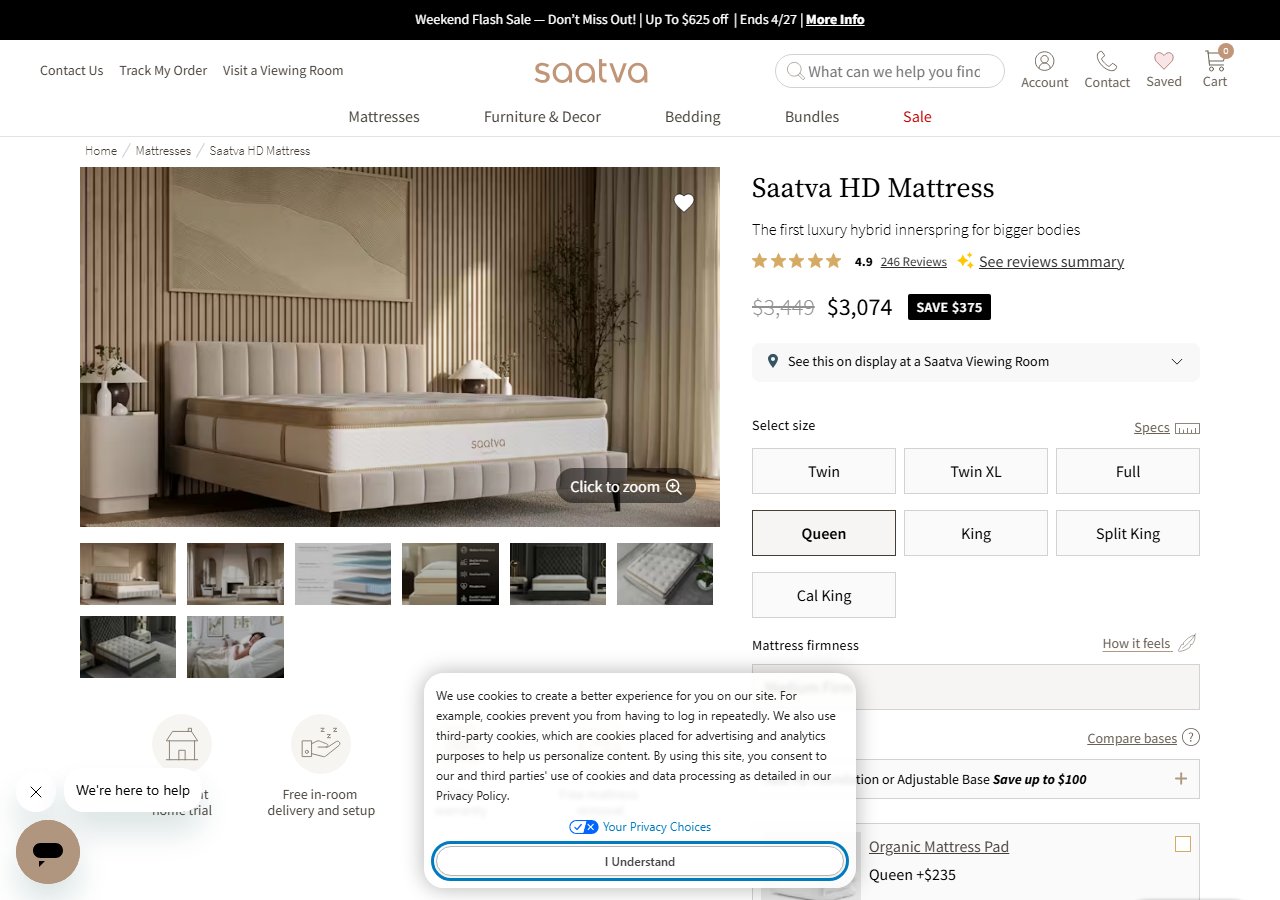
Saatva HD Mattress (Heavy-Duty)
$2,395-$3,995
See Price at Saatva →
Purple Hybrid Premier Mattress
$2,499-$4,799
See Price at Purple →What the Federal Data Is Actually Telling You
Taken together, the BLS, NIOSH, CDC, SSA, and AHRQ data paint a consistent picture: warehouse work generates real, measurable, mechanically predictable spinal loading that accumulates across careers. Workers in these occupations are disproportionately represented in chronic pain statistics, disability claims, and high-cost healthcare utilization. The downstream of unmanaged occupational back loading is expensive — personally in healthcare costs and lost wages, and systemically in workers' compensation premiums and disability insurance.
The hierarchy of intervention that federal research supports is: first, correct the mechanics (OSHA lifting guidance); second, add movement (NIH NCCIH walking evidence); third, optimize sleep position (NIH NIAMS posture guidance); fourth, audit your current sleep surface (CDC sleep hygiene); and finally, if you have done all of that and are still waking with significant lumbar pain, consider a sleep surface engineered for your load profile.
A mattress is not a treatment. It is one variable in a recovery equation that also includes how you move during the shift, how much total sleep you get, and whether any of your symptoms warrant clinical attention. But for a worker who spends eight or nine hours on a sleep surface that was designed for median body weight and median mechanical stress — and whose job exceeds both of those assumptions every single day — upgrading to a surface that matches the actual engineering requirements of your life is not a luxury purchase. It is applied occupational health, executed at home.
The federal data does not recommend specific mattresses. That is not what federal agencies do. What the data does — unambiguously — is establish that warehouse workers carry a disproportionate spinal load burden, that recovery quality during off-duty hours matters for cumulative injury prevention, and that sleep surface characteristics are a real and modifiable variable in that recovery. Use the data to make the decision that makes sense for your body, your shift schedule, and your budget.