The federal data is blunt: warehouse work is a back injury machine
You already know this in your body. After a 10-hour shift picking orders, loading pallets, or driving a forklift over cracked concrete floors, your lower back doesn't just ache — it feels compressed, like something is slowly being wrung out of alignment. Federal data confirms what you feel: BLS Musculoskeletal Disorders by Occupation tracking consistently identifies the back as the most injured body part across all U.S. occupations involving days away from work. This is not a warehouse-specific finding. It's an all-industry finding, which makes it even more striking when you consider that warehousing and storage is one of the highest-volume MSD sectors in the country.
The cost of that injury pattern is not abstract. AHRQ HCUP data ranks back pain among the most expensive conditions in U.S. healthcare by total inpatient and outpatient spending. SSA Disability Insurance reports identify musculoskeletal disorders as the single largest category of new disability claims filed annually. And BLS Employer Costs for Employee Compensation data shows that industries with high MSD incidence carry workers' compensation insurance rates 3 to 5 times higher than low-MSD industries — a cost that employers eventually price into wages and benefits packages. The worker pays twice: first in physical pain, then in suppressed compensation.
This article exists at the intersection of those two facts. The question isn't whether warehouse work damages backs. The data settled that. The question is what happens during the 8 hours you're supposed to be recovering — and whether your sleep surface is helping or quietly making things worse.
Why warehouse work specifically destroys the lumbar spine
Understanding why your back is at risk requires a brief look at spinal biomechanics under occupational load. The lumbar spine — the five vertebrae at the base of your back — is designed to handle compressive load, but within a range. The intervertebral discs between those vertebrae are essentially hydraulic shock absorbers: fibrocartilage rings (annulus fibrosus) filled with a gel-like nucleus. Under repeated compressive load, especially combined with flexion and rotation, the nucleus can migrate outward, producing herniation, nerve impingement, and the radiating pain that warehouse workers know as the sensation of "electricity shooting down the leg."
The NIOSH Lifting Equation is the federal benchmark for safe manual material handling. It establishes a Recommended Weight Limit (RWL) based on load weight, horizontal distance from the body, vertical position of the lift, asymmetry (twisting), and lift frequency. NIOSH's own documentation confirms that manual material-handling tasks across warehousing, construction, and healthcare routinely exceed safe spinal loading limits — not occasionally, but as a structural feature of how these jobs are designed. A picker pulling 200 units per shift is not just performing repetitive motion; they are performing repetitive overload.
Shift structure compounds this. The rise of 10-hour and 12-hour warehouse shifts — accelerated by e-commerce fulfillment demands — means workers are sustaining spinal load for durations that exceed what lumbar musculature and disc tissue are designed to tolerate. Fatigue in the erector spinae and multifidus (the deep stabilizing muscles of the spine) increases the mechanical load transferred directly to discs and facet joints. A worker who is physically fatigued by hour eight is lifting with significantly less muscular protection than they had in hour one. That is the moment when acute injuries happen.
And then comes the shift to horizontal rest. After hours of compressive vertical loading, warehouse workers lie down on whatever sleep surface they have — and that surface either supports spinal decompression or continues to load the lumbar spine in new, passive ways.
The sleep-recovery gap in physically demanding occupations
CDC sleep data shows approximately 35% of U.S. adults report sleeping fewer than 7 hours per night, the threshold below which chronic disease risk — including musculoskeletal disease — rises measurably. Among shift workers specifically, sleep deprivation rates are substantially higher due to circadian disruption, social obligations that compress rest windows, and the physical discomfort that makes it hard to reach deep sleep stages.
This matters biomechanically. Intervertebral disc nutrition is largely avascular — discs receive nutrients and expel metabolic waste products through a diffusion process called imbibition, which is most active during horizontal rest. When you lie down, intradiscal pressure drops dramatically compared to standing or sitting under load, allowing discs to rehydrate. Chronic sleep deprivation, or sleep spent on a surface that maintains abnormal spinal alignment, reduces this recovery window. Over time, disc dehydration contributes to the degenerative disc disease that shows up in warehouse workers' MRI reports in their forties and fifties.
CDC NCHS Data Brief 390 reports that approximately 20% of U.S. adults experience chronic pain, with lower back as the most common pain location. Among physically demanding occupations, that prevalence is almost certainly higher — and a meaningful portion of that chronic pain burden is modifiable through the interventions covered below.
Addressing the real costs before you spend on equipment
AHRQ Medical Expenditure Panel Survey data documents that adults with chronic back conditions spend substantially more on personal healthcare annually than adults without such conditions. CMS drug spending data identifies opioid and non-opioid pain medication among the most expensive Medicare drug categories — a downstream indicator of how undertreated and undertreated-by-appropriate-means chronic back pain tends to become. The healthcare system's default response to occupational back pain has historically been pharmacological, when the evidence base for movement and postural interventions is at least as strong.
The cheapest intervention is the one that requires buying nothing. Before evaluating sleep surfaces, warehouse workers should audit the free variables: lifting mechanics, sleep position, daily movement volume, and mattress age. These interventions are drawn from federal health agency guidance and carry genuine evidence weight.
For readers who have already worked through the free interventions — who sleep in correct position, walk daily, lift with good mechanics, and still wake up stiff — the sleep surface becomes a legitimate variable. It is one variable among several, not a magic fix. But for a worker whose lumbar spine is under 10 hours of occupational load daily, even marginal improvements in spinal alignment during sleep can compound favorably over months.
When the pain isn't just mechanical: clinical red flags for warehouse workers
Not every back issue a warehouse worker experiences is a sleep or ergonomics problem. Some presentations require medical evaluation before any lifestyle or equipment intervention. Buying a new mattress for symptoms that actually indicate nerve compression, spinal stenosis, or a systemic condition is not just wasted money — it delays care that matters.
NIH National Institute of Neurological Disorders and Stroke guidance on back pain is clear: see a clinician promptly if your back pain radiates below the knee, follows a traumatic event, is accompanied by leg weakness, bowel or bladder changes, or unexplained fever. These presentations are not ergonomic problems. They are medical problems. The same applies to pain that wakes you from sleep consistently, is worse at night than during activity, or is accompanied by unintended weight loss — patterns that can indicate inflammatory or oncologic causes rather than mechanical overload.
For warehouse workers specifically, the risk of ignoring these signals is elevated. The culture in physically demanding occupations frequently normalizes pain as an expected cost of the job, which delays diagnosis. CDC arthritis data shows approximately 25% of U.S. adults report doctor-diagnosed arthritis, with prevalence concentrated in occupations involving sustained physical demand — meaning many warehouse workers who attribute their stiffness to a bad mattress may actually have an inflammatory joint condition that responds to clinical treatment.
Where the sleep surface fits into recovery: what the evidence actually supports
Once mechanical red flags are ruled out and free interventions are in place, the sleep surface becomes a legitimate recovery tool. The research on mattresses and back pain is less robust than the federal injury data — most sleep surface studies are industry-funded and small — but the biomechanical rationale is sound: a surface that allows the lumbar spine to maintain its natural curve (not sag into flexion, not be pushed into extension) reduces the muscular bracing required during sleep and allows deeper, less-interrupted rest.
For warehouse workers specifically, a few construction features matter more than brand marketing:
Zoned lumbar support — A mattress that provides firmer support under the lumbar region and softer pressure relief at the shoulders and hips keeps the spine in a more neutral alignment for side sleepers, which is the position recommended by NIH back pain guidance for lumbar pain sufferers.
Body weight accommodation — Warehouse work attracts a range of body types, and mattress compression behavior is heavily body-weight-dependent. A surface that performs well for a 160-pound office worker may bottom out for a 240-pound warehouse worker, eliminating the zoned support entirely. Coil gauge, foam density, and overall mattress height all interact with body weight.
Heat management — Warehouse environments are often temperature-extreme, and workers who run hot during sleep experience fragmented sleep that cuts into disc recovery time. Mattresses with phase-change materials, open-cell foams, or hybrid constructions that allow airflow reduce this disruption.
Durability under sustained load — A mattress rated for average consumer use may develop body impressions faster under heavier, more physically fatigued users. Impressions deeper than 1.5 inches represent a meaningful loss of spinal support and are a valid reason to replace a mattress before its expected lifespan.
The three sleep surfaces worth considering for warehouse workers
With those criteria in mind, three options stand out for this specific reader — not because of their marketing, but because of their construction specs and how those specs address the biomechanical pressures documented above.
For workers dealing with serious chronic lower back pain and who want premium memory foam that contours precisely to lumbar curvature, the Saatva Loom & Leaf Memory Foam Mattress is the first option to evaluate. It uses high-density memory foam (5 lb/cu ft density, versus the 3 lb density common in budget foam beds) that resists the body-impression problem over time. The construction includes a cooling gel layer above the memory foam layer — relevant for workers who run hot after physically demanding shifts — and an organic cotton cover. At $1,695–$3,295 depending on size, it is not a budget option, but for a worker who spends 10 hours per day loading their spine and 8 hours per day on their mattress, the per-night cost math is more defensible than it appears at the sticker price.
For heavier-framed warehouse workers — the workers for whom standard mattresses bottom out and lose their zoned support within months — the Saatva HD Mattress is explicitly engineered for this use case. Rated for users up to 500 lbs per side, it uses a dual coil system with individually wrapped micro-coils sitting atop a base of tempered steel coils, providing the kind of deep support that body weight demands without sacrificing the surface conformability that pressure relief requires. The lumbar zone is reinforced with additional coil count and foam encasement. This is not a mattress that happens to work for larger-framed workers; it is a mattress specifically built around that load profile — which maps directly to the BLS and NIOSH data on who is carrying the heaviest occupational injury burden.
For workers whose primary complaint is pressure buildup — the hip and shoulder soreness that develops when a dense mattress doesn't yield enough at high-pressure contact points — the Purple Hybrid Premier Mattress offers a different mechanical approach. Purple's GelFlex Grid is a hyper-elastic polymer grid rather than foam or coil, and its unique property is that it collapses under pressure points while remaining rigid under lower-pressure areas like the lumbar span. This means it can simultaneously provide lumbar support and pressure relief at the hips — a combination that standard foam mattresses struggle to achieve. At $2,499–$4,799, it sits at the top of this price range, but for workers with hip-dominant pressure complaints layered on top of lumbar pain, the construction logic is specific.
Sleep Surfaces Engineered for Warehouse Worker Lumbar Recovery
These three mattresses were selected based on construction features that directly address the spinal loading patterns documented in BLS and NIOSH data for manual material-handling workers: zoned lumbar support, body-weight accommodation, heat management, and long-term durability under sustained compressive use.

Saatva Loom & Leaf Memory Foam Mattress
$1,695-$3,295
See Price at Saatva →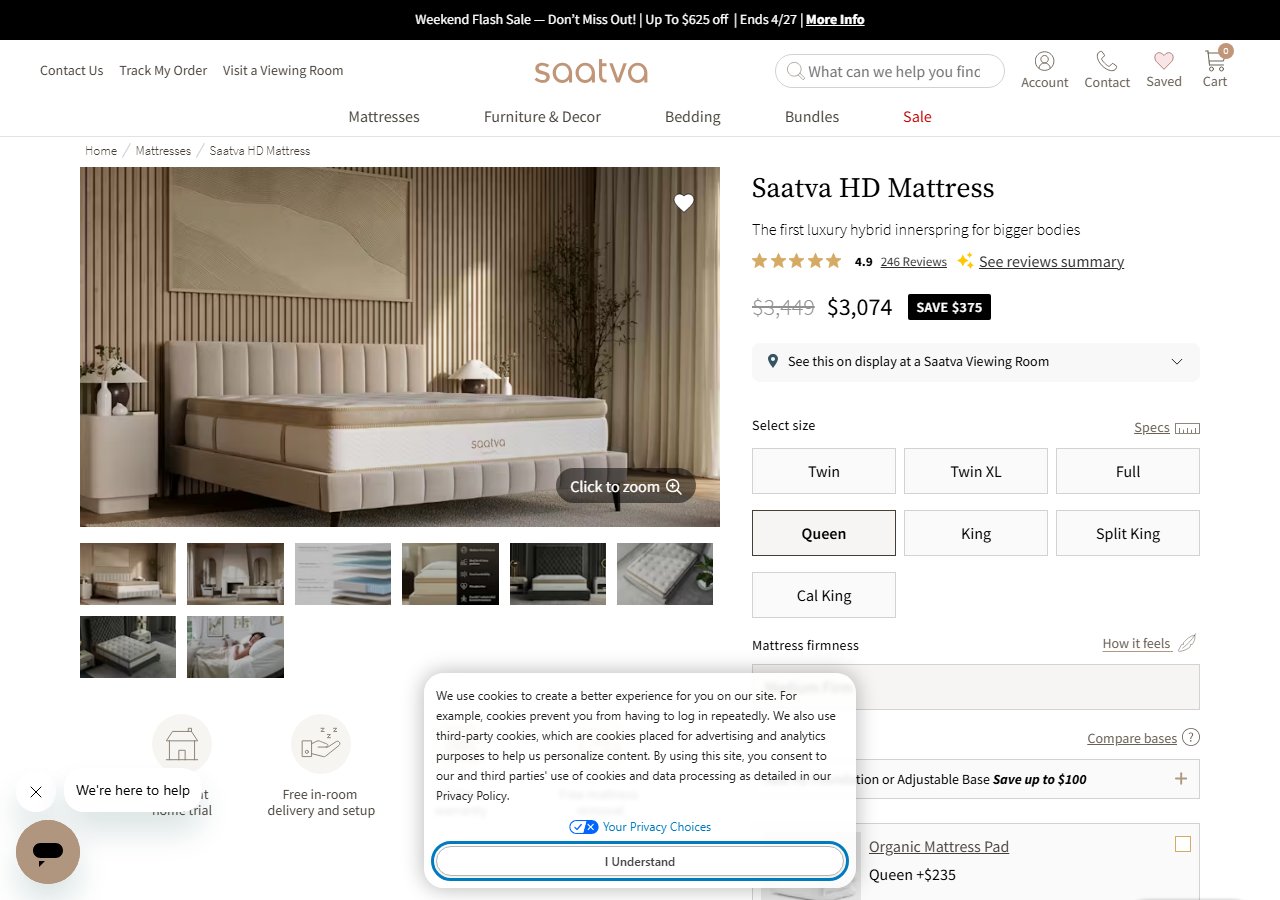
Saatva HD Mattress (Heavy-Duty)
$2,395-$3,995
See Price at Saatva →
Purple Hybrid Premier Mattress
$2,499-$4,799
See Price at Purple →Putting it all together: the data-to-recovery hierarchy
The federal data tells a consistent story. Warehouse work loads the lumbar spine at rates that routinely exceed NIOSH's documented safe limits. That load accumulates across shifts, across years, and across the career arc of a physically demanding occupation. The back is the most injured body part in U.S. workplaces with days away from work. Musculoskeletal disorders are the largest single category of new SSA disability claims. Back pain is among the costliest conditions in the entire U.S. healthcare system by AHRQ's accounting.
Sleep is the primary biological window for soft-tissue repair and disc rehydration. If that window is shortened by inadequate sleep duration — as it is for approximately 35% of U.S. adults per CDC data — or degraded by a sleep surface that maintains poor spinal alignment through the night, the recovery deficit compounds. The body goes back to the warehouse each shift with less repair than it needed.
The hierarchy of interventions is clear. Lift mechanics and movement come first — they address the loading problem at its source. Sleep position comes next — it is free and immediately modifiable. Mattress age and condition are evaluated third, because a visibly sagging or decade-old mattress is a legitimate structural problem. Clinical evaluation comes whenever red flags are present, without delay.
The sleep surface is the last variable to change, but for a worker who has done everything else right and still wakes up stiff, it is a legitimate lever. The construction features that matter — foam density, zoned lumbar support, body-weight accommodation, heat management, and long-term durability — are all traceable back to the biomechanical problems that federal data has documented for decades in this workforce. Choose by construction spec, not by brand marketing. Your back has enough to deal with on the clock.