The federal data on warehouse lumbar injury is not subtle
According to BLS Musculoskeletal Disorders by Occupation tracking, the back is the most common body part injured across all U.S. occupations with days away from work — and warehousing and storage consistently appears at the top of industry-level MSD incidence tables. That is not a coincidence. It is the predictable output of a job that involves repetitive bending, sustained static loading, awkward postures, and cumulative spinal compression that builds over an 8- to 12-hour shift.
The financial signal is just as stark. BLS Employer Costs for Employee Compensation data shows that industries with high MSD incidence carry workers' compensation insurance rates 3–5 times higher than low-MSD industries. Employers absorb that premium partly because the workers absorbing the physical load — people stacking, scanning, pulling, and palletizing — are taking damage that does not fully reverse overnight. When the back is the injury site and sleep is the primary recovery window, the quality of that sleep window matters in a way it simply does not for desk workers.
This article is built on a single premise grounded in federal occupational health data: if your back is being stressed beyond safe biomechanical limits during every shift, the 6–8 hours you spend in contact with a sleep surface are among the highest-leverage recovery hours available to you. Getting those hours right does not require starting with a product purchase. It requires understanding the mechanism first.
Why warehouse work specifically destroys the lumbar spine
The NIOSH Lifting Equation is a federal engineering tool used to assess whether a given manual material-handling task exceeds the spinal loading threshold considered safe for the majority of the working population. The threshold — a Recommended Weight Limit (RWL) calculated from load weight, horizontal distance from the body, vertical height, asymmetry, and lift frequency — is routinely exceeded in real warehousing environments. NIOSH documents this explicitly: manual material-handling tasks across warehousing, construction, and healthcare routinely exceed safe spinal loading limits.
What does exceeding the RWL repeatedly, across an 8-hour shift, actually do to spinal tissue? The intervertebral discs — the shock-absorbing cartilage structures between each lumbar vertebra — are avascular. They receive nutrients through diffusion from surrounding tissue, a process that depends heavily on position changes and offloading. When a warehouse worker spends hours in a forward-flexed, axially loaded posture, fluid is expressed from disc tissue faster than it can be replenished. The result is disc dehydration, reduced disc height, and increased vulnerability to annular tears — the structural precursor to herniation.
The paraspinal musculature — the erector spinae, multifidus, and quadratus lumborum — experience prolonged eccentric contraction during lifting and reach their fatigue threshold well before a shift ends in physically demanding workers. Once fatigued, these muscles are less effective at distributing spinal load, shifting stress to passive structures: facet joints, ligaments, and disc annulus. This is why back injuries in warehousing are not random events but rather the final failure in a cumulative loading model.
The CDC reports that approximately 20% of U.S. adults experience chronic pain, with lower back as the most common pain location. Warehousing workers are disproportionately represented in that 20% — chronic occupational spinal loading is one of the clearest etiological pathways into the chronic back pain population. And once there, the costs compound quickly: AHRQ MEPS data shows that average annual personal healthcare expenditures for adults with chronic back conditions substantially exceed costs for those without — and AHRQ HCUP data identifies back pain as one of the most expensive conditions in U.S. healthcare by total inpatient and outpatient cost.
The SSA Disability Insurance reports identify musculoskeletal disorders as the largest single category of new disability claims annually. For a warehouse worker in their 40s with a decade of cumulative spinal loading, that statistic is not abstract — it is a career risk.
Sleep as a lumbar recovery variable — what federal data tells us
Sleep is when the body rebuilds. Spinal discs rehydrate during recumbent rest because axial load is removed and osmotic pressure draws fluid back into the nucleus pulposus. The paraspinal musculature undergoes protein synthesis and metabolic waste clearance. Inflammatory mediators released during tissue stress are downregulated. For a warehouse worker, this is not passive rest — it is active biological maintenance of the primary anatomical structures under occupational threat.
Now consider what CDC sleep data shows: approximately 35% of U.S. adults report sleeping fewer than 7 hours per night — the threshold the CDC associates with elevated chronic disease risk. Shift workers, including the large share of warehouse employees working non-standard hours, consistently report worse sleep duration and quality than day-shift workers. The recovery window is already compressed. If the sleep surface itself imposes additional biomechanical stress — a sagging mattress that collapses the lumbar spine into flexion, or an overly firm surface that creates sustained pressure at the sacrum and hips — the already-shortened recovery window becomes less effective.
Furthermore, CDC arthritis data documents that approximately 25% of U.S. adults report doctor-diagnosed arthritis, with prevalence concentrated in occupations involving sustained physical demand. Arthritis in the lumbar facet joints — a common sequela of years of repetitive spinal loading — is particularly position-sensitive during sleep. A surface that does not support lumbar lordosis can cause hours of sustained facet joint compression that keeps inflammatory signaling elevated rather than allowing it to resolve.
The implication is straightforward: for a warehouse worker, the sleep surface is not a comfort product. It is occupational recovery infrastructure. But infrastructure is not the first intervention. The first interventions cost nothing.
Try these first — free interventions that move the needle before any product purchase
The cheapest intervention is the one that does not require buying anything. Federal health agencies have documented several behavioral and mechanical modifications that demonstrably reduce chronic low back pain burden — and every one of them should be in place before a mattress purchase enters the conversation. The evidence for these is as strong or stronger than the evidence for any particular sleep product.
Daily walking is the most underrated tool in this context. NIH NCCIH's evidence review of low back pain interventions finds that walking 30 minutes most days reduces chronic low back pain as effectively as most non-drug clinical treatments. For a warehouse worker who is already on their feet all shift, this prescription sounds counterintuitive — but the difference is posture and pace. Walking with neutral spinal alignment and a comfortable gait pattern provides low-load spinal mobilization that accelerates disc rehydration and reduces paraspinal stiffness. A mattress cannot do that.
Sleep position is the biggest free variable available to you tonight. NIH guidance on back pain is explicit: side-sleeping with a pillow between the knees or back-sleeping with a pillow under the knees keeps the spine in a mechanically neutral position. Stomach-sleeping — which an estimated 16% of adults prefer — torques the lumbar spine into extension and lateral rotation simultaneously, loading facet joints in a sustained, unresolved position for hours. Changing sleep position is free and has immediate effect on morning stiffness.
OSHA's ergonomics guidance on lifting mechanics — hinging at the hips, keeping loads close to the body, avoiding twisting under load — is the upstream intervention that determines how much damage the back absorbs during a shift. Most acute back episodes in warehousing are mechanical and rehearsable. Better technique on the floor means less total spinal stress arriving at the recovery window each night.
Finally, the mattress itself may simply need to be replaced rather than upgraded. CDC sleep hygiene guidance and general clinical consensus identify visible sag, waking stiffer than you went to bed, and mattress age beyond 7–10 years as the primary replacement triggers. A sagging mattress creates a hammock effect that holds the lumbar spine in sustained flexion — no sleep position correction fully overcomes that.
For readers who have already addressed sleep position, mattress age, lifting mechanics, and daily activity — and who are still waking with lumbar stiffness or experiencing disrupted sleep from back pain — a targeted equipment upgrade is a legitimate next step. The evidence base for specific mattress construction approaches and spinal recovery is thinner than we would like (no randomized controlled trials with warehouse workers specifically), but biomechanical principles and the clinical literature on spinal load distribution during sleep give us enough signal to make defensible product choices.
When to see a clinician first — red flags that no mattress addresses
Before any product recommendation, a direct statement about clinical red flags: certain back pain presentations in warehouse workers are medical emergencies or serious pathology that require imaging and professional evaluation — not a new sleep surface. Purchasing equipment for these conditions delays appropriate care and can allow serious conditions to progress.
NIH National Institute of Neurological Disorders and Stroke guidance is clear: see a clinician promptly for back pain that radiates below the knee, follows significant trauma, presents with leg weakness, accompanies bowel or bladder changes, or occurs with fever. These are not symptoms that a supportive mattress can address. They are symptoms that warrant urgent evaluation for disc herniation with nerve compression, cauda equina syndrome, vertebral fracture, or infectious or malignant spinal pathology.
For the broader warehouse worker population with chronic, non-radicular lumbar pain — the more common presentation — a primary care visit or occupational health evaluation is still a reasonable early step. CMS drug spending data identifies opioid and non-opioid pain medication spending among the most expensive Medicare drug categories, reflecting the enormous chronic-pain treatment burden in the U.S. A clinician who practices evidence-based occupational medicine may redirect you toward physical therapy, targeted exercise, and behavioral sleep strategies long before medication or imaging — and certainly before equipment.
The red flags that demand clinical evaluation before any product purchase are summarized below.
Where a sleep surface actually helps — and what to look for
For warehouse workers without clinical red flags, with appropriate sleep position habits, with a mattress older than 7 years or showing visible sag, or with persistent morning lumbar stiffness despite behavioral corrections — the sleep surface is a legitimate intervention target. Here is what the biomechanical literature and product construction tell us to prioritize.
Zoned support matters most for back pain sleepers. A mattress with differentiated firmness zones — softer under the shoulders to allow them to sink and maintain thoracic alignment, firmer under the hips and lumbar to prevent the pelvis from dropping into flexion — directly addresses the neutral-spine problem. Standard uniform-firmness mattresses work adequately for many people but were not designed around the lumbar lordosis preservation that chronic-back-pain sleepers need.
Body-weight-appropriate support is the variable most overlooked in consumer mattress guidance. A 165-pound person and a 265-pound person have fundamentally different compression loads on the same surface. For heavier individuals — a category that includes a significant share of warehouse workers who carry higher body weight from muscle mass or general build — standard consumer mattresses compress beyond their designed support range, causing the hammock effect that no amount of foam quality can overcome.
Temperature regulation is a practical variable for shift workers, who often sleep during non-standard hours when ambient temperature is higher. A sleep surface that traps heat disrupts sleep architecture in ways that reduce deep sleep duration — the phase most associated with physical recovery.
With those criteria in mind, here are the three products we evaluated for this specific reader profile.
The Saatva Loom & Leaf Memory Foam Mattress is our premium memory foam pick for warehouse workers with serious lumbar pain. Saatva builds it with a 5-lb-density memory foam comfort layer — denser than the 3- to 4-lb foam used in most mid-market options — which provides superior pressure relief at the hips and lumbar without the excessive sinking that causes spinal flexion. The dual-layer support core and lumbar zone reinforcement directly address the neutral-lordosis problem. For a warehouse worker whose back is inflamed and compressed at the end of a shift, landing on a surface with genuine pressure relief (not just softness) is a meaningful biomechanical distinction. The Loom & Leaf comes in Relaxed Firm and Firm configurations; most back-pain sleepers with lumbar issues do better in Relaxed Firm unless they are stomach sleepers.
The Saatva HD Mattress is the specific pick for warehouse workers who are 250 pounds or above, or who have noticed that their current mattress compresses toward the center under their weight. Saatva engineered the HD explicitly for higher body-weight sleepers: it uses a 3-inch comfort layer over a dual steel coil system with individually wrapped coils that respond to localized pressure and a 20-gauge tempered steel base coil system that maintains support geometry over time. The construction does not just accommodate higher weight — it is load-rated for it. For a warehouse worker who has been sleeping on a standard consumer mattress that was never designed for their body weight, the HD may be the single highest-leverage equipment change available.
The Purple Hybrid Premier Mattress earns its place in this list through a different mechanism: the GelFlex Grid, Purple's proprietary polymer grid, neutrally responds to pressure rather than conforming directionally like foam. This means it supports the lumbar in neutral without actively pushing back in a way that some foam sleepers find uncomfortable. The grid also collapses under pressure points — hips, shoulders — without sinking the surrounding surface, which preserves spinal alignment across body positions. For warehouse workers who are active combination sleepers (shifting between side and back throughout the night), the Purple Hybrid Premier accommodates position changes without the motion penalty that dense foam imposes.
Mattresses Built for Warehouse Worker Lumbar Recovery
These three mattresses were selected specifically for warehouse workers dealing with chronic occupational spinal loading — evaluated on zoned support, body-weight-appropriate compression resistance, and thermal regulation for shift workers.

Saatva Loom & Leaf Memory Foam Mattress
$1,695-$3,295
See Price at Saatva →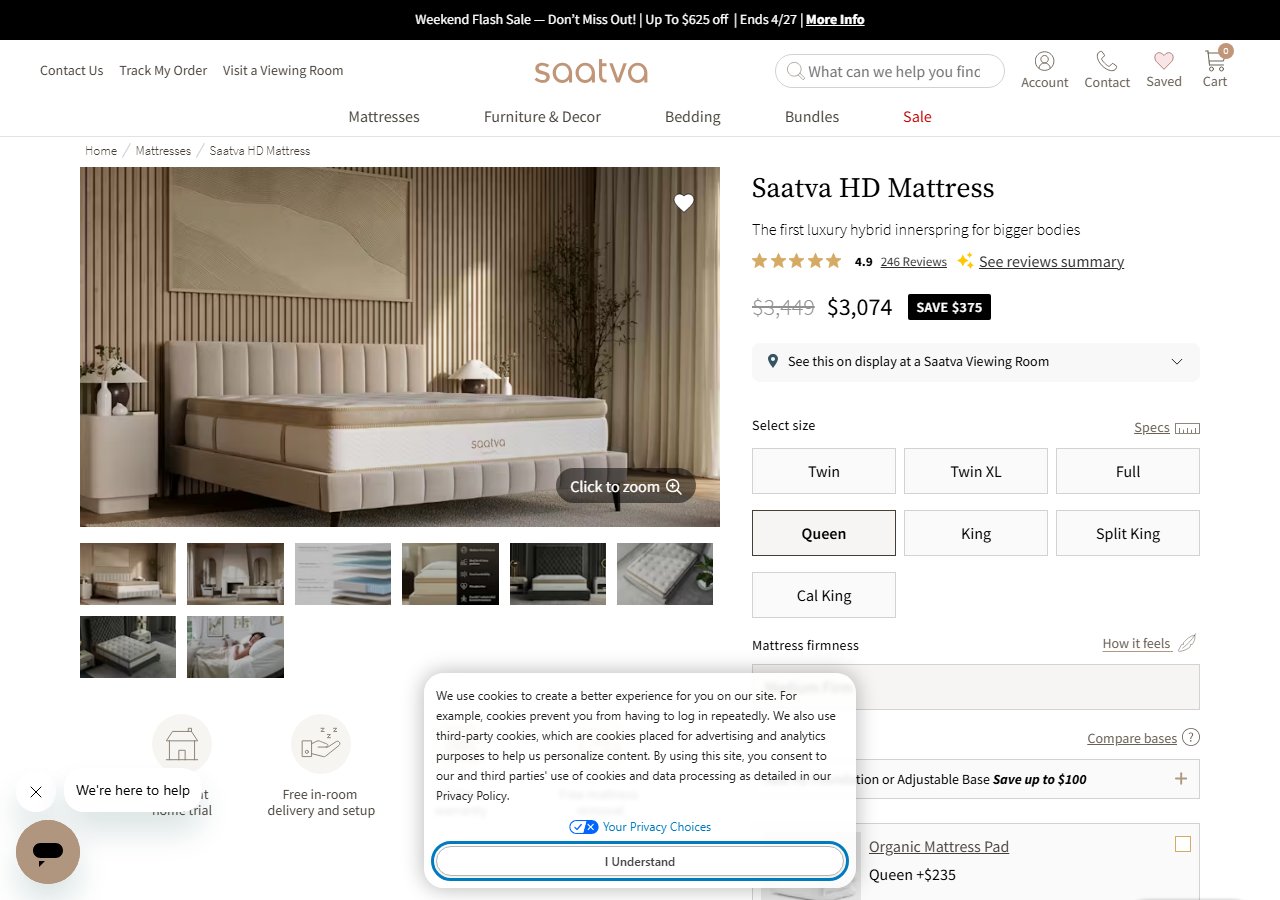
Saatva HD Mattress (Heavy-Duty)
$2,395-$3,995
See Price at Saatva →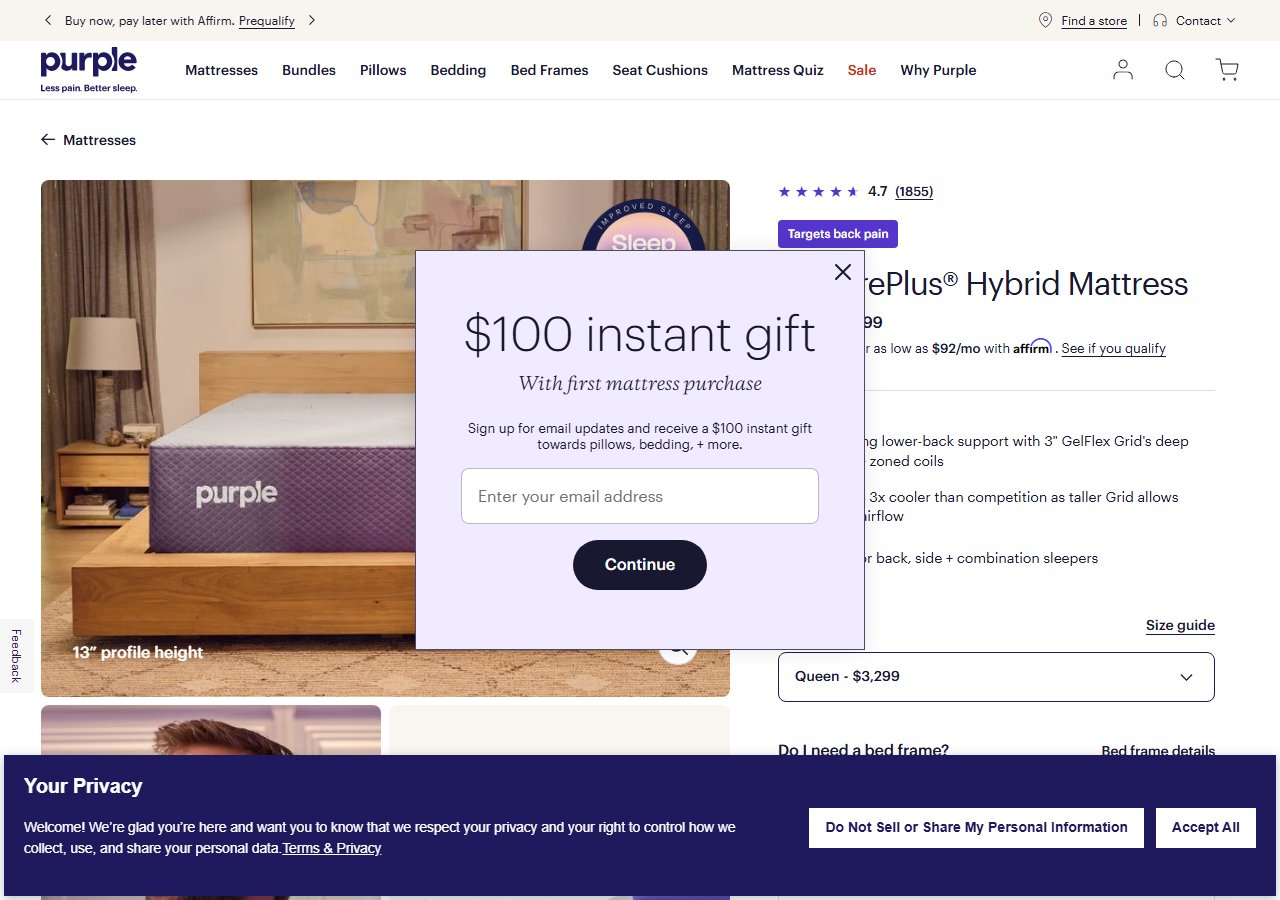
Purple Hybrid Premier Mattress
$2,499-$4,799
See Price at Purple →Putting it all together — a data-to-intervention hierarchy for warehouse workers
Federal data tells a clear story: warehousing is among the highest MSD-incidence industries in the U.S. labor force, the NIOSH Lifting Equation confirms that shift-level spinal loading routinely exceeds safe limits, and SSA disability data shows musculoskeletal disorders are the leading driver of new disability claims — making lumbar health a long-term financial and career risk, not merely a comfort issue.
The intervention hierarchy that federal data supports is this: correct sleep position first (free, immediate effect), ensure the mattress is not visibly sagging or more than 10 years old (replace before upgrading), walk 30 minutes most days (as effective as most non-drug treatments per NIH NCCIH), and practice load-appropriate lifting mechanics at work (OSHA's upstream intervention). When those levers are in place and back pain during sleep remains a problem, a targeted sleep surface upgrade — one designed around zoned support, body-weight-appropriate compression resistance, and thermal regulation — is a justified investment in occupational recovery infrastructure.
The Saatva Loom & Leaf is the premium call for most warehouse workers with lumbar pain. The Saatva HD is the non-negotiable pick for anyone above 250 pounds who has been sleeping on a standard consumer mattress. The Purple Hybrid Premier is the strongest option for combination sleepers or those who find memory foam uncomfortably warm. None of these products fixes chronic occupational spinal loading. All of them improve the quality of the recovery window that exists between shifts — and for a population carrying the back-injury burden that warehousing workers carry, that window is too important to leave to a sagging mattress.