The Data on Your Back Pain Is Unambiguous
According to BLS Musculoskeletal Disorders by Occupation tracking, the back is the single most commonly injured body part across all U.S. occupations that result in days away from work. That statistic is not evenly distributed. Warehousing, transportation, and material-handling occupations consistently rank among the highest-incidence sectors in the Bureau of Labor Statistics' Survey of Occupational Injuries and Illnesses (SOII). If you are pulling shifts in a fulfillment center, distribution hub, or loading dock, you are not anecdotally unlucky — you are operating in one of the most biomechanically punishing environments the U.S. economy has built.
The financial consequences are staggering. AHRQ HCUP data identifies back pain as one of the most expensive conditions in U.S. healthcare by total inpatient and outpatient cost. AHRQ's Medical Expenditure Panel Survey shows that adults with chronic back conditions spend substantially more on personal healthcare annually than adults without. And at the disability endpoint, SSA Disability Insurance data identifies musculoskeletal disorders as the single largest category of new disability claims filed each year. The pathway from warehouse floor to disability claim runs directly through cumulative spinal loading — and it is well-documented in federal data.
For employers, BLS workers' compensation cost data shows that industries with high musculoskeletal disorder incidence carry workers' comp insurance rates 3 to 5 times higher than low-MSD industries. The cost is systemic. What concerns us here is the individual: the picker, the loader, the forklift operator who clocks out after a 10-hour shift and needs to actually recover before doing it again.
Why Warehouse Work Injures the Lumbar Spine Specifically
The lumbar spine — the five vertebrae between the thoracic cage and the pelvis — is designed to bear compressive load in a neutral, lordotic curve. It is not designed to be repeatedly loaded in flexion, rotation, or shear. Warehouse work does all three, repeatedly, across a full shift.
The NIOSH Lifting Equation, which is the federal standard for assessing manual material-handling tasks, calculates a Recommended Weight Limit (RWL) for any given lift based on load weight, lift frequency, horizontal distance from the body, vertical travel distance, trunk rotation angle, and coupling quality. The Lifting Index — the ratio of actual load to the RWL — tells you how far over the safe threshold a task runs. NIOSH's own documentation confirms that tasks across warehousing, construction, and healthcare routinely exceed the safe spinal loading limits the equation establishes. A Lifting Index above 1.0 means elevated injury risk. Many warehouse pick-and-pack or unloading tasks run Lifting Index values of 2.0 to 4.0 or higher under real conditions.
The mechanism of injury is not usually one dramatic event. It is cumulative disc compression over thousands of repetitions per shift, combined with paraspinal muscle fatigue that progressively reduces the spine's ability to protect itself. As shift length extends — many warehouse operations run 10-hour minimum shifts — fatigue-driven technique breakdown becomes inevitable. Workers begin flexing at the lumbar spine instead of hinging at the hips. They begin twisting under load. The intervertebral discs, already compressed through hours of standing and lifting, face shear forces they were not built to absorb. Disc herniation, facet joint irritation, and paraspinal strain are the predictable downstream results.
Chronicity follows. CDC NHANES data shows that approximately 20% of U.S. adults report chronic pain, with lower back as the most common location. In occupational populations with sustained physical demand, that prevalence is higher — and CDC arthritis surveillance data shows approximately 25% of U.S. adults have doctor-diagnosed arthritis, with concentration in physically demanding occupations. For warehouse workers, the combination of acute injury risk, cumulative loading, and inadequate recovery time creates a trajectory toward chronic pain that federal data tracks in detail.
Where Sleep Fits Into the Recovery Equation
Recovery from physical work is not passive. During sleep, the body conducts structural repair: intervertebral discs, which are largely avascular and depend on fluid diffusion during off-loading for nutrient exchange, rehydrate during recumbency. Paraspinal muscles repair micro-trauma accumulated during the shift. Inflammatory signaling moderates. Cortisol — chronically elevated in physically and psychologically demanding jobs — drops. Inadequate sleep interrupts all of these processes.
CDC sleep data shows that approximately 35% of U.S. adults already sleep fewer than 7 hours per night, the threshold the CDC associates with elevated chronic disease risk. Shift workers — a category that includes a large share of the warehouse labor force — are disproportionately sleep-deprived. Rotating schedules, overnight shifts, and early morning start times all disrupt circadian rhythm and reduce sleep duration and quality. The worker who most needs deep, restorative sleep is often the one with the most structural barriers to getting it.
The sleep surface matters in this context — not as a miracle cure, but as a modifiable variable. A mattress that does not maintain spinal alignment during sleep forces the paraspinal muscles to remain active rather than releasing completely, reducing the recovery benefit of each sleep hour. A surface with visible sag or insufficient support for the worker's body weight can place the lumbar spine in the same flexion-compromised position it spent the whole shift trying to avoid. These are mechanical problems with mechanical solutions. But — and this is critical — a better sleep surface addresses one variable among many. The interventions that come before it are cheaper, faster, and often more effective.
Try These First: Free and Low-Cost Interventions Backed by Federal Evidence
The cheapest intervention is the one that does not require buying anything. Before evaluating any sleep surface, warehouse workers managing back pain should exhaust the evidence-based, zero-cost or low-cost interventions that federal health agencies document as effective. These are not alternative medicine suggestions. They are practices backed by NIH systematic reviews and OSHA ergonomics guidance.
Sleep position is the most immediately actionable variable. NIH guidance on back pain recommends side-sleeping with a pillow between the knees, or back-sleeping with a pillow under the knees, as positions that maintain lumbar neutral alignment. Stomach-sleeping — which many chronic pain sufferers default to — forces the lumbar spine into hyperextension and increases anterior disc pressure throughout the night. Changing sleep position costs nothing and can produce noticeable improvement within days.
Daily walking is the movement intervention with the strongest evidence base for chronic low back pain. NIH NCCIH's systematic review of low back pain treatments documents that 30 minutes of walking most days reduces chronic low back pain as effectively as most non-drug clinical treatments. For warehouse workers who are already on their feet, this seems counterintuitive — but the key distinction is the type of movement. Walking with normal gait mechanics, without load, actually promotes disc fluid exchange and reduces the compressive fatigue pattern from loaded standing and lifting. A 30-minute walk before or after a shift, or on off days, is not a luxury. It is one of the most effective lumbar pain interventions available.
On-shift lifting mechanics are worth rehearsing even for experienced workers. OSHA's ergonomics guidance is explicit: hinge at the hips, not the lumbar spine; keep loads close to the body's center of gravity; avoid twisting under load; use team lifts for objects above the NIOSH recommended limits. Most acute warehouse back episodes are mechanical events — they result from a specific lift with poor mechanics, often when fatigue has already degraded movement quality. These events are, to a meaningful extent, rehearsable and preventable.
Mattress assessment should precede mattress shopping. CDC sleep hygiene guidance supports replacing a mattress if it shows visible sag, if you wake stiffer than you went to bed on a consistent basis, or if it is older than 7 to 10 years. These are diagnostic criteria, not marketing copy. Even the most supportive, well-engineered mattress cannot compensate for poor sleep hygiene, inconsistent schedules, or sedentary off-days.
For workers who have already addressed sleep position, daily movement, and on-shift mechanics — and who are sleeping on a surface that is visibly degraded, inadequate for their body weight, or more than a decade old — a sleep surface upgrade is a legitimate next step. The following sections cover when to involve a clinician first, and then what to look for in a mattress built for the specific demands of warehouse-scale physical recovery.
When to See a Clinician First
Not all back pain is musculoskeletal strain from cumulative loading. NIH neurological disorders guidance documents specific red flags that warrant prompt clinical evaluation rather than conservative management. Warehouse workers, who may be inclined to push through pain, should take these seriously.
Buying a new sleep surface is not an appropriate first response to back pain that radiates below the knee (potential nerve root compression), that followed a significant traumatic event, that comes with leg weakness or numbness, that is associated with bowel or bladder dysfunction, or that accompanies fever or unexplained weight loss. These presentations require imaging and clinical evaluation. Similarly, back pain that is worsening progressively despite rest, or that does not improve at all after several weeks of conservative management, warrants a physician visit. CMS drug spending data identifies opioid and non-opioid pain medication among the most expensive Medicare drug categories — a reflection of how commonly back pain escalates to pharmacological treatment when the underlying cause is not identified and addressed. Early clinical evaluation is less expensive, in every sense, than delayed intervention.
What to Look For in a Sleep Surface Built for Warehouse Recovery
For workers who have cleared the clinical threshold and are looking at sleep surface options, the relevant engineering criteria are specific. Warehouse workers are not a generic consumer population. They tend to carry more lean mass and overall body weight than sedentary populations — which changes the load demands on a mattress significantly. They spend more hours on their feet than desk workers, meaning their lumbar musculature arrives at sleep in a state of genuine fatigue. And they may work rotating shifts, meaning sleep sometimes happens during daylight hours and under non-ideal conditions — a context where sleep quality per available hour becomes even more important.
Support under the lumbar region is the single most critical feature. A mattress that allows the lumbar spine to sag into the sleep surface places the discs in overnight flexion — the same position that caused the day's injury load. Adequate zonal support, or a sufficiently firm support core beneath a comfort layer, maintains the natural lumbar curve during recumbency. This is not a matter of overall firmness; it is a matter of support geometry.
Weight capacity and body weight distribution matter for warehouse populations. Standard mattresses are typically rated for total weights below 500 pounds across both sleepers. Workers who are larger — or whose body composition includes significant upper-body muscle mass from manual handling — may find that standard consumer mattresses compress beyond their rated support threshold within 2 to 3 years, producing the sagging that drives lumbar misalignment.
Pressure relief at the hips and shoulders is the complementary feature. For side sleepers following the NIH-recommended position, the mattress must allow the hip and shoulder to sink appropriately while supporting the waist. A surface that is too firm for the sleeper's weight keeps the spine in lateral deviation throughout the night. Memory foam and adaptive polymer layers address this; the question is whether the comfort layer is balanced by an adequate support core beneath it.
Motion isolation is underrated for warehouse workers on rotating or early-morning schedules who share a bed. A surface that transfers motion disrupts sleep continuity — which matters most for workers who are already sleep-deprived.
Three products stand out for this specific population.
The Saatva HD Mattress is the most directly engineered for warehouse workers and large-frame users. Saatva built it specifically for sleepers up to 500 pounds per side, with a dual-layer coil system — a micro-coil comfort layer over a heavy-gauge tempered steel support coil — that maintains structured lumbar support well beyond the point where standard mattresses begin to fail. The HD's lumbar zone enhancement targets the L1-L5 region specifically, which is precisely where warehouse cumulative loading concentrates. If your body weight or frame has caused previous mattresses to sag prematurely, or if you have been told by a physical therapist that you need more support than a standard consumer mattress provides, the Saatva HD is the most evidence-aligned pick in this list.
The Saatva Loom & Leaf Memory Foam Mattress is the premium memory foam pick for workers whose primary complaint is pressure accumulation — the joint and soft-tissue soreness that builds from hours of standing on concrete or warehouse flooring. Its gel-infused memory foam construction provides the adaptive pressure relief that allows hips and shoulders to decompress during sleep without sacrificing the lumbar support that back-pain management requires. Available in Relaxed Firm and Firm configurations, it suits back sleepers and combination sleepers who need both contouring and structural support. This is a meaningful distinction from generic memory foam: the Loom & Leaf's support layer is substantial enough to prevent the full-body sinkage that cheaper memory foam mattresses allow.
For workers dealing with significant hip and joint pressure — a common secondary complaint in populations that spend long shifts on hard surfaces — the Purple Hybrid Premier Mattress offers a genuinely differentiated pressure-relief mechanism. Purple's GelFlex Grid is a hyper-elastic polymer structure that collapses under pressure points (hips, shoulders) while remaining firm under lighter areas (lumbar, legs), a geometric property that no foam or traditional spring system replicates. The Hybrid Premier adds a pocketed coil support layer beneath the Grid, providing the structural support that back-pain management requires. It runs warmer than the Saatva options for some sleepers, which is worth noting for workers who already sleep warm from shift exertion.
Sleep Surfaces Built for Warehouse-Scale Lumbar Recovery
Each of these mattresses was selected for features directly relevant to warehouse workers: sufficient weight capacity, lumbar zone support, and pressure relief for workers spending 8-12 hours on concrete flooring before they ever reach their bed.

Saatva Loom & Leaf Memory Foam Mattress
$1,695-$3,295
See Price at Saatva →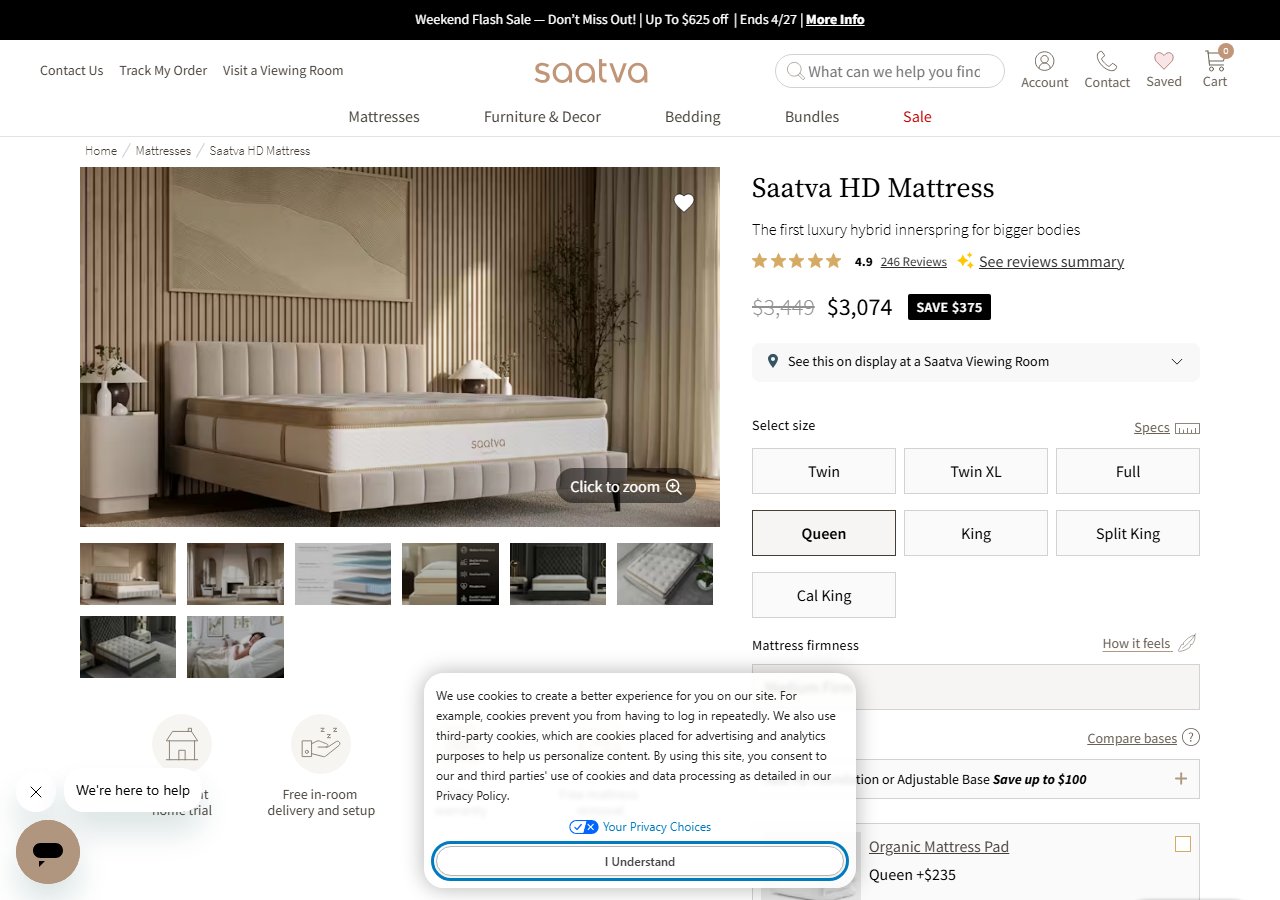
Saatva HD Mattress (Heavy-Duty)
$2,395-$3,995
See Price at Saatva →
Purple Hybrid Premier Mattress
$2,499-$4,799
See Price at Purple →Putting the Data Hierarchy Together
Federal data makes the priority order clear. BLS occupational injury data documents the scale of the problem. NIOSH's Lifting Equation explains the mechanism. NIH evidence reviews identify walking and sleep position optimization as among the highest-value free interventions. AHRQ cost data quantifies what happens when the injury escalates. And CDC sleep data contextualizes why off-shift recovery quality is a legitimate health variable — not a lifestyle luxury.
A sleep surface that maintains lumbar neutral alignment, accommodates your body weight without premature compression, and relieves pressure at the hips and shoulders is a real tool in the recovery toolkit. It is not a substitute for movement, clinical care when indicated, or on-shift ergonomics. It is one modifiable variable in a system where all the variables compound.
Warehouse workers carry the physical cost of supply chain operations in their spines and joints. Federal agencies have documented that cost in granular detail. The least those workers can do is give their off-shift hours the same structural attention they give to the work itself. Start with position and movement. Clear the clinical threshold. Then, if the sleep surface itself is part of the problem — assess it with the same rigor you would apply to any other piece of equipment you rely on.