The federal data on warehouse back injuries is not subtle
According to BLS Musculoskeletal Disorders by Occupation tracking, the back is the most common body part injured across all U.S. occupations that result in days away from work. That is not a warehousing-specific statistic — it is an economy-wide finding. But warehousing workers live inside the worst slice of that curve. The industry combines four of the most back-hostile exposures that occupational medicine has documented: sustained forward flexion, repetitive axial loading, whole-body vibration from powered industrial equipment, and asymmetric lifting under time pressure. Put those four together across an eight- or ten-hour shift, and you have a near-perfect recipe for cumulative disc and facet joint degradation.
BLS Employer Costs for Employee Compensation data quantifies the financial consequence: industries with high musculoskeletal disorder (MSD) incidence carry workers' compensation insurance rates three to five times higher than low-MSD industries. That premium is not random. It is actuarially derived from the frequency and severity of claims — which means the insurers have already done the math on how often warehouse spines fail.
Why warehouse work specifically destroys the lumbar spine
The mechanism is not mysterious, but it is worth stating precisely because understanding it helps you intervene at the right points — on the floor and off it.
The NIOSH Lifting Equation is the federal standard for quantifying spinal load risk during manual material handling. It calculates a Recommended Weight Limit (RWL) based on load weight, horizontal and vertical distance of the lift, lift frequency, asymmetry angle, and coupling quality. When actual lift weight exceeds the RWL, the Lifting Index climbs above 1.0 — the threshold at which injury risk increases significantly. In warehousing operations that involve pallet building, conveyor feeding, truck loading, or high-shelf picking, Lifting Index values of 2.0 to 4.0 or higher are common. NIOSH documents that these tasks routinely exceed safe spinal loading limits across warehousing, construction, and healthcare.
The specific structures that accumulate damage are the intervertebral discs — particularly L4–L5 and L5–S1 — and the facet joints of the lumbar vertebrae. Disc compression under axial load is normal and reversible over short time horizons. What makes warehousing dangerous is the combination of frequency and asymmetry. Twisting under load, which is endemic to order picking and truck unloading, creates shear forces across disc annulus fibers that are far more damaging than pure axial compression. Over months and years, those fibers develop micro-tears. The disc height decreases. The facet joints compensate. Nerve root irritation follows.
CDC NCHS Data Brief 390 reports that approximately 20% of U.S. adults experience chronic pain, with the lower back as the most common pain location. Among workers in physically demanding occupations, that prevalence is substantially higher. The SSA Disability Insurance program reports that musculoskeletal disorders are the single largest category of new disability claims each year — meaning the lumbar injuries that start as soreness after a shift have a documented pathway to permanent work incapacity.
The off-shift recovery window: why sleep surface matters for warehouse workers specifically
Here is the piece that federal injury statistics do not capture but that occupational medicine increasingly emphasizes: the eight hours you spend supine or side-lying are the primary window during which the lumbar spine decompresses, disc hydration partially restores, and inflammatory mediators clear from compressed tissues. That window can either accelerate recovery or compound the damage done on the floor, depending almost entirely on whether the spine maintains a neutral lordotic curve while you sleep.
A sleep surface that sags under a heavier body — the typical warehouse worker is on their feet for extended periods and often carries more body mass than a sedentary office worker — allows the lumbar spine to flex into kyphosis during the night. Eight hours in lumbar kyphosis after eight hours of axial loading means the spine gets no true decompression window. CDC sleep disorder data shows that approximately 35% of U.S. adults already sleep fewer than seven hours per night, the threshold associated with elevated chronic disease risk. For warehouse workers on rotating shifts or overnight schedules, that percentage is meaningfully worse — shift work disrupts both sleep duration and sleep architecture, compressing the recovery window even further.
AHRQ MEPS data shows that average annual personal healthcare expenditures for adults with chronic back conditions substantially exceed those for adults without such conditions. AHRQ HCUP data independently identifies back pain as one of the most expensive conditions in U.S. healthcare by total inpatient and outpatient spending. CMS Drug Spending Dashboard data shows that opioid and non-opioid pain medications are among the most expensive Medicare drug categories — a downstream indicator of how undertreated chronic spinal pain becomes pharmacologically managed rather than structurally addressed.
The financial and health case for addressing the recovery window is strong. But the right intervention hierarchy matters. Products come last.
Try these first — the cheapest interventions are the ones that don't require buying anything
Before any discussion of sleep surfaces, warehouse workers with lower back pain should audit whether the free or near-free interventions have been fully implemented. These are not consolation prizes for people who cannot afford a new mattress. In many cases, they are more effective than any hardware change.
Lifting mechanics are rehearsable and immediate. OSHA's ergonomics guidance is explicit: hinge at the hips, not the lumbar spine. Keep loads within the body's base of support, close to the torso. Avoid twisting under load — if you need to rotate, move your feet rather than your spine. Most acute back episodes in warehousing are mechanical and prevention-rehearsable. Technique changes cost nothing and have immediate effect on cumulative Lifting Index exposure.
Sleep position is the largest free variable in off-shift recovery. NIH NIAMS back pain guidance recommends side-sleeping with a pillow between the knees, or back-sleeping with a pillow under the knees, to maintain spinal neutrality. Stomach-sleeping applies a sustained hyperextension moment to the lumbar spine and is consistently associated with worse chronic low back pain outcomes. A folded bath towel between the knees costs nothing and can meaningfully change lumbar mechanics during sleep.
Daily walking is among the most evidence-supported interventions for chronic low back pain. NIH NCCIH's evidence review on low back pain concludes that walking 30 minutes most days reduces chronic low back pain as effectively as most non-drug clinical treatments. The mechanism is both mechanical — walking promotes disc nutrition through cyclic loading and unloading — and systemic, through anti-inflammatory pathways. Warehouse workers who are on their feet all shift often assume they do not need additional movement. That is incorrect: shift-pattern walking under load is not therapeutic walking. A post-shift 20-minute walk at comfortable pace serves an entirely different physiological function.
Sleep hygiene determines whether any mattress performs to spec. CDC sleep hygiene guidance is straightforward: consistent sleep and wake times, a dark and cool sleep environment, avoidance of screens and stimulants before bed. Even the most supportive mattress on the market cannot compensate for two-hour sleep debt, irregular sleep timing, or a sleep environment that prevents deep-sleep stages. Address hygiene before attributing poor recovery to the mattress.
Know when your mattress is actually the problem. Per CDC sleep hygiene guidance, the relevant indicators are visible sag or deformation in the sleep surface, waking consistently stiffer than you went to bed, or a mattress that is older than seven to ten years. These are the conditions under which the mattress itself is a mechanical contributor to inadequate recovery.
For the subset of warehouse workers who have implemented these behavioral and positional interventions and are still waking with persistent lumbar stiffness, experiencing poor sleep quality on a degraded surface, or are above average body weight in a way that causes conventional consumer mattresses to bottom out — this is where the sleep surface becomes a legitimate clinical variable.
When to see a clinician — red flags that no mattress addresses
Before moving to product recommendations, it is worth being direct about the category of symptoms that warrant physician evaluation before any other intervention. NIH National Institute of Neurological Disorders and Stroke back pain guidance identifies several presentations that require prompt clinical workup rather than self-managed treatment.
Spinal nerve compression that has progressed to true neurological deficit — leg weakness, difficulty controlling bladder or bowel function, pain that radiates below the knee in a dermatomal pattern — is not a mattress problem. Neither is back pain that follows direct trauma, back pain accompanied by fever or unexplained weight loss (which can indicate infectious or neoplastic causes), or back pain that does not improve at all with any position change. CDC arthritis data reports that approximately 25% of U.S. adults have doctor-diagnosed arthritis, with prevalence concentrated in physically demanding occupations. If your back pain is related to inflammatory arthropathy rather than purely mechanical overload, the intervention hierarchy changes substantially and requires physician guidance.
A new mattress is an adjunct to structural recovery. It is not a treatment for nerve compression, inflammatory disease, or acute injury. If you are in the red-flag category, the correct sequence is clinical evaluation first, then address sleep surface quality as part of a broader management plan.
Where the right sleep surface enters the equation
For warehouse workers whose back pain is mechanical in origin, whose mattress is visibly degraded or over a decade old, and who have not found adequate relief from positional and behavioral changes alone, the sleep surface is a legitimate intervention point. But the biomechanics of what you need are specific to your occupation — and most consumer mattress marketing does not speak to those specifics at all.
A warehouse worker with chronic lumbar load needs a mattress that does three things: (1) maintains spinal neutrality across the lumbar-to-pelvis transition without requiring the lumbar musculature to stay active to compensate for surface sag; (2) distributes body weight broadly enough across the hips and shoulders to relieve pressure point concentration at the iliac crests and trochanters during side sleep; (3) sustains those properties at above-average body weights without progressive compression that defeats the entire purpose of the surface.
The Saatva Loom & Leaf Memory Foam Mattress is the premium memory foam option that addresses points one and two directly. Loom & Leaf uses a multi-layer American-made memory foam system with a gel-infused comfort layer over a high-density support foam base. The construction is specifically oriented toward the spinal alignment needs of back and side sleepers — the two positions that NIH back pain guidance recommends for lumbar health. For warehouse workers who sleep primarily on their side or back and whose primary complaint is lumbar stiffness on waking, the contouring behavior of high-density memory foam provides sustained pressure relief at the hip and shoulder contact zones without the sinkage that causes lumbar flexion in lower-density foams. The Loom & Leaf is available in Relaxed Firm and Firm options; the Firm is appropriate for heavier side sleepers and back sleepers who need more pushback to maintain lordotic curve.
For workers at higher body weights — an important design variable that the NIOSH Lifting Equation implicitly recognizes, since heavier operators exert different moment arms across the same lift — the Saatva HD Mattress is the purpose-engineered option. The Saatva HD is built specifically for big and tall users and warehouse-scale physical demands. Its construction uses a patented lumbar zone support system with three coil layers engineered for up to 500 pounds per sleeper, a dual-tempered steel coil system that resists progressive compression over time, and enhanced edge support that prevents the roll-off sensation that becomes a mechanical problem for heavier sleepers at the mattress perimeter. This is not a mattress that has been generically upscaled — it is a distinct construction for a distinct load pattern. For a warehouse worker who has found that conventional mattresses begin sagging within two years of purchase, the HD's durability engineering addresses what is likely the primary mechanical failure mode of their previous sleep surfaces.
For workers whose primary complaint is not just lumbar pain but full-body pressure buildup — hips, shoulders, knees — after a physically demanding shift, the Purple Hybrid Premier Mattress offers a materially different pressure-relief mechanism. Purple's GelFlex Grid is a polymer grid structure that collapses under pressure points while providing firm support where the body needs it, rather than the uniform contouring of memory foam. For workers who run hot during sleep — a common complaint in warehouse environments where the physical demands of the job elevate baseline metabolic rate — the grid's open-cell airflow is a meaningful functional advantage over solid foam. The Hybrid Premier combines the GelFlex Grid with individually wrapped coils, giving it a more responsive feel than pure foam options. For warehouse workers who find memory foam too motion-restrictive when shifting positions during sleep (a common pain-management behavior), the Purple Hybrid Premier's grid-and-coil construction allows easier repositioning without sacrificing pressure relief.
Mattresses Built for Warehouse-Worker Lumbar Recovery
Each option below was selected for its documented ability to maintain lumbar spinal neutrality, manage pressure distribution at warehouse-worker body weights, and sustain those properties over the years-long use period that occupational spinal health demands.

Saatva Loom & Leaf Memory Foam Mattress
$1,695-$3,295
See Price at Saatva →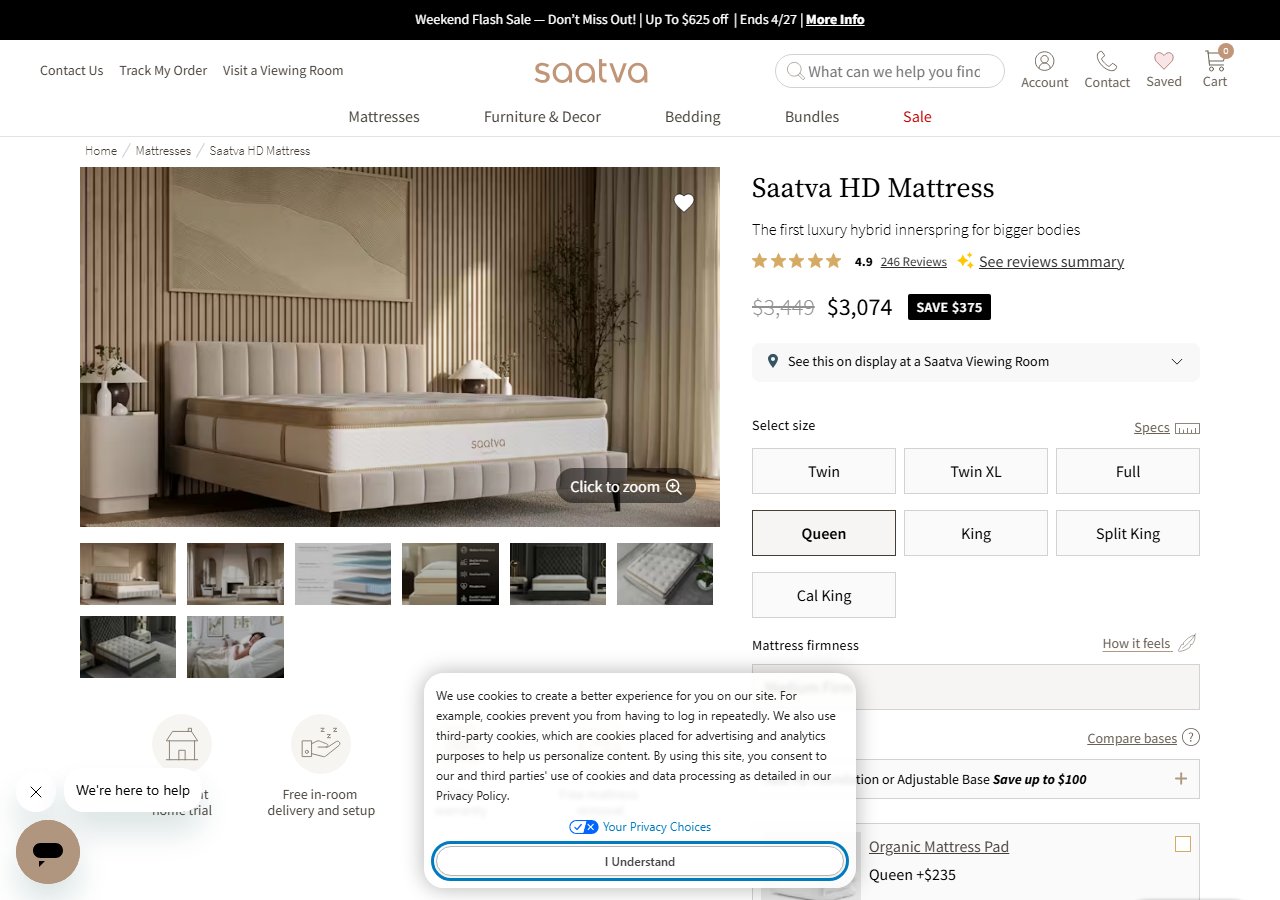
Saatva HD Mattress (Heavy-Duty)
$2,395-$3,995
See Price at Saatva →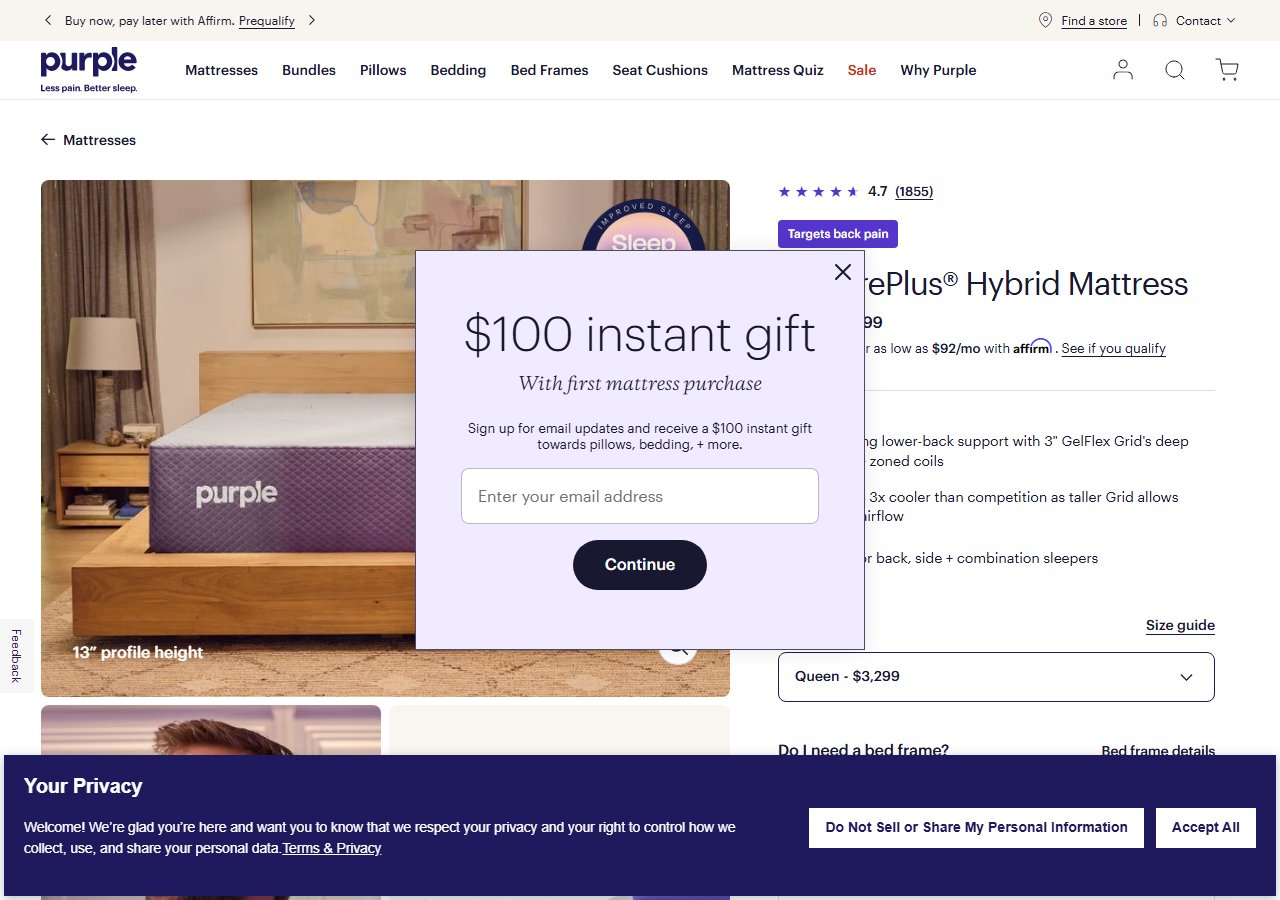
Purple Hybrid Premier Mattress
$2,499-$4,799
See Price at Purple →Choosing based on your specific situation
The federal data creates a clear decision framework for warehouse workers evaluating sleep surface options:
If your primary symptom is lumbar stiffness on waking and your current mattress is over seven years old or visibly sagging, the Saatva Loom & Leaf is the strongest premium memory foam option for mechanical lumbar support. Its multi-layer construction is well-suited to the spinal neutrality needs that NIH back pain guidance identifies as central to off-shift lumbar recovery.
If you are at higher body weight and have a documented history of mattresses compressing or sagging prematurely, the Saatva HD is the only purpose-built heavy-duty option in this list. Its three-layer coil system and lumbar zone engineering directly address the load distribution problem that conventional consumer mattresses are not designed to handle.
If full-body pressure buildup, heat retention during sleep, or restricted repositioning is your primary complaint alongside lumbar pain, the Purple Hybrid Premier offers a pressure-relief mechanism that is architecturally different from foam — and a hybrid coil base that provides more active support than foam-only options.
The data-to-intervention hierarchy in summary
SSA Disability Insurance data shows that musculoskeletal disorders are the single largest category of new disability claims each year. AHRQ HCUP data shows back pain among the most expensive conditions in U.S. healthcare by total treatment cost. CMS Drug Spending Dashboard data shows chronic pain management has become one of the largest pharmaceutical cost categories in Medicare. These numbers describe the downstream of undertreated occupational back injury — and warehouse workers are disproportionately represented in that downstream.
The intervention hierarchy that federal data supports is: fix mechanics on the floor first (OSHA ergonomics guidance), address sleep position and sleep hygiene at zero cost (NIH and CDC guidance), walk daily (NIH NCCIH evidence), rule out clinical red flags with a physician (NIH NINDS guidance), then evaluate whether your sleep surface is mechanically inadequate and — if it is — replace it with something engineered for your load pattern.
The products described above are not treatments. They are the hardware end of a recovery system that has to start with mechanics, movement, and clinical judgment. Used in that sequence, they support what the science actually recommends: a nightly decompression window that is long enough, deep enough, and properly positioned to give the lumbar structures that warehousing taxes every shift the best available chance to recover before the next one.