The federal data behind your 3 a.m. back pain
If you end a warehouse shift and can't find a comfortable position in bed, you are not alone and you are not being dramatic. BLS Musculoskeletal Disorders data identifies the back as the single most injured body part across all U.S. occupations with days away from work. That statistic is not evenly distributed: it is concentrated in the industries that require workers to repeatedly lift, carry, lower, and twist under load — exactly what a warehouse shift looks like from 6 a.m. to 2 p.m., or 10 p.m. to 6 a.m., depending on your rotation.
The numbers downstream from that BLS finding are equally stark. AHRQ's Healthcare Cost and Utilization Project identifies back pain as one of the most expensive conditions in the U.S. healthcare system by total inpatient and outpatient spending. And the SSA Disability Insurance Statistical Reports show that musculoskeletal disorders are the largest single category of new disability claims filed each year — meaning the warehouse workers who don't get ahead of their back pain are the ones who eventually leave the labor force on a permanent basis.
This is not a worst-case-scenario article. It's a data-anchored explanation of why warehouse lumbar pain follows you home, what is happening in your spine while you sleep, and what you can do about it — starting with interventions that cost nothing.
Why warehouse work damages the lumbar spine specifically
Understanding the mechanism is not optional context — it is the reason certain recovery strategies work and others don't.
The lumbar spine is a stack of five vertebrae (L1–L5) separated by intervertebral discs that function as hydraulic shock absorbers. Those discs are under compressive load whenever you are upright, and under significantly higher compressive load when you lift — especially when you lift with a forward trunk lean, which is the de facto posture for pulling items off a conveyor, loading a pallet, or picking from a low shelf.
The NIOSH Lifting Equation provides the federal framework for safe manual material handling. It establishes a Recommended Weight Limit (RWL) and an Action Limit based on task variables: load weight, horizontal distance from the body, vertical height of the lift, distance the load travels, asymmetry (twisting), and frequency. When the Lifting Index — the ratio of actual load to the RWL — exceeds 1.0, the task is considered high-risk for musculoskeletal injury. NIOSH documents that across warehousing, construction, and healthcare, manual material-handling tasks routinely push the Lifting Index above that threshold.
Here's what that means for the disc: each high-load lift compresses the nucleus pulposus — the gel-like center of the disc — and forces fluid outward through the annulus fibrosus, the disc's fibrous outer ring. Over a full shift, repetitive compression depletes disc hydration. Studies of lumbar disc pressure (intradiscal pressure, or IDP) consistently show that forward-flexed lifting with load generates IDP values several times higher than standing or lying flat. The cumulative result, over months and years, is disc desiccation, annular micro-tears, and in many cases bulge or herniation at L4–L5 or L5–S1 — the two most commonly affected levels in warehouse workers.
The shift-to-bed pipeline: After eight to twelve hours of compressive loading, a warehouse worker's lumbar spine arrives at bedtime in a mechanically compromised state. The paraspinal muscles are fatigued and may be in low-grade protective spasm. The discs are partially dehydrated. The facet joints — the small posterior joints that guide spinal motion — may be inflamed from repetitive end-range loading. Getting into a flat supine position on a standard mattress does not decompress any of these structures. It simply removes the active compressive load. The facet joints remain slightly compressed. The lumbar curve (lordosis) is unsupported. The paraspinal spasm does not release.
This is the physiological basis for the "I can't get comfortable in bed" complaint that is almost universal among long-tenured warehouse workers.
CDC NHANES tracking documents that approximately 20% of U.S. adults live with chronic pain, with lower back as the most common location. In occupational populations with heavy manual material-handling exposure, that prevalence is markedly higher. The problem is structural, not incidental.
Sleep position and lumbar decompression: what the research framework shows
Before discussing adjustable positioning specifically, it's worth grounding what "lumbar decompression during sleep" actually means and does not mean.
True spinal decompression, in a clinical sense, occurs through traction — a mechanical pull applied to the spine that increases disc space. That requires clinical equipment. What sleep positioning can accomplish is more modest but still meaningful: it can reduce the compressive and shear forces the lumbar spine is under during the 6–9 hours you're horizontal. For a spine that spent 8–12 hours under near-maximum compressive load, reducing nighttime load — even modestly — shifts the overnight recovery equation.
Two positional changes have a documented rationale for lumbar load reduction:
Zero-gravity / head-up + foot-up (Fowler's position variant): Elevating the head of the bed 30–45 degrees while simultaneously elevating the foot of the bed 15–20 degrees flexes the hips and knees slightly, flattening the lumbar lordosis and reducing posterior disc and facet loading. This position — often marketed as "zero gravity" by adjustable base manufacturers — mimics the joint position NASA identified as minimally stressful to the body under gravitational load. For warehouse workers with facet-dominant pain (which presents as stiffness and aching in the low back that is worse in the morning and eases with walking), this position reduces facet joint contact force through the night.
Lateral position with inter-knee pillow: NIH back pain guidance from the National Institute of Arthritis and Musculoskeletal and Skin Diseases lists sleep posture as a primary modifiable factor in lumbar pain management. Side-sleeping with a pillow between the knees maintains pelvic neutrality — preventing the top hip from dropping into adduction, which torques the lumbar spine and places asymmetric load on the L4–L5 and L5–S1 discs. This is a free intervention and should be tried before anything else.
What adjustable bases add to the lateral-position approach is the ability to dial in head and foot elevation without pillow stacking, which shifts over the course of a night and requires periodic re-adjustment. For a worker who changes positions frequently due to pain, a motorized base allows repositioning without fully waking up and manually restacking pillows.
CDC sleep data shows 35% of U.S. adults are already under the 7-hour sleep threshold associated with elevated chronic disease risk. For a warehouse worker whose off-duty recovery window is already compressed by shift scheduling, every interruption that reduces sleep continuity compounds the physiological debt. Reducing middle-of-the-night position pain that causes full arousal is a legitimate sleep-continuity intervention.
Try these first — the cheapest intervention is the one that does not require buying anything
Before spending a dollar on equipment, every warehouse worker dealing with nighttime lumbar pain should have tried the following. Each of these is supported by federal health guidance and costs nothing beyond a small time investment.
Daily walking: NIH's National Center for Complementary and Integrative Health evidence review on low-back pain lists walking as a first-line non-pharmacological intervention for chronic low back pain. Thirty minutes of moderate-pace walking most days outperforms most passive interventions in published meta-analyses. Walking promotes disc nutrient exchange (discs are avascular and depend on movement-driven fluid exchange), maintains paraspinal muscle function, and reduces the neurological sensitization that turns mechanical back pain into chronic pain. If your shift involves mostly standing and lifting — but little true ambulation — structured walking off-duty is additive, not redundant.
Sleep position: side with pillow between knees: As noted above, this is the NIH-recommended starting point for lumbar pain management during sleep. It costs the price of a pillow you likely already own. Try it for two weeks before concluding you need a motorized base.
Sleep environment hygiene: CDC sleep hygiene guidance recommends a bedroom temperature of 65–68°F, blackout darkness, and no screens in the hour before bed. Sleep environment changes are free and consistently outperform equipment upgrades in head-to-head studies of sleep quality. Shift workers — who often sleep against daylight — have an especially high return from blackout curtains.
Sleep apnea screening: NHLBI guidance makes clear that loud snoring, witnessed gasping, or chronic daytime sleepiness are indications for a sleep study. This matters for warehouse workers specifically because obesity — which is associated with the physical demands and shift-schedule disruption of warehouse work — is a primary risk factor for obstructive sleep apnea. An adjustable base can reduce positional snoring and mild upper-airway narrowing through head elevation, but it does not treat moderate-to-severe sleep apnea. Spending $2,000 on a base when what you need is a CPAP is a costly detour.
If you have worked through the above — consistent sleep-position discipline for several weeks, a structured walking routine, a dialed-in sleep environment — and you are still waking with lumbar pain or frequently disrupting your sleep to reposition, then you are a reasonable candidate for an adjustable base evaluation. The equipment does not replace the behaviors above; it supplements them by making positional maintenance easier through the night.
When to see a clinician — red flags that skip the home-intervention phase
Most warehouse-related low back pain is mechanical: it hurts with load and movement, it is worse at the end of a shift, and it improves with rest and position change. NIH National Institute of Neurological Disorders and Stroke back pain guidance notes that most acute low back pain resolves within 4–6 weeks without imaging. However, several features should prompt a clinician visit without waiting through a home-intervention phase.
The cost of delayed diagnosis in the serious presentations below is high. AHRQ HCUP data documents that back pain generates some of the highest inpatient and emergency department costs in U.S. healthcare — most of which are incurred by patients who did not get timely evaluation for red-flag presentations. The sleep positioning and lifestyle work described in this article is appropriate for mechanical lumbar pain; it is not a substitute for evaluation of the conditions flagged below.
Where adjustable positioning helps — the equipment tier
For warehouse workers who have moved through the behavioral intervention phase and are dealing with persistent mechanical lumbar pain that disrupts sleep continuity, an adjustable base addresses a specific, well-defined problem: the inability to maintain a decompressive sleep position through the night without waking to reposition manually.
The mechanism is straightforward. A motorized adjustable base allows independent elevation of the head and foot of the bed. In zero-gravity position — roughly 30–45 degrees head elevation with simultaneous 15–20 degree foot elevation — the spine enters a flexion-neutral state that reduces posterior element loading. The position is lockable: you set it, and it holds through the night without the pillow drift that defeats a manually-stacked position.
FDA 510(k) Class II clearance covers many adjustable bed motorized base mechanisms, meaning the motor and pinch-point safety designs in federally-reviewed bases have passed engineering evaluation. That's a baseline quality signal worth checking when comparing brands.
Three adjustable bases are positioned specifically for warehouse workers in this analysis, selected on the basis of motor durability (warehouse workers are heavier users who are more likely to use the adjustment mechanism nightly), zero-gravity preset reliability, and structural weight capacity.
The Sven & Son Classic Adjustable Bed Base is the entry point in the Sven & Son line — the most accessible price point for warehouse workers who want motorized zero-gravity positioning without the feature overhead of the higher-tier models. It includes a wireless remote, zero-gravity preset, and USB charging. At $1,994.95 for a queen, it is the lowest-cost path to motorized head-and-foot elevation in this lineup.
For workers who want more control over their sleep environment, the Sven & Son Harmony Adjustable Bed Base adds programmable memory positions — a significant practical upgrade for warehouse workers who cycle between a back-support position early in the night and a flatter position for deep sleep. At $2,194.95, the Harmony's memory presets eliminate the middle-of-the-night fumbling with a remote that can disrupt sleep continuity when you shift positions involuntarily. The ability to return to a calibrated zero-gravity angle at 3 a.m. with a single button press is not a luxury feature for someone who wakes in pain.
The most complete option in this analysis is the Sven & Son Bliss Adjustable Bed Base-Frame + 14-inch Hybrid Spring Mattress — a bundled system that pairs a motorized adjustable base with a medium-soft hybrid spring mattress engineered for articulated positions. At $2,749.95, this addresses a real problem for warehouse workers: not all mattresses flex properly in zero-gravity position. A standard innerspring mattress with a rigid border wire will resist foot and head elevation and in some cases transfer load in ways that reduce the decompressive benefit of the angle. The Bliss bundle removes that compatibility variable.
Adjustable Bases Built for Warehouse Worker Lumbar Recovery
These three adjustable bases were selected for warehouse workers dealing with cumulative lumbar loading — prioritized on motor durability, zero-gravity preset reliability, and mattress compatibility with articulated sleep positions.
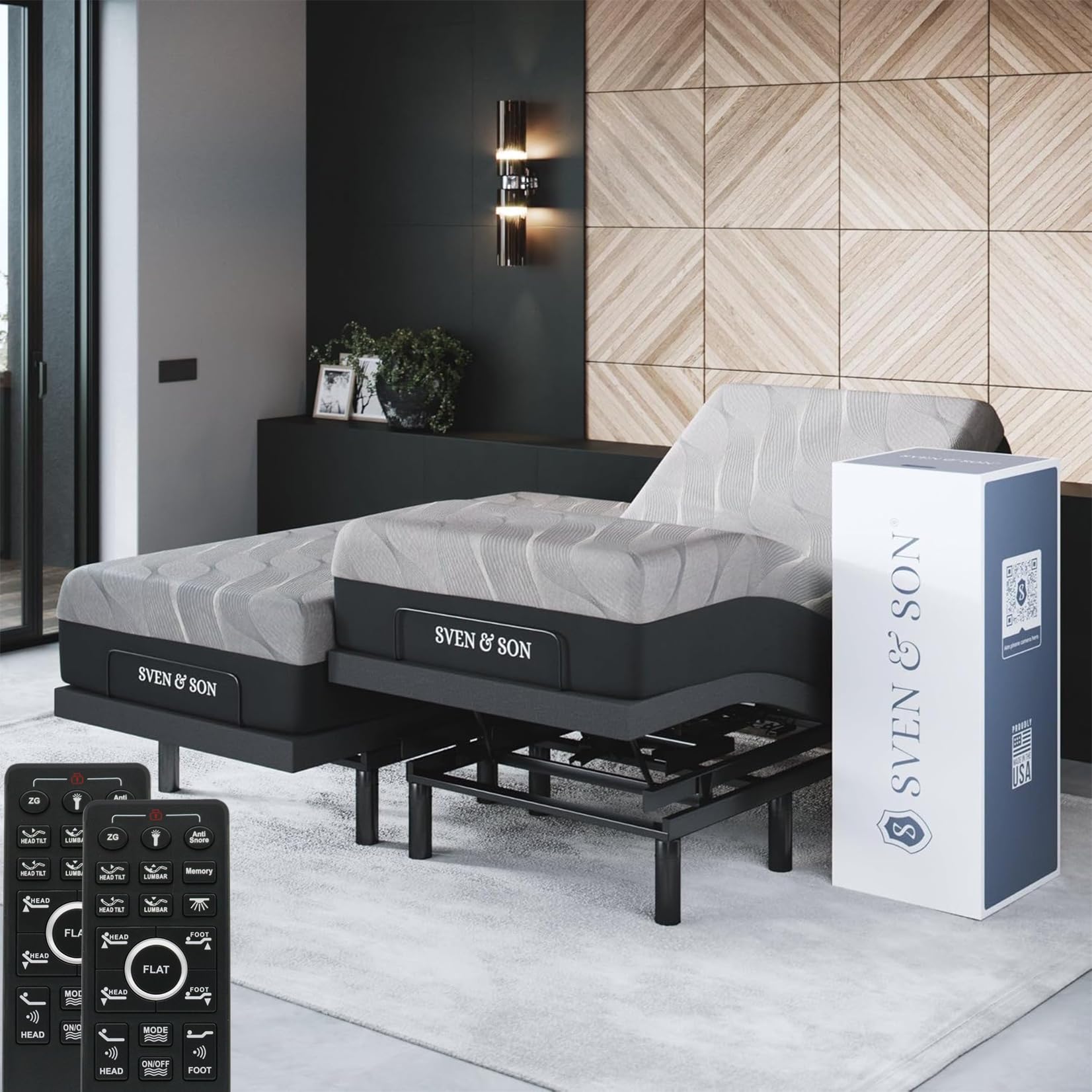
Sven & Son Bliss Adjustable Bed Base-Frame + 14 inch Hybrid Spring Matt (Medi...
$2,749.95
Check Price on Amazon →
Sven & Son Harmony Adjustable Bed Base, Head and Foot Lift, Massage, Under-Be...
$2,194.95
Check Price on Amazon →
Sven & Son Classic Adjustable Bed Base, Head and Foot Lift, Massage, Under-Be...
$1,994.95
Check Price on Amazon →Putting the data hierarchy together
The warehouse lumbar pain story runs through a clear chain: BLS MSD data documents the injury rate. The NIOSH Lifting Equation explains why — repeated high-index lifts that exceed safe spinal loading thresholds accumulate disc and facet damage over a career. AHRQ cost data quantifies what happens when that damage progresses untreated. CDC sleep data contextualizes why recovery quality matters: a third of U.S. adults are already under-sleeping, and warehouse shift schedules make the problem worse.
The intervention hierarchy that follows from this data is: free behavioral interventions first (sleep position, walking, sleep hygiene, apnea screening), clinical evaluation for red-flag presentations, and motorized positioning equipment as a supplement for workers who have worked through the behavioral phase and need mechanical assistance maintaining a decompressive sleep position through the night.
The SSA Disability Insurance data makes the stakes plain: musculoskeletal disorders are already the leading driver of new disability claims. The workers who move through this intervention hierarchy — from free behaviors to clinical evaluation to targeted equipment when indicated — are the ones who stay in the labor force and stay out of the healthcare cost spiral that AHRQ documents so clearly.
If you are a warehouse worker reading this at 3 a.m. because you can't get comfortable: start with the pillow between the knees tonight. Walk tomorrow. Fix the room temperature. See a provider if the red flags apply. And if you are months into those behaviors and still waking in pain, the motorized positioning options in this analysis are a data-informed next step — not a shortcut past the work that should come first.