The federal data portrait of a warehouse worker's back
If you spend a shift pulling orders, loading trailers, or operating a stand-up forklift, you already know your lower back is working harder than almost any other part of your body. The federal data simply confirms what you feel. According to BLS Musculoskeletal Disorders by Occupation tracking, the back is the single most common body part injured across all U.S. occupations with days away from work. Warehousing, transportation, and wholesale trade consistently rank among the highest-incidence sectors in that dataset. This is not a coincidence of reporting — it is a predictable outcome of job design.
The financial consequence tracks the injury data closely. AHRQ HCUP data identifies back pain as one of the most expensive conditions in U.S. healthcare measured by total inpatient and outpatient cost. The SSA Disability Insurance reports identify musculoskeletal disorders as the largest single category of new disability claims filed annually — meaning that for a meaningful share of workers in high-load occupations, the back problem that starts as a dull ache after a long shift eventually becomes the reason they cannot work at all. And BLS Employer Costs for Employee Compensation data shows industries with high MSD incidence carry workers' compensation insurance rates 3 to 5 times higher than low-MSD industries, which is both a system-level cost and a leading indicator of how common serious injury is in those trades.
The population-level picture reinforces the occupational picture. CDC NCHS Data Brief 390 estimates approximately 20% of U.S. adults experience chronic pain, with lower back identified as the most common pain location. CDC Arthritis data shows approximately 25% of U.S. adults report doctor-diagnosed arthritis, with prevalence concentrated in occupations involving sustained physical demand — the exact profile of a full-time warehouse worker with five or more years on the floor. These are not abstract statistics. They describe a trajectory that begins with recoverable shift fatigue and, without intervention, moves toward chronic structural dysfunction.
Why warehouse work specifically breaks down the lumbar spine
Understanding why the back takes the punishment it does in warehousing requires a brief look at spinal biomechanics and what the federal ergonomics literature says about load tolerance.
The lumbar spine is designed to bear axial load — weight pressing straight down through the vertebrae. What it tolerates poorly is repeated asymmetric loading: forward flexion while bearing weight, rotation under load, and sustained static postures that hold the lumbar musculature under constant tension. Warehouse work delivers all three in combination across an eight- to twelve-hour shift. A picker who pulls 300 orders a shift is bending at the waist, reaching into shelving, twisting to place items on a conveyor belt, and doing it again hundreds of times. A loader working a trailer is lifting to overhead and floor-level positions in the same sequence, compressing and decompressing the lumbar discs asymmetrically with each repetition.
The NIOSH Lifting Equation is the federal benchmark for quantifying this risk. NIOSH documents that manual material-handling tasks across warehousing, construction, and healthcare routinely exceed safe spinal loading limits — meaning that a large share of the lifts performed in a typical warehouse shift generate forces at the L4-L5 and L5-S1 discs that exceed the tolerance thresholds the NIOSH model uses to define acceptable risk. Over one shift, this is manageable. Over months and years, it produces the disc degeneration, facet joint arthritis, and chronic paraspinal muscle dysfunction that show up in the BLS injury data.
The recovery window between shifts is where the compounding effect either gets interrupted or accelerates. Intervertebral discs are avascular — they do not have a direct blood supply. They rehydrate and recover nutrients through a passive diffusion process that requires the disc to be unloaded. That unloading happens primarily during sleep, when the spine is horizontal and bearing no axial load. If the sleep surface does not support neutral spinal alignment, that recovery process is compromised. A mattress with excessive sag at the hips allows the lumbar spine to drop into flexion, placing the already-stressed posterior disc and ligament structures under sustained tension for six to eight hours — precisely the opposite of what disc recovery requires. This is why sleep surface quality is not a luxury issue for warehouse workers. It is a recovery physiology issue.
CDC Sleep and Sleep Disorders data already shows approximately 35% of U.S. adults report sleeping fewer than 7 hours per night, the threshold associated with elevated chronic disease risk. For shift workers — whose sleep schedules are disrupted by rotating hours, early morning start times, and inadequate wind-down time — that percentage is almost certainly higher. The combination of high spinal load during the workday and inadequate or poor-quality sleep at night creates a deficit that compounds shift over shift.
Try these first — free interventions before you spend anything
The cheapest intervention is the one that does not require buying anything. Before evaluating mattresses, warehouse workers dealing with chronic lower back pain have meaningful options that federal occupational health guidance explicitly supports. The evidence for these non-product interventions is at least as strong as the evidence for any particular sleep surface, and for many workers the combination of better mechanics, more daily movement, and a corrected sleep position will produce more relief than a mattress upgrade alone.
Lifting and bending mechanics are the first lever. OSHA's Ergonomics Solutions guidance is unambiguous: hinge at the hips rather than the lumbar spine, keep loads close to the body's center of mass, and avoid twisting under load. Most acute back episodes in warehousing are mechanical — they are produced by a specific movement pattern that exceeds tissue tolerance — and they are rehearsable in the other direction. Workers who consciously practice hip-hinge mechanics, even under time pressure, reduce the peak spinal loading that the NIOSH Lifting Equation documents as the primary injury driver.
Daily walking is the movement intervention with the strongest evidence base. The NIH NCCIH evidence review on low back pain finds that walking 30 minutes most days reduces chronic low back pain as effectively as most non-drug clinical treatments. For workers who are already on their feet for a shift, structured walking on rest days — rather than total rest — maintains the lumbar musculature and avoids the deconditioning cycle that makes pain worse.
Sleep position is the biggest free variable in the off-duty recovery equation. NIH National Institute of Arthritis and Musculoskeletal and Skin Diseases back pain guidance is specific: side-sleeping with a pillow between the knees keeps the pelvis level and the lumbar spine neutral; back-sleeping with a pillow under the knees reduces lumbar extension. Stomach-sleeping torques the lumbar spine and forces the neck into sustained rotation, worsening chronic pain in both regions. This costs nothing to change.
Sleep hygiene matters independent of the surface you sleep on. CDC Sleep Hygiene guidance is direct: even the most expensive mattress does not undo inadequate sleep duration or poor sleep habits. If visible sag has developed in your current mattress, you wake stiffer than when you went to bed, or your mattress is older than 7 to 10 years, replacement becomes relevant. But for a newer mattress in serviceable condition, position and hygiene changes should come first.
For workers who have already tried the above — better mechanics on the floor, daily walking, corrected sleep position, and adequate sleep duration — and still wake with significant stiffness or pain that takes hours to resolve, the sleep surface itself becomes a legitimate variable. This is not a small population. The chronic nature of occupational back pain means that a subset of warehouse workers will have done everything right in terms of mechanics and lifestyle and still face a recovery deficit that a better-matched mattress can measurably address. The question then becomes which characteristics actually matter for someone carrying the specific load pattern of warehouse work.
When to see a clinician — before you buy anything
Some back pain presentations are not sleep-surface problems. They are medical problems, and no mattress addresses them. NIH National Institute of Neurological Disorders and Stroke back pain guidance is explicit about the presentations that require prompt clinical evaluation: pain that radiates below the knee (possible nerve root compression or disc herniation with radiculopathy), back pain following trauma, leg weakness or numbness, bowel or bladder dysfunction associated with back pain, and back pain accompanied by fever or unexplained weight loss. These are not mattress-selection problems. They are referral problems.
For warehouse workers specifically, the risk of missing a serious diagnosis is elevated because the assumption in high-load occupations is often that back pain is just part of the job. AHRQ MEPS data shows average annual personal healthcare expenditures for adults with chronic back conditions substantially exceed costs for adults without such conditions — in part because delayed diagnosis allows mechanical problems to progress to structural ones that require more expensive intervention. The clinical window for conservative management of lumbar disc herniation, for example, is widest when the problem is caught early. If your back pain has any of the red-flag features above, the first step is a clinician, not a product comparison.
Where the sleep surface actually matters — and what to look for
For warehouse workers whose back pain is mechanical and whose clinical evaluation has ruled out serious pathology, the sleep surface becomes a genuine recovery tool. The relevant characteristics are specific and differ from what a sedentary office worker needs.
Zoned lumbar support is the most important structural feature for this population. Workers who have spent a shift repeatedly loading the L4-L5 and L5-S1 segments need a surface that provides firmer resistance under the hips and lumbar region to prevent the sag-and-flexion pattern described above, while allowing softer conformance at the shoulders to maintain lateral alignment during side-sleeping. A uniform-firmness mattress — whether uniformly soft or uniformly firm — does not accomplish this. A zoned design does.
Weight capacity and edge support are practical considerations that many mattress reviews underweight for this audience. Warehouse work skews toward workers who are larger in frame — the physical demands of the job self-select for body size — and standard mattress weight ratings frequently assume an average consumer weight profile. A mattress that performs well at 180 pounds may develop premature sag at 240 or 280 pounds, defeating the lumbar support architecture entirely.
Temperature regulation matters for shift workers more than is typically acknowledged. Workers coming off a physical shift often have elevated core body temperature, and a sleep surface that traps heat prolongs the time to sleep onset and reduces deep-sleep proportion — exactly the stage when the most tissue repair occurs.
With those criteria in mind, three mattresses stand out for this specific population.
The Saatva Loom & Leaf Memory Foam Mattress is the premium memory foam pick for warehouse workers dealing with serious chronic back pain. Saatva builds the Loom & Leaf with multiple foam layers that include a lumbar zone crown — a denser foam region under the lower back that provides targeted support precisely where warehouse workers carry the most cumulative load. It is available in Relaxed Firm and Firm configurations; for most warehouse workers with lumbar pain, the Relaxed Firm is the appropriate choice — firm enough to prevent hip sag, with enough surface conformance to relieve pressure at the hip and shoulder during side-sleeping. The organic cotton cover and gel memory foam address the temperature-regulation concern that plagues many all-foam constructions. At $1,695 to $3,295 depending on size, it represents a serious investment, but one calibrated to a specific clinical need.
For workers who are larger in frame — say, 230 pounds or more — or who work particularly heavy-loading roles like trailer loading or receiving dock work, the Saatva HD Mattress is specifically engineered for this profile. Saatva designs the HD with a weight capacity up to 500 pounds per side and uses a tempered steel coil system with a higher coil count than standard innerspring constructions, providing edge support and center-zone firmness that does not degrade at higher body weights. The lumbar zone in the HD is reinforced relative to the standard Saatva model — appropriate for workers who are loading both body weight and spinal stress onto the surface every night. Pricing runs $2,395 to $3,995 depending on size.
For workers whose primary complaint is pressure-point pain at the hips and shoulders — often the pattern for side-sleepers who have developed hip bursitis or rotator cuff irritation alongside lumbar pain — the Purple Hybrid Premier Mattress takes a different engineering approach. Purple's GelFlex Grid distributes pressure across a wider surface area than either memory foam or traditional innerspring, reducing peak pressure at bony prominences while maintaining the pushback that prevents lumbar sag. The hybrid construction adds pocketed coils beneath the grid for support and airflow. For workers who have tried firm mattresses and found them aggravating at the hip or shoulder, the Purple Hybrid Premier is the premium pressure-relief alternative to consider.
Mattresses Built for Warehouse Worker Lumbar Recovery
These three mattresses were selected specifically for workers in high manual-handling roles: zoned lumbar support, weight capacity, and temperature regulation were the primary criteria, not general consumer comfort scores.

Saatva Loom & Leaf Memory Foam Mattress
$1,695-$3,295
See Price at Saatva →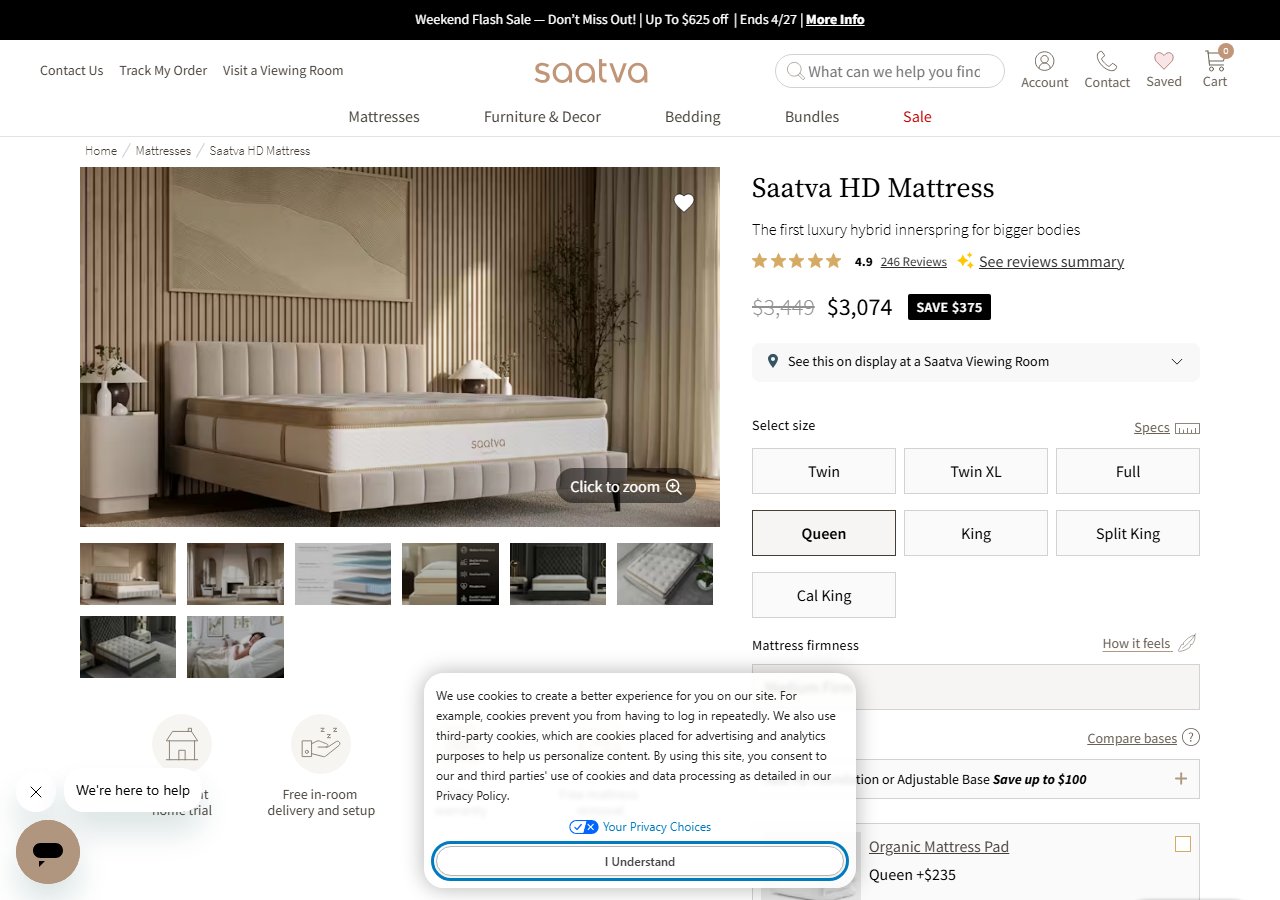
Saatva HD Mattress (Heavy-Duty)
$2,395-$3,995
See Price at Saatva →
Purple Hybrid Premier Mattress
$2,499-$4,799
See Price at Purple →Putting it together — the data-to-recovery hierarchy
The federal data on warehouse worker back injury is not ambiguous. BLS MSD tracking places the back at the top of the injury list across all occupations. The NIOSH Lifting Equation documents that the loads warehouse workers handle routinely exceed safe spinal tolerance thresholds. The SSA disability data shows where that trajectory leads if the cumulative stress is not interrupted. And the CDC sleep data shows that the recovery window — the off-duty hours when disc rehydration and tissue repair are supposed to happen — is already compressed for a third of American adults.
The hierarchy for interrupting this trajectory runs in a specific order: mechanics first, movement second, sleep position and hygiene third, clinical evaluation for anyone with red-flag symptoms, and sleep surface optimization last — but meaningfully, for workers who have addressed everything above and still face a recovery deficit. That is the honest reading of the evidence. A better mattress does not undo poor mechanics, does not replace movement, and does not treat a herniated disc. But for the worker who has done the other things right and is sleeping on a mattress with two inches of center sag at six years old, replacing it with a surface that maintains lumbar alignment through the night is a legitimate, evidence-consistent recovery intervention — not a luxury purchase.