The numbers behind the ache you already know
If you work in a warehouse and your lower back hurts, you are not imagining a pattern — you are living one that federal data has documented for decades. According to BLS Musculoskeletal Disorders by Occupation tracking, the back is the single most commonly injured body part across all U.S. occupations that result in days away from work. Warehousing and storage sit at the intersection of nearly every known risk factor for that statistic: repetitive bending, sustained awkward posture, high-frequency lifting, and shift schedules that compress recovery windows.
The financial scale of that injury pattern is staggering. BLS Employer Costs for Employee Compensation data shows that industries with high musculoskeletal disorder (MSD) incidence carry workers' compensation insurance rates 3 to 5 times higher than low-MSD industries. AHRQ HCUP data independently identifies back pain as one of the most expensive conditions in U.S. healthcare when totaling inpatient and outpatient costs. And the SSA Disability Insurance program records musculoskeletal disorders as the largest single category of new disability claims filed annually — a bureaucratic endpoint that many warehouse workers are on a slow trajectory toward without knowing it.
This is not a scare article. It is a data article. The numbers above describe what is already happening at scale. What they do not describe — and what this piece will — is the mechanism driving the injury, and the sequence of interventions, from free to purchased, that can interrupt it.
Why warehouse work breaks your lower back: the biomechanical mechanism
Understanding why your back gets damaged during a shift is the prerequisite to doing anything useful about it. The lumbar spine — five vertebrae stacked between your pelvis and mid-back — is an engineering compromise. It is flexible enough to allow you to bend and rotate, but that flexibility comes at the cost of stability under high compressive and shear loads. The intervertebral discs that cushion those vertebrae are pressure-sensitive structures: they absorb force when you lift, rotate, and bend, and they rehydrate and decompress when you are horizontal and at rest.
The NIOSH Lifting Equation is the federal standard for quantifying when a lifting task exceeds safe spinal loading limits. NIOSH's research documents that manual material-handling tasks across warehousing, construction, and healthcare routinely exceed those limits — meaning the compressive and shear forces experienced during a typical warehouse shift are, by engineering measure, more than the lumbar spine is designed to sustain repetitively. Every time you bend at the waist to grab a box from a pallet, twist to place it on a conveyor, and repeat that motion hundreds of times in a shift, you are accumulating microstress in the posterior disc annulus and the facet joints of L4-L5 and L5-S1, the two most commonly injured lumbar segments.
Shift schedules compound the mechanical problem. Discs rehydrate primarily during recumbent rest — lying down allows the disc to absorb fluid from the surrounding tissue, restoring height and shock-absorbing capacity. Workers running overnight or rotating shifts are frequently sleeping fewer hours and at circadian-misaligned times. CDC sleep data shows that approximately 35% of U.S. adults already sleep fewer than 7 hours per night — the threshold the CDC associates with elevated chronic disease risk. Among shift workers, that percentage is substantially higher. A disc that cannot fully rehydrate overnight because the worker only slept five hours before a back-to-back shift is a disc that enters the next shift already compromised.
CDC NCHS Data Brief 390 puts a population-level number on where this ends: approximately 20% of U.S. adults experience chronic pain, with lower back as the most common location. For warehouse workers, chronic low back pain is not a remote statistical risk. It is an occupational trajectory that begins with acute soreness and — absent intervention — progresses through recurring episodes, eventual structural change, and, in the worst cases, disability.
The AHRQ Medical Expenditure Panel Survey confirms the cost: adults with chronic back conditions incur annual personal healthcare expenditures that substantially exceed what adults without those conditions pay. That gap compounds year over year, and it falls disproportionately on workers in physically demanding jobs who may have less access to employer-sponsored health coverage.
Try these first: interventions that do not require spending money
The cheapest intervention is the one that does not require buying anything. Before discussing sleep surfaces — or any product — it is worth being direct: the evidence base for non-product interventions in chronic low back pain management is robust, federal-agency endorsed, and frequently more effective than any consumer purchase. The following four interventions are supported by NIH, OSHA, and CDC evidence and are available to any warehouse worker at no cost.
Daily walking is the most underused tool in warehouse worker recovery. An NIH National Center for Complementary and Integrative Health evidence review found that walking 30 minutes most days reduces chronic low back pain as effectively as most non-drug clinical treatments. For workers who spend eight to twelve hours on their feet, this recommendation may feel paradoxical — but the distinction is between load-bearing walking under compressive shift conditions and deliberate, low-load aerobic walking during off-duty hours. The latter promotes lumbar muscle endurance, reduces systemic inflammation, and maintains the disc nutrition that recumbent sleep provides.
Sleep position is the biggest free variable in your recovery. NIH National Institute of Arthritis and Musculoskeletal and Skin Diseases guidance specifically identifies sleep position as a modifiable factor for back pain. Side-sleeping with a pillow between the knees maintains pelvic alignment and keeps the lumbar spine in a neutral arc. Back-sleeping with a pillow under the knees reduces lumbar extension stress. Stomach-sleeping torques both the lumbar spine and the cervical spine and is consistently associated with worse morning pain outcomes. This costs nothing to change tonight.
Lifting mechanics on the floor matter as much as lifting mechanics at work. OSHA's ergonomics guidance — the same guidance that governs workplace lifting standards — applies identically to off-duty activity. Hinging at the hips rather than rounding the lumbar spine, keeping loads close to the body, and avoiding combined bending-and-twisting movements are not workplace rules; they are biomechanical facts. Most acute back episodes in warehouse workers are mechanical in origin and are directly reproducible by poor movement habits outside of work: loading a car trunk, picking up a child, moving furniture.
Know when your mattress is actually the problem. CDC Sleep Hygiene guidance is clear that a sleep surface with visible sag, one that leaves you stiffer than when you went to bed, or one older than 7 to 10 years is a legitimate recovery impairment — not a comfort preference. Even an expensive new mattress does not undo poor sleep hygiene, sedentary days, or untreated clinical conditions. But a mattress that has structurally failed is actively preventing disc rehydration and spinal decompression from occurring during the hours that are supposed to be your body's repair window.
For workers who have already addressed sleep position, walking habits, and lifting mechanics — and who have confirmed their current sleep surface is the limiting factor — the conversation about sleep infrastructure is worth having. The evidence for sleep surface selection is less robust than the evidence for the interventions above, but it is not absent, and the biomechanical logic is sound. A surface that fails to support spinal neutral alignment during sleep keeps the lumbar musculature in low-level contraction all night, prevents full disc rehydration, and delivers a worker to the next shift already behind on recovery.
When to see a clinician: red flags that no mattress addresses
There is a category of back pain for which no sleep surface, movement habit, or ergonomic adjustment is the appropriate first response. NIH National Institute of Neurological Disorders and Stroke back pain guidance is explicit: certain symptom patterns require prompt clinical evaluation, and delaying that evaluation to try consumer interventions first is medically risky. Warehouse workers — who often normalize high levels of back discomfort as occupational background noise — are particularly likely to underreact to symptoms that deserve imaging or specialist referral.
The red flags are listed below in the clinical red flags section of this article. If any of them apply to you, the next step is a clinician appointment, not a mattress purchase. The SSA Disability Insurance data showing musculoskeletal disorders as the top disability claim category is, in part, a record of cases where early clinical intervention was delayed. The CMS drug spending data identifying opioid and non-opioid pain medication as among the most expensive Medicare drug categories reflects the downstream cost of undertreated structural back conditions. Early evaluation is cheaper and more effective than late-stage pain management.
For warehouse workers without those red flags — workers dealing with the mechanical, cumulative, fatigue-driven low back soreness that is the statistical norm in this industry — the products below represent the best-evidence sleep surface choices for lumbar recovery support.
Where sleep surfaces fit: engineered for the load patterns warehouse work creates
Not every mattress is built for a body that has absorbed eight to twelve hours of compressive spinal loading. The engineering requirements for a warehouse worker's sleep surface differ meaningfully from what a sedentary office worker needs: deeper pressure relief for lumbar musculature that is chronically contracted rather than simply fatigued; edge and perimeter support that accommodates larger body masses that many warehouse workers carry from years of physical work; and temperature regulation that matters more when a worker runs hot from physical exertion and may sleep at circadian-disrupted times.
Three products stand out for this specific reader profile.
The Saatva Loom & Leaf Memory Foam Mattress is the premium memory foam pick for warehouse workers dealing with serious, chronic lower back pain. Loom & Leaf is constructed with high-density support foam at the base — a 5-inch layer that resists the kind of progressive sag that cheaper memory foam mattresses develop under sustained physical load — topped with a cooling gel memory foam layer and a lumbar zone enhancement that provides targeted support to the L1-L5 region. For workers whose primary complaint is waking up with lumbar stiffness and difficulty getting out of bed, this zoned support architecture addresses the biomechanical problem directly: it keeps the lumbar spine in neutral rather than allowing it to sink into a hammock shape that keeps the paraspinal musculature under low-level strain all night. Saatva's white-glove delivery and setup removes one more lifting event from a worker who should not be wrestling a mattress up a staircase.
The Saatva HD Mattress is the most specifically engineered option for the warehouse worker demographic. Saatva built the HD explicitly for heavier sleepers — the product is rated to 500 pounds per sleeper — using a dual steel coil system (a 4-inch base coil layer topped by an 8-inch individually wrapped micro-coil comfort layer) that provides progressive resistance rather than the linear compression failure that causes standard mattresses to sag under sustained high load. Many warehouse workers are large-framed adults whose body mass alone exceeds the engineering assumptions of standard consumer mattresses; a mattress that bottoms out under a 250-pound worker is not a lumbar support tool, it is a lumbar stress tool. The HD also incorporates a lumbar crown — a raised center-third support zone — that positions the heaviest part of the torso in slight elevation relative to the hips and shoulders, a design choice that has direct alignment implications for workers who cannot yet change their sleep position due to pain.
For workers whose primary complaint is pressure-point pain — the hip, shoulder, and rib pain that comes from sleeping on a surface that is too firm for a body that is already inflamed — the Purple Hybrid Premier Mattress offers a different engineering approach. Purple's GelFlex Grid is a hyper-elastic polymer grid that buckling-collapses under point loads (shoulders, hips, knees) while remaining supportive under distributed loads (the lumbar span). The result is a surface that simultaneously relieves pressure at the high-contact points and supports the lumbar region — a combination that is difficult to achieve with traditional foam or innerspring constructions. For warehouse workers who run hot, sleep disrupted, or have been told by a physical therapist that pressure relief is the priority over firmness, the Purple Hybrid Premier is the most differentiated option in this set.
Sleep Surfaces Engineered for Warehouse-Worker Lumbar Recovery
These three mattresses were selected for their structural engineering specificity to the spinal loading patterns, body-mass profiles, and shift-recovery demands of warehouse workers — not for general comfort ratings.

Saatva Loom & Leaf Memory Foam Mattress
$1,695-$3,295
See Price at Saatva →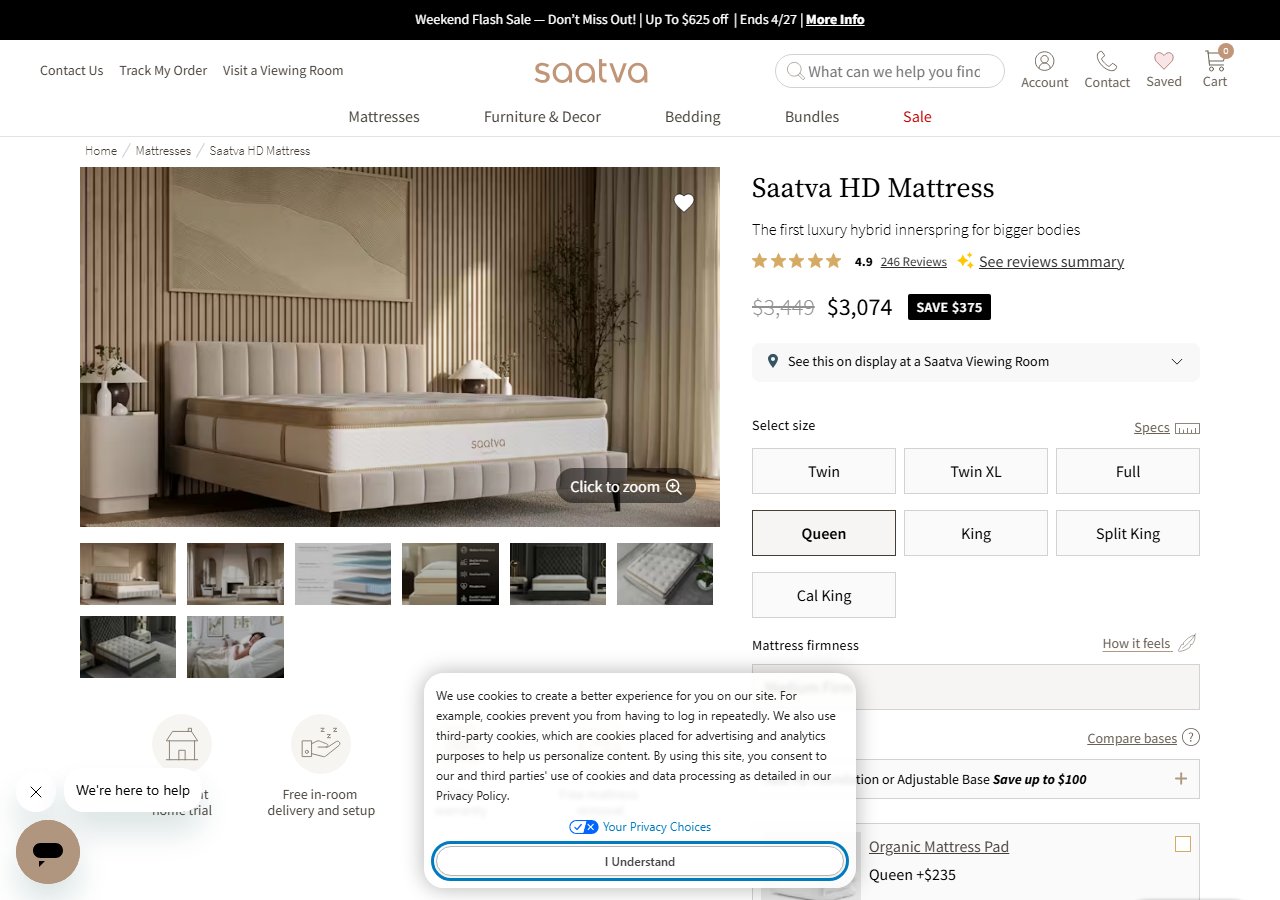
Saatva HD Mattress (Heavy-Duty)
$2,395-$3,995
See Price at Saatva →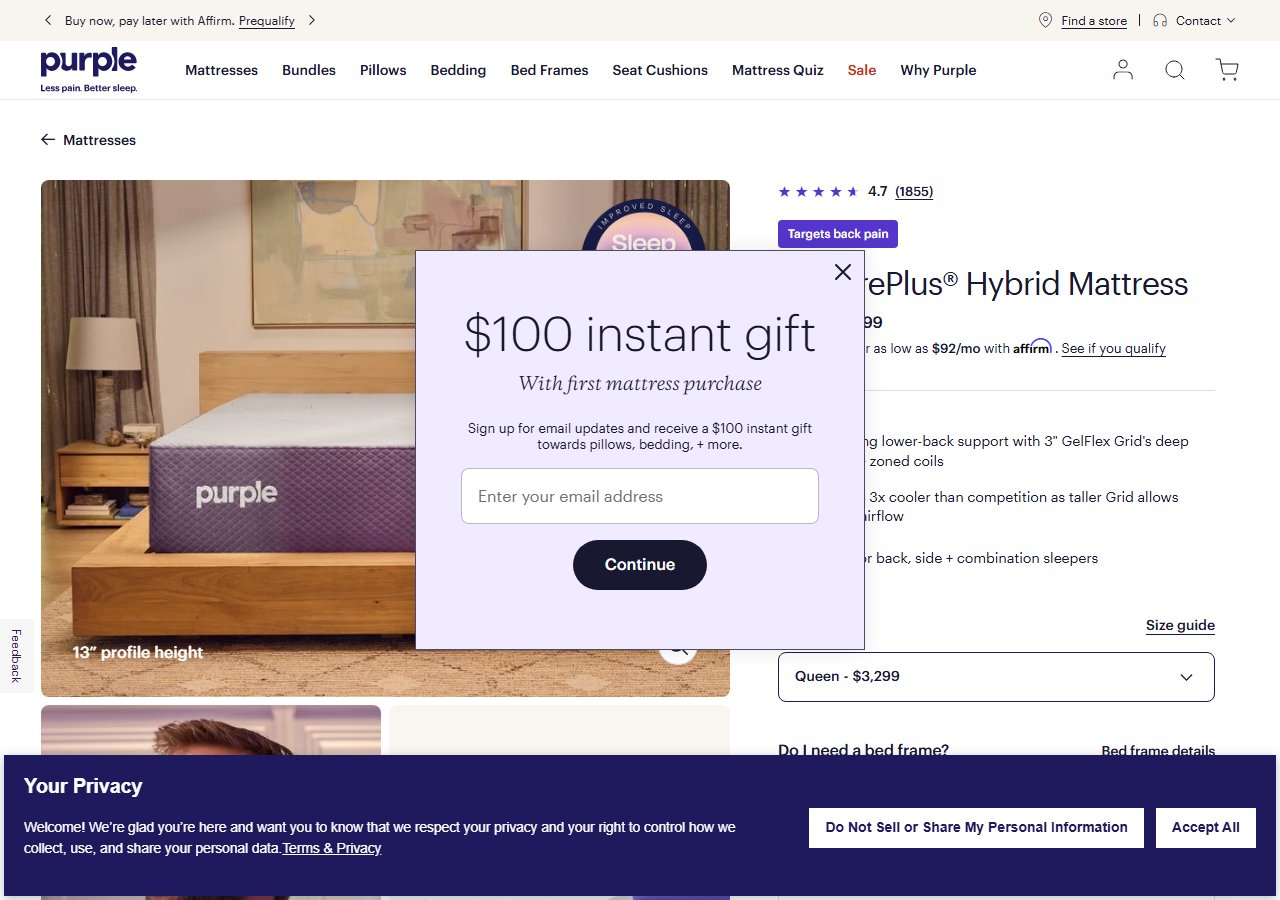
Purple Hybrid Premier Mattress
$2,499-$4,799
See Price at Purple →The data-to-intervention-to-product hierarchy: a summary
The federal data on warehouse worker lumbar injury is not ambiguous. The BLS MSD tracking confirms the back as the dominant injury site. The NIOSH Lifting Equation confirms that the tasks producing those injuries routinely exceed safe spinal loading limits. The CDC sleep data confirms that the workforce most exposed to those loads is also the workforce most likely to be sleeping too few hours for adequate disc recovery. And the AHRQ MEPS data confirms that the financial consequence of untreated chronic back conditions falls on the individual, substantially and progressively.
The appropriate response to that data is hierarchical. Move daily — the NIH NCCIH evidence review is unambiguous that walking is as effective as most clinical treatments. Fix sleep position tonight — it is free and evidence-backed. Apply OSHA lifting mechanics outside of work, not just during the shift. If your mattress is visibly sagging or older than a decade, replace it — but do so knowing that the mattress is an adjunct to those behaviors, not a substitute for them.
If red flags are present — radiating leg pain, trauma-associated pain, neurological symptoms — see a clinician before doing anything else. The SSA disability data is, among other things, a record of what happens when structural back problems go undiagnosed until they become disabling.
For workers who have done the free work and need the equipment layer, the three products above — Saatva Loom & Leaf, Saatva HD, and Purple Hybrid Premier — were selected for their engineering specificity to the load and recovery patterns that warehousing creates. They are not the solution. They are one well-chosen tool in a recovery system that starts with movement, continues with clinical vigilance, and uses product investment last.
CDC Arthritis Data notes that approximately 25% of U.S. adults report doctor-diagnosed arthritis, with prevalence concentrated in occupations involving sustained physical demand — a category that describes warehousing precisely. For workers in that cohort, the sleep surface question is not aesthetic. It is mechanical. A surface engineered for your load profile is, by the standards of this data, a legitimate recovery tool. Use it as one.