The federal data behind your morning stiffness
If you leave a warehouse shift feeling like your lower back was used as a forklift counterweight, federal occupational health data confirms you are not imagining it. According to BLS Musculoskeletal Disorder tracking, the back is the most commonly injured body part across all U.S. occupations that result in days away from work. Warehousing — with its combination of repetitive lifting, floor-to-overhead stacking, prolonged walking on concrete, and awkward-angle retrieval — sits near the top of every industry-specific injury table the Bureau of Labor Statistics publishes.
The economic toll is not abstract. AHRQ HCUP data places back pain among the most expensive conditions in the U.S. healthcare system measured by combined inpatient and outpatient cost. AHRQ's Medical Expenditure Panel Survey shows that adults living with chronic back conditions spend substantially more on personal healthcare every year than adults without those conditions. And BLS Employer Costs data shows that industries with high musculoskeletal disorder incidence — warehousing is one — carry workers' compensation insurance rates 3 to 5 times higher than low-MSD industries. The injury is not a minor inconvenience; it is a financial event for workers and employers alike.
This article is about what happens after the shift ends. Specifically: what the off-duty hours on a sleep surface are actually doing — or failing to do — for lumbar recovery, and what the evidence says you should act on first, second, and third.
Why warehousing specifically breaks down the lumbar spine
Understanding the injury mechanism matters before you spend a dollar on any intervention, because the mechanism tells you exactly what you are trying to counteract during sleep.
The NIOSH Lifting Equation is the federal standard for quantifying spinal load risk in manual material-handling environments. It generates a Recommended Weight Limit and a Lifting Index — when the Lifting Index exceeds 1.0, spinal loading is considered above safe limits for the average worker. Studies applying the NIOSH equation across distribution center and warehouse task inventories consistently find that a substantial share of routine picks, especially from low shelf positions, from pallet ground level, or in constrained aisles — exceed that threshold. NIOSH documents this explicitly: manual material-handling tasks across warehousing, construction, and healthcare routinely exceed safe spinal loading limits.
The biomechanics are specific. When a warehouse associate bends forward to retrieve a case from a floor-level pallet — the single most common warehouse pick posture — the lumbar erector spinae and multifidus muscles fire at high intensity while the intervertebral discs are compressed asymmetrically. At a 45-degree forward trunk lean, compressive force on the L4–L5 disc can reach 1,500 to 2,000 Newtons depending on load weight and horizontal reach distance. Repeat that pattern 80 to 150 times across a shift, five or six days a week, and you are accumulating microdamage to the annular fibers of the lumbar discs, fatiguing the posterior spinal musculature, and sensitizing the facet joints.
Warehouse workers also spend extended time on concrete or asphalt surfaces — flooring with near-zero vibration damping. Low-frequency whole-body vibration from pallet jacks and order-picking equipment adds to the compressive load. Unlike seated workers, warehouse associates cannot meaningfully change posture between tasks; the job is the posture.
The result: by the time a warehouse worker gets home, the lumbar spine has been mechanically loaded, the posterior muscles are fatigued and often in protective spasm, and the intervertebral discs are in a relatively dehydrated, compressed state. The off-duty period is not passive downtime — it is when disc rehydration (the imbibition of fluid back into the nucleus pulposus) occurs, when the erector spinae and multifidus recover, and when systemic inflammation markers from the day's micro-injury either resolve or compound.
CDC NCHS Data Brief 390 reports that approximately 20% of U.S. adults experience chronic pain, with lower back identified as the most common pain location. Among physically demanding occupational groups, that prevalence is substantially higher. And SSA Disability Insurance data identifies musculoskeletal disorders as the single largest category of new disability claims filed annually — the endpoint no warehouse worker wants to reach.
This is the physiological context in which a sleep surface either helps or doesn't. A mattress that allows the lumbar spine to sag out of neutral alignment during the 6 to 8 hours of recovery time will undo whatever progress the discs made during the first hour of sleep. A surface that maintains neutral spinal alignment — neither hammocking the spine into flexion nor holding it in rigid hyperextension — supports the recovery the body is already programmed to do.
The cheapest intervention is the one that doesn't require buying anything
Before discussing sleep surfaces, it is worth being direct: product purchases sit third or fourth in the hierarchy of effective interventions for warehouse-related lumbar pain. Federal evidence reviews are consistent on this point. The interventions below are either free or low-cost, and several of them have larger effect sizes on chronic low-back pain outcomes than any mattress on the market.
Movement is the most underused tool. The NIH National Center for Complementary and Integrative Health evidence review on low-back pain is explicit: walking 30 minutes most days reduces chronic low-back pain as effectively as most non-drug clinical treatments. This is not a minor finding. It means that a consistent walking habit — even a 20-minute after-shift walk — is likely doing more for your lumbar health than any premium sleep surface. The mechanism is circulatory: walking drives fluid exchange in the lumbar discs, reduces pro-inflammatory cytokine levels, and activates the paraspinal musculature in a low-load, rhythmic pattern that accelerates soft-tissue recovery.
Sleep position is the biggest free variable in lumbar recovery. NIH NIAMS guidance on back pain recommends side-sleeping with a pillow between the knees or back-sleeping with a pillow under the knees — both positions keep the lumbar spine closer to neutral alignment. Stomach-sleeping torques the lumbar spine into extension and lateral rotation and consistently worsens chronic low-back symptoms. This position change costs nothing and can meaningfully reduce morning stiffness within days.
Lifting and bending mechanics are rehearsable. OSHA's ergonomics guidance frames most acute back episodes as mechanical events — the product of a specific movement pattern under load, not an inevitable consequence of warehouse work. Hinging at the hips (not the lumbar spine), keeping loads close to the body, and avoiding twisting under load are behaviors that can be practiced off-shift during household tasks and that reduce cumulative lumbar loading during shifts.
When the mattress itself is the problem. The CDC's sleep hygiene guidance supports replacing a sleep surface when there is visible sagging, when you wake stiffer than you went to bed consistently, or when the mattress is older than 7 to 10 years. But the same guidance is clear: even the most expensive mattress does not undo poor sleep hygiene — irregular sleep schedules, screen exposure before bed, or the shortened sleep that warehouse shift work notoriously produces. CDC sleep data shows 35% of U.S. adults are already under the 7-hour threshold associated with elevated chronic disease risk; for rotating-shift warehouse workers, that number is almost certainly worse.
For readers who have already worked through the interventions above — who walk regularly, sleep in a neutral position, are not stomach-sleepers, and whose mattress is either visibly worn or over a decade old — the evidence does support a sleep-surface upgrade as a meaningful next step. The question then becomes which construction features actually correspond to the biomechanical needs of a worker carrying the specific load pattern described above.
When to see a clinician before buying anything
Some back pain presentations are not solved by sleep surfaces or movement programs — they require imaging and clinical evaluation. NIH NINDS back pain guidance identifies the following as red flags warranting prompt medical evaluation rather than self-management:
- Pain that radiates below the knee, particularly with numbness or tingling, which may indicate lumbar nerve root compression or disc herniation.
- Back pain following trauma — a fall from height, a vehicle accident, or a significant compressive event on the job.
- Leg weakness or loss of coordination accompanying back pain, which may indicate spinal cord or cauda equina involvement.
- Bowel or bladder changes concurrent with back pain — a potential sign of cauda equina syndrome, a surgical emergency.
- Back pain with fever or unexplained weight loss, which raises concern for infectious or malignant etiology.
These are not mattress problems. For warehouse workers specifically, the risk of undiagnosed disc herniation from cumulative high-load mechanical exposure is real, and masking radicular pain with a new sleep surface delays a diagnosis that may require prompt treatment. CMS drug spending data identifies opioid and non-opioid pain medication spending among the most expensive Medicare drug categories — a downstream cost that often begins with undertreated mechanical back pain becoming chronic. Early clinical evaluation is the intervention that avoids that trajectory.
If your back pain is non-radicular, non-traumatic, and positional — meaning it is worse after prolonged loading and improves with rest and movement — that is the presentation where sleep-surface construction is a legitimate adjunct intervention.
What sleep-surface features actually matter for warehouse lumbar recovery
For the warehouse worker with non-radicular, mechanically-driven lumbar pain and a worn or aging mattress, three construction features correspond directly to the recovery physiology described earlier: zoned lumbar support, pressure-relieving surface layers, and weight-appropriate core construction.
Zoned support means the mattress provides differential firmness across body zones — firmer under the lumbar spine and hips (where the heaviest structures are), softer under the shoulders and knees (where pressure concentration occurs first). For a worker whose lumbar paraspinals are fatigued and in partial spasm at bedtime, a mattress that allows the lumbar to sag into flexion will sustain the loading pattern from the shift rather than reversing it. Zoned construction counteracts this.
Pressure relief matters primarily for side sleepers (the position NIH recommends for lumbar pain). In side-lying, the greater trochanter and shoulder are the primary pressure points. A surface without adequate conforming layers will push back against these prominences, causing the sleeper to shift position repeatedly through the night — disrupting the deep sleep stages when tissue repair is most active.
Weight-appropriate core construction is the least-discussed variable, but arguably the most important for warehouse workers. A mattress rated for a 180-pound sleeper will perform adequately at 180 pounds and progressively worse above that. Warehouse associates are not a uniform population — many are physically large workers, and the coil gauge, foam density, and edge-support construction of a standard mattress will fail faster and provide less support for workers at higher body weights. This is not a niche consideration; it is a basic engineering fit.
With those criteria established, here are the three sleep surfaces that best address this specific combination of needs.
For workers whose primary concern is deep pressure relief with lumbar contouring — particularly those who are side sleepers or who have joint pain layered on top of back pain — the Saatva Loom & Leaf Memory Foam Mattress is the premium memory-foam pick in this category. It uses gel-infused memory foam in dual layers with a lumbar zone enhancement built into the support core — a deliberate engineering choice to increase support specifically at the lower-back region, where warehouse workers carry the most accumulated mechanical load. Saatva builds the Loom & Leaf in the United States with higher-density foam than most mid-market memory foam beds, which translates to longer-lasting lumbar support rather than the progressive sagging that accelerates in cheaper foam mattresses under sustained use.
For warehouse workers who are larger-framed, heavier, or who have found that standard mattresses sag prematurely — the Saatva HD Mattress is the most explicitly engineered option in this list for that profile. Saatva designed the HD specifically for sleepers who need higher weight capacity and more durable support architecture. The HD uses a dual-coil system (micro coils over a tempered steel coil base) with higher coil counts and heavier-gauge steel than the standard Saatva Classic — the construction approach that maintains lumbar support over time for workers who would otherwise compress a standard mattress out of effective range within two or three years.
For workers whose back pain is accompanied by hip and shoulder pressure (common in side sleepers who have developed referred pain patterns from facet joint loading), the Purple Hybrid Premier Mattress offers a fundamentally different pressure-relief mechanism. Purple's GelFlex Grid — a hyper-elastic polymer grid — collapses under direct pressure points while remaining firm under distributed load, which means it provides both pressure relief at the hip and shoulder and responsive support under the lumbar. Unlike memory foam, the GelFlex Grid does not trap heat and provides a more immediate pressure response, which benefits combination sleepers who shift position during the night.
Sleep Surfaces Built for Warehouse Lumbar Recovery
These three mattresses were selected specifically for the zoned support, pressure-relief architecture, and weight-appropriate construction that warehouse workers' cumulative lumbar loading demands.

Saatva Loom & Leaf Memory Foam Mattress
$1,695-$3,295
See Price at Saatva →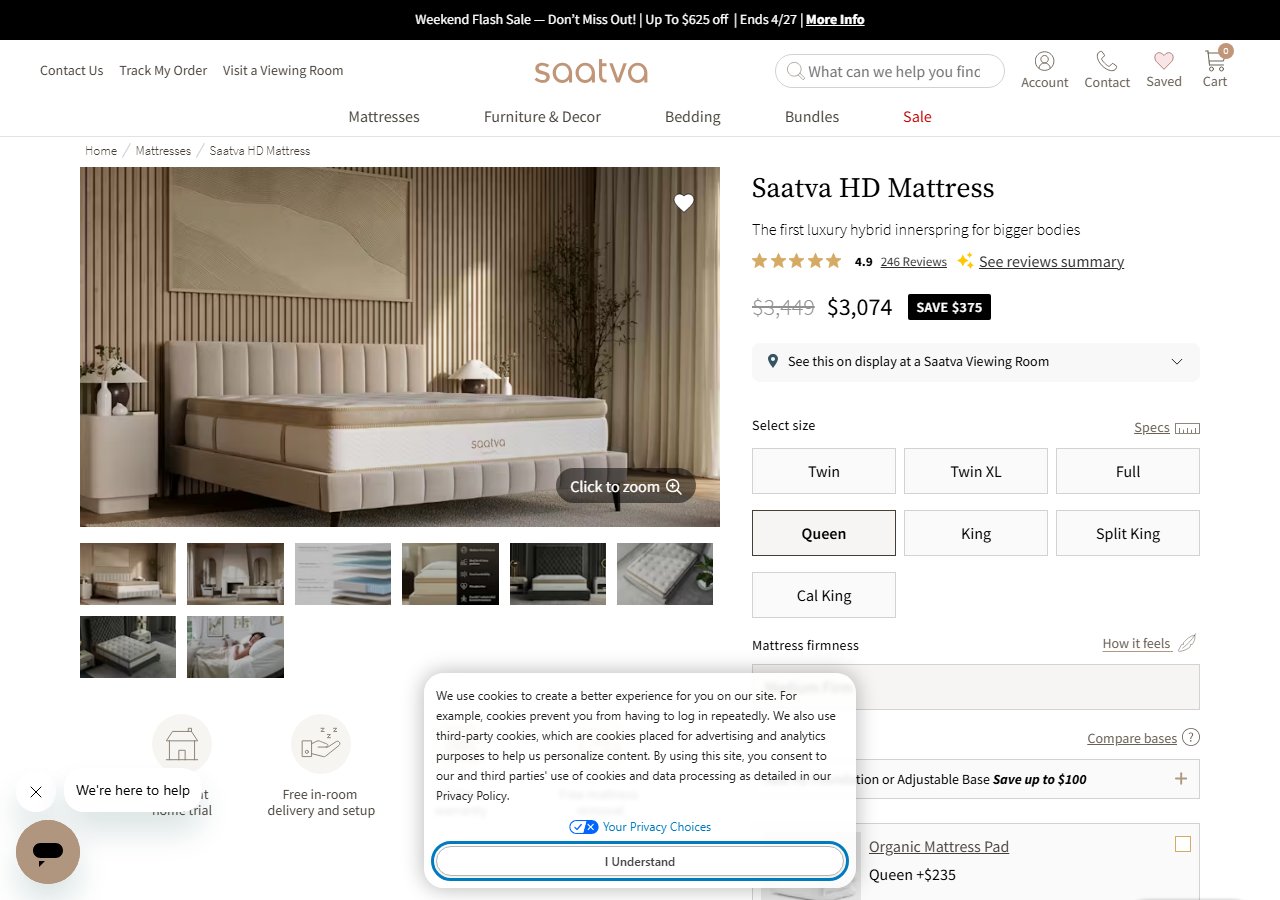
Saatva HD Mattress (Heavy-Duty)
$2,395-$3,995
See Price at Saatva →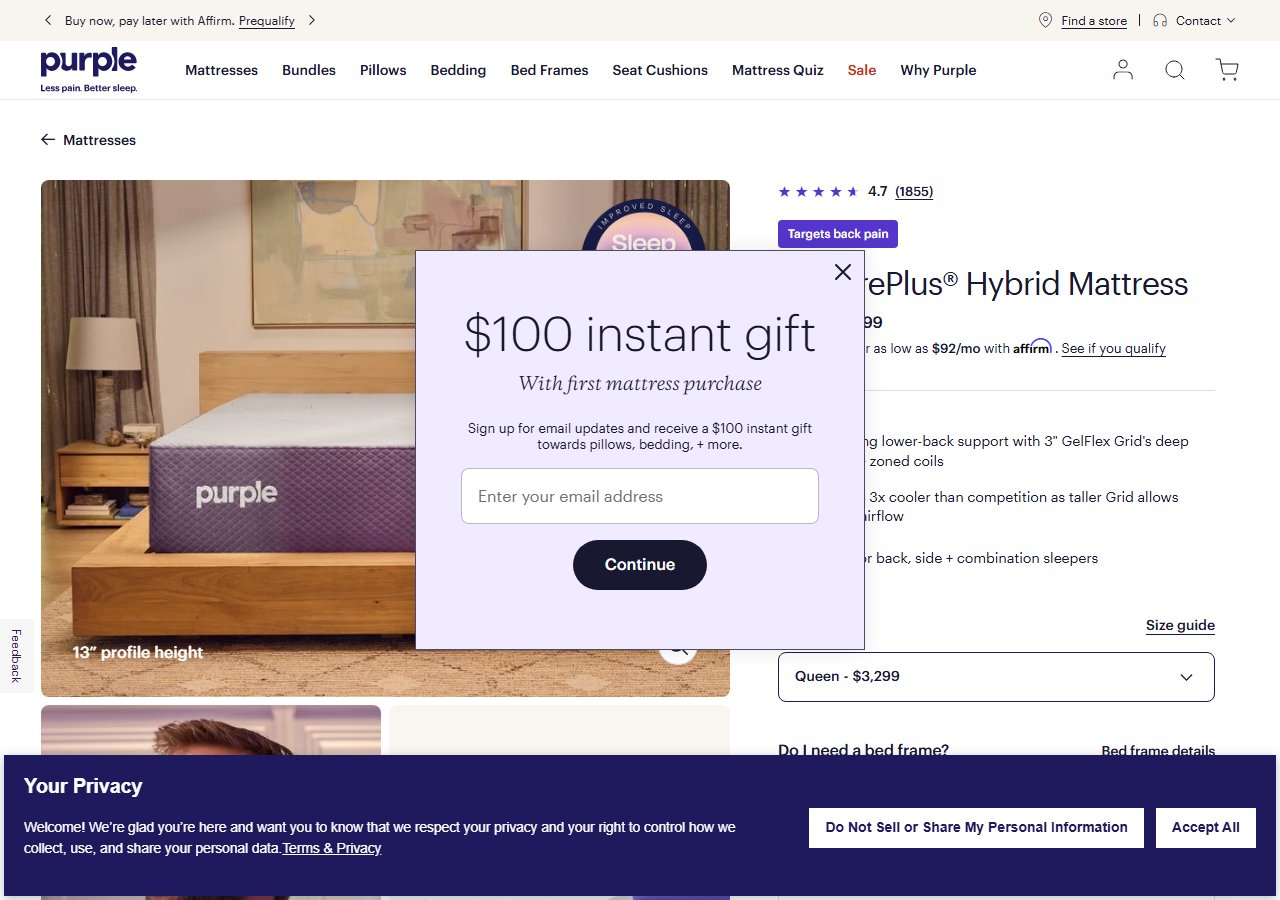
Purple Hybrid Premier Mattress
$2,499-$4,799
See Price at Purple →Putting the hierarchy together
The federal data tells a consistent story: warehouse workers are exposed to lumbar spinal loads that exceed NIOSH safe limits on a routine basis, the back is the most commonly injured body part in U.S. occupations with days away from work, and the downstream costs — healthcare expenditure, disability claims, workers' compensation — are substantial. SSA Disability Insurance reports show musculoskeletal disorders as the largest single category of new disability claims each year, and AHRQ data shows chronic back pain patients spend significantly more on healthcare annually than their counterparts without the condition. These are not outcomes that a new mattress alone prevents.
The evidence-based hierarchy is: daily walking and movement first, sleep position optimization second, clinical evaluation if red flags are present, and — for workers with a worn or inadequate sleep surface who have already addressed the preceding steps — a sleep surface selected for zoned lumbar support, pressure relief, and weight-appropriate construction. The Saatva Loom & Leaf leads for memory-foam contouring, the Saatva HD leads for higher-weight-capacity durability, and the Purple Hybrid Premier leads for pressure relief combined with responsive lumbar support.
For a worker logging 50,000 steps on concrete per week, the most important intervention is the one that compounds over time: consistent movement, neutral sleep position, and a surface that does not actively work against your lumbar recovery. The federal data supports all three. Start with the free ones.