The federal data on warehouse backs is not ambiguous
You clock out after a 10-hour shift in a fulfillment center. Your lumbar spine has absorbed thousands of compression cycles — bending, twisting, lifting, reaching — many of them above the limits that NIOSH's Lifting Equation defines as safe for sustained manual material handling. You drive home, maybe eat something, and then you have one recovery window before the alarm goes off again: sleep. What you sleep on, and how you sleep, determines whether your spine gets eight hours of active decompression or eight more hours of mechanical stress layered on top of the shift you just finished.
The Bureau of Labor Statistics is unambiguous about where warehouse workers land in the national injury picture. BLS Musculoskeletal Disorders by Occupation tracking identifies the back as the most commonly injured body part across all U.S. occupations resulting in days away from work. That is not a warehouse-specific finding — it spans every industry — but warehousing and transportation-sector workers are disproportionately represented in those tallies because their job tasks concentrate exactly the loading patterns that damage lumbar discs, facet joints, and paraspinal musculature.
The downstream costs of that injury pattern are staggering. SSA Disability Insurance data identifies musculoskeletal disorders as the largest single category of new disability claims filed annually in the United States. AHRQ's Hospital Cost and Utilization Project confirms that back pain ranks among the most expensive conditions in the U.S. healthcare system by combined inpatient and outpatient cost. And BLS Employer Costs for Employee Compensation data shows that employers in high-MSD industries — warehousing very much included — carry workers' compensation insurance rates that run 3 to 5 times higher than employers in low-MSD industries. The injury is not just a personal health problem. It is a structural economic problem that the federal data system has been documenting for decades.
This article is not a pitch for a new mattress. A new mattress does not fix a job that routinely loads your spine beyond safe limits. What federal data does support is this: sleep is the primary physiological window for spinal disc rehydration, paraspinal muscle recovery, and systemic inflammation reduction — and a sleep surface that fights your spine's geometry during that window makes an already-difficult recovery harder. For warehouse workers, who bring a specific set of biomechanical stressors to bed every night, the sleep surface question is worth taking seriously.
Why this happens: the biomechanics of warehouse lumbar injury
The lumbar spine is engineered for load-bearing. Five large vertebrae, thick intervertebral discs, and a dense paraspinal musculature make the lower back the structural workhorse of upright human movement. But it is not engineered for the specific loading patterns that warehouse work imposes over an 8- to 12-hour shift.
The NIOSH Lifting Equation defines a Recommended Weight Limit for any given lift based on load weight, horizontal reach from the body, vertical height of the lift, frequency, and the degree of trunk twisting required. When actual task conditions push the Lifting Index above 1.0 — meaning the task demands exceed what NIOSH considers safe — spinal compressive forces routinely exceed 3,400 Newtons, the threshold associated with cumulative disc damage. Order-picking tasks in fulfillment centers, by nature of their geometry (reaching into low bins, twisting to place items on conveyor belts, frequent bending), push the Lifting Index well above 1.0 for significant portions of a typical shift. This is documented, not speculative.
Cumulative spinal loading across a shift does specific damage. Intervertebral discs are avascular — they have no direct blood supply — and rely on the mechanical pumping action of movement and the decompression of lying down to rehydrate and exchange nutrients. After hours of sustained compressive loading, discs lose water content and become less able to absorb subsequent loads. The paraspinal muscles — erector spinae, multifidus, quadratus lumborum — fatigue under sustained static and dynamic loading, losing their ability to stabilize the lumbar spine against shear forces. The result is a back that is mechanically vulnerable at the end of every shift, not just after an acute injury event.
Sleep is when disc rehydration occurs. Horizontal posture removes compressive load from the disc and allows osmotic rehydration from surrounding tissue. Research on spinal MRI changes across the sleep period confirms measurable disc height recovery overnight. But this rehydration process depends on the spine maintaining a neutral or near-neutral curve during sleep. A mattress that sags under the hips — either because it is too soft for the person's weight or because it has aged past its structural integrity threshold — allows the lumbar spine to drop into flexion for hours at a time. That is not recovery. That is continued loading in a different direction.
CDC NCHS Data Brief 390 reports that approximately 20% of U.S. adults experience chronic pain, with lower back as the most common pain location. But the warehouse workforce is not a random draw from that 20%. They are a population that self-selects into physically demanding work, often without the cushion of employer-sponsored physical therapy, ergonomic assessment, or adequate recovery time between shifts. CDC arthritis data shows that approximately 25% of U.S. adults carry a doctor-diagnosed arthritis diagnosis, with prevalence concentrated in occupations involving sustained physical demand — exactly the occupational profile of a warehouse worker.
And layered on top of the injury risk is the sleep deprivation problem. CDC sleep data documents that approximately 35% of U.S. adults sleep fewer than 7 hours per night — the threshold associated with elevated chronic disease risk. Shift workers, who make up a large fraction of the warehouse labor force, are dramatically overrepresented in that 35%. Shift rotation disrupts circadian rhythm, compresses sleep windows, and degrades sleep quality independent of any mattress variable. The sleep surface problem, in other words, sits on top of a broader sleep deprivation problem that no mattress can solve alone.
Try these first — the cheapest intervention is the one that does not require buying anything
Before this article discusses any sleep surface, it is worth being direct: the interventions with the strongest federal evidence base for warehouse-worker lumbar pain are free or near-free. For a workforce where AHRQ MEPS data documents substantially higher out-of-pocket healthcare expenditures among adults with chronic back conditions compared to those without, spending money on a new mattress before exhausting free interventions is a poor use of resources.
The four interventions below have federal or NIH-level evidence behind them. They should be tried, consistently, before any equipment purchase is made. For workers who are already doing all of them and still waking up with a back that is stiffer than when they went to bed — especially on a mattress that has visible sag or is more than 7 to 10 years old — a sleep surface upgrade becomes a legitimate next step.
For readers who have already addressed sleep position, are walking daily, are using better lifting mechanics at work, and whose mattress is either visibly compromised or past its service life — the equipment question becomes real. The research on sleep surface and chronic low back pain is not as strong as the research on movement and positioning, but it is not negligible either. A Cochrane-level review of mattress firmness studies found that medium-firm mattresses produced better outcomes for nonspecific low back pain than firm mattresses — counter to older conventional wisdom. For warehouse workers, the relevant variable is not just firmness but support consistency under body weight and pressure distribution across the hip and shoulder contact points.
When to see a clinician
A new mattress is not the right response to every type of back pain. NIH National Institute of Neurological Disorders and Stroke guidance on back pain identifies several presentations that require clinical evaluation before any self-care intervention. For warehouse workers — who may normalize pain as occupational background noise — it is worth stating these explicitly.
The critical red flags for warehouse workers are: pain that radiates below the knee (suggesting nerve root compression or disc herniation requiring imaging); back pain that follows a specific trauma event, even a minor one; any new weakness in the legs, feet, or ankles; changes in bowel or bladder function; and back pain accompanied by fever or unexplained weight loss. These are not mattress problems. These are clinical problems, and deferring evaluation because you do not want to miss work or cannot afford a co-pay carries real risk of permanent neurological injury.
The SSA Disability Insurance system — which already identifies musculoskeletal disorders as its largest disability claim category — is the downstream destination for workers whose lumbar injuries progress unchecked. Early clinical intervention is almost always cheaper, faster, and more effective than late-stage management. AHRQ HCUP data consistently shows that back pain managed surgically carries dramatically higher total costs than back pain managed conservatively and early.
Where sleep surfaces fit in the evidence hierarchy
For warehouse workers who have cleared the clinical red flag checklist and are dealing with the ordinary chronic low-grade lumbar soreness that accumulates from high-MSD-incidence work — the kind of soreness that makes it hard to get comfortable at night and that is worse in the morning than in the evening — sleep surface matters. Not as a cure. As a recovery optimization tool.
The specific needs of warehouse workers differ from the general population in a few ways that should drive mattress selection:
Body weight and pressure distribution. Warehouse labor skews toward workers who are heavier than the general population's average mattress design target. Most mattresses are engineered around a 150- to 175-pound reference occupant. Workers who are significantly heavier will sink through soft comfort layers and experience the support core beneath — which, if it is not rated for higher loads, will sag faster and provide less consistent lumbar support over time.
Hip and shoulder loading. Side-sleeping — the position recommended by NIH NIAMS for back pain — requires enough give at the shoulder and hip to allow the spine to remain horizontal. Too-firm mattresses force side-sleepers into a lateral spinal curve. Too-soft mattresses allow the hips to sink and create the same problem from the other direction. The target is a surface that compresses proportionally under denser body regions while supporting the lumbar curve.
Heat retention. Warehouse workers performing physical labor often run warmer than sedentary office workers. Mattresses with poor thermal regulation — dense closed-cell foams without ventilation — will produce a heat-building sleep environment that fragments sleep and degrades the recovery quality of every hour spent in bed.
Durability under higher loads. A mattress that performs well for a 160-pound person for 10 years may begin sagging for a 250-pound person at year 4. Coil gauge, foam density, and edge support all scale with load capacity in ways that matter for the warehouse worker demographic.
With those parameters in mind, three sleep surfaces address the warehouse-worker recovery problem with enough specificity to be worth naming.
The Saatva Loom & Leaf Memory Foam Mattress is the premium memory foam pick for workers dealing with serious, chronic lumbar pain. Its multi-layer construction uses high-density memory foam with a gel layer for thermal management — directly addressing the heat-retention problem that dense viscoelastic foam typically creates. The lumbar zone support enhancement in the center third of the mattress is engineered to maintain the lordotic curve in side and back sleepers, rather than allowing the lumbar region to sink into a flexed position overnight. For warehouse workers who have already tried medium-firm innerspring mattresses without relief, a pressure-conforming memory foam system like the Loom & Leaf offers a meaningfully different load distribution profile.
For workers who are larger — say, 250 pounds or more, or couples where combined weight creates a high-load sleep surface — the Saatva HD Mattress was specifically engineered for that weight range. Its support core uses a higher-gauge coil system with reinforced perimeter support, rated to provide consistent lumbar support well above the load thresholds that cause standard mattresses to sag prematurely. The comfort layer uses a memory foam formulation designed for pressure relief without bottoming out — the specific failure mode that causes heavier sleepers to wake up with hip and lumbar pain despite sleeping on what is nominally a good mattress. For warehouse workers whose size has been a limiting factor in mattress selection, the Saatva HD is the most biomechanically appropriate option on this list.
If pressure relief is the primary complaint — hip pain at the contact point, shoulder pain from side sleeping, inability to stay comfortable across a full sleep period — the Purple Hybrid Premier Mattress takes a fundamentally different engineering approach. Purple's GelFlex Grid is a non-foam polymer grid that compresses under point loads (hips, shoulders) while remaining firm under distributed loads (lumbar spine, torso). The clinical implication for warehouse workers is that the mattress can be simultaneously soft where the body needs pressure relief and firm where the spine needs support — without the heat-trapping of dense memory foam. The coil base provides the durability and motion isolation that higher-load sleepers need.
Sleep Surfaces Engineered for Warehouse-Worker Lumbar Recovery
These three mattresses were selected specifically for the body-weight distribution, pressure-point patterns, and thermal management needs of warehouse workers managing cumulative spinal load — not for the general population.

Saatva Loom & Leaf Memory Foam Mattress
$1,695-$3,295
See Price at Saatva →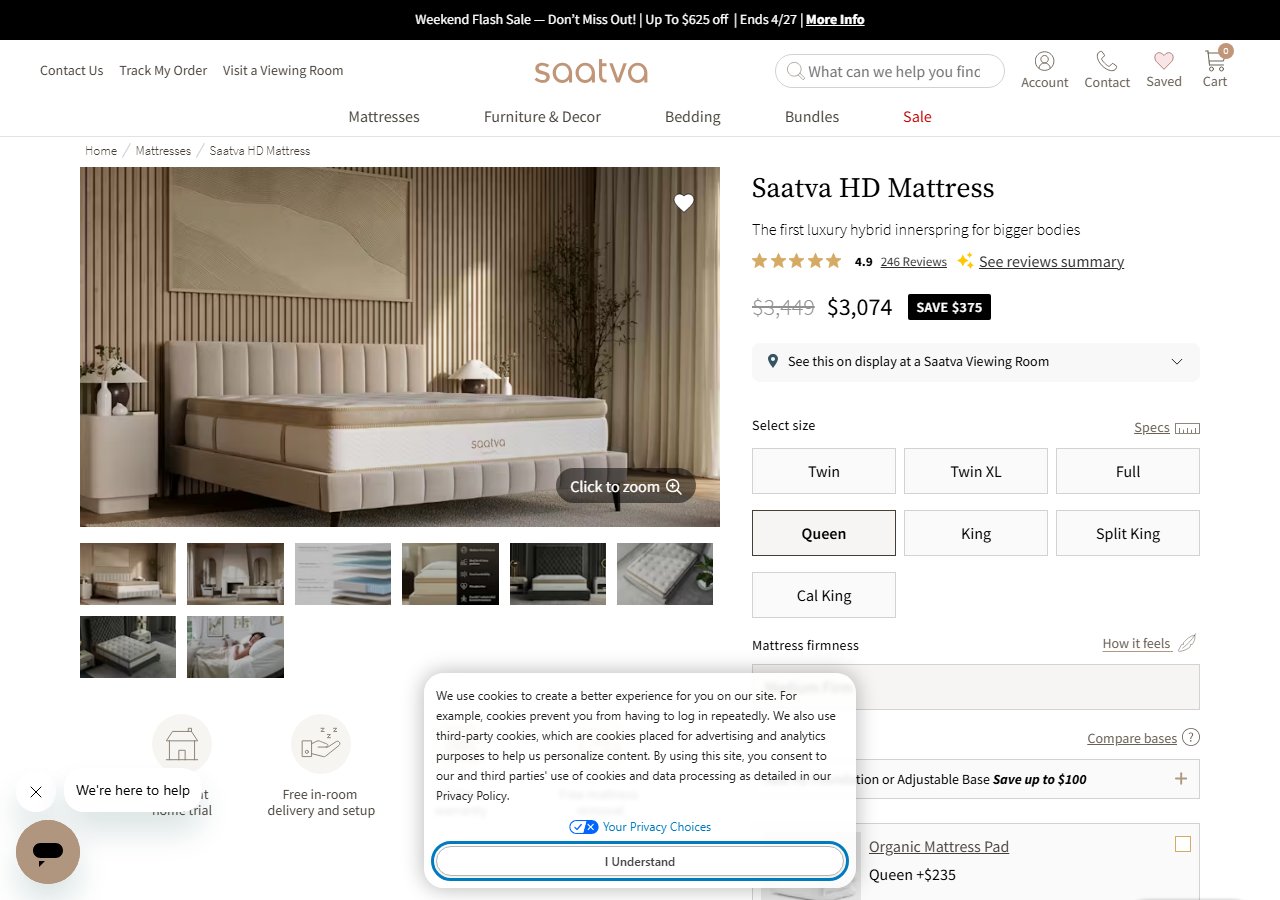
Saatva HD Mattress (Heavy-Duty)
$2,395-$3,995
See Price at Saatva →
Purple Hybrid Premier Mattress
$2,499-$4,799
See Price at Purple →The data-to-intervention-to-product hierarchy, summarized
The federal evidence on warehouse lumbar injury is not a subtle story. BLS documents the injury rates. NIOSH documents the mechanical causes. SSA documents the downstream disability burden. AHRQ documents the personal cost. And CDC documents the sleep deprivation that sits underneath all of it, compounding the recovery deficit every night.
The right response to that data, for a warehouse worker dealing with chronic lumbar soreness, is ordered: first, nail sleep position — side or back, never stomach, pillow between or under the knees. Second, walk daily — NIH NCCIH evidence rates walking as effective for chronic low back pain as most non-drug clinical treatments. Third, address lifting mechanics at work using OSHA's ergonomic guidance — most acute episodes are mechanical and preventable. Fourth, evaluate your mattress against objective criteria: visible sag, morning stiffness worse than evening stiffness, age over 7 to 10 years. If it fails those tests, a sleep surface upgrade is warranted.
If you clear those four steps and still need equipment, the three mattresses above address the specific load, pressure, and thermal requirements of the warehouse-worker body. They are not cures. They are recovery tools — and for a worker whose job routinely loads their spine past the limits that NIOSH considers safe, an optimized recovery window is not a luxury. It is occupational maintenance.
The CMS Drug Spending Dashboard identifies opioid and non-opioid pain medication spending among the most expensive Medicare drug categories — reflecting what happens when the chronic-pain treatment burden of the warehouse workforce age cohort reaches the healthcare system. The cheaper intervention is better sleep, earlier. The data supports that hierarchy clearly.